 跳到内容

Jewelry stores need sparkle, but a display that is full of white hot spots can make pieces harder—not easier—to examine. Glass cases, polished metals and gemstones reflect small bright sources in different directions. A spotlight that creates a beautiful highlight from one angle may throw a distracting reflection across the glass from another. The lighting brief is therefore about controlled contrast, product colour and customer viewing positions, not maximum brightness.
This guide explains how to plan jewelry store lighting for showcases and surrounding retail space. It is a practical buyer’s checklist for track spotlights, case lighting and mock-up approval. The final design still needs a site-specific lighting review and compliance check.
The featured store image and the display illustration below are concept visuals, not photographs of an LCB installation or evidence of measured performance.
Understand the two layers of a jewelry display
Jewelry is often lit by sources inside a showcase and by ceiling-mounted accent lighting. The case layer can reveal details close to the pieces; the ceiling layer can provide wider visual focus and make the storefront read from a distance. They should be planned together. If both layers aim at the same reflective surface without coordination, the result may be overbright glass rather than visible jewelry.
Separate the general store layer as well. Customers need to see faces, price tags and routes, while the showcase should remain the visual focus. When the entire room is extremely bright, accent light must work harder to stand out. When the room is too dim, moving between case and surrounding space can feel uncomfortable. Create a hierarchy that works from the entrance, at the case and across the consultation counter.
Start with the customer’s viewing position
Stand where customers actually look into the case. Check both a close view and a step back. Is the jewelry visible through glass, or does the glass mirror a ceiling luminaire? Move to the position used by a sales associate. A reflection that appears from only one position can still be a problem if that is where a purchase conversation happens.
Repeat the test for seated consultation. Diamonds, watches, pearls and gold can respond differently to light and background materials. A dark velvet tray, pale stone counter and mirror-polished case edge all change contrast. A lighting design approved with an empty display can fail once real products and props are installed.
Control reflections on glass before increasing output
More light cannot fix a bright source reflected directly into the viewer’s eyes. Change the source position, beam direction, shielding or case geometry first. Avoid pointing track spotlights at a case lid from an angle that sends a mirror image back toward the customer. Ceiling height and the customer’s eye level affect that geometry, so a plan view alone is not enough.
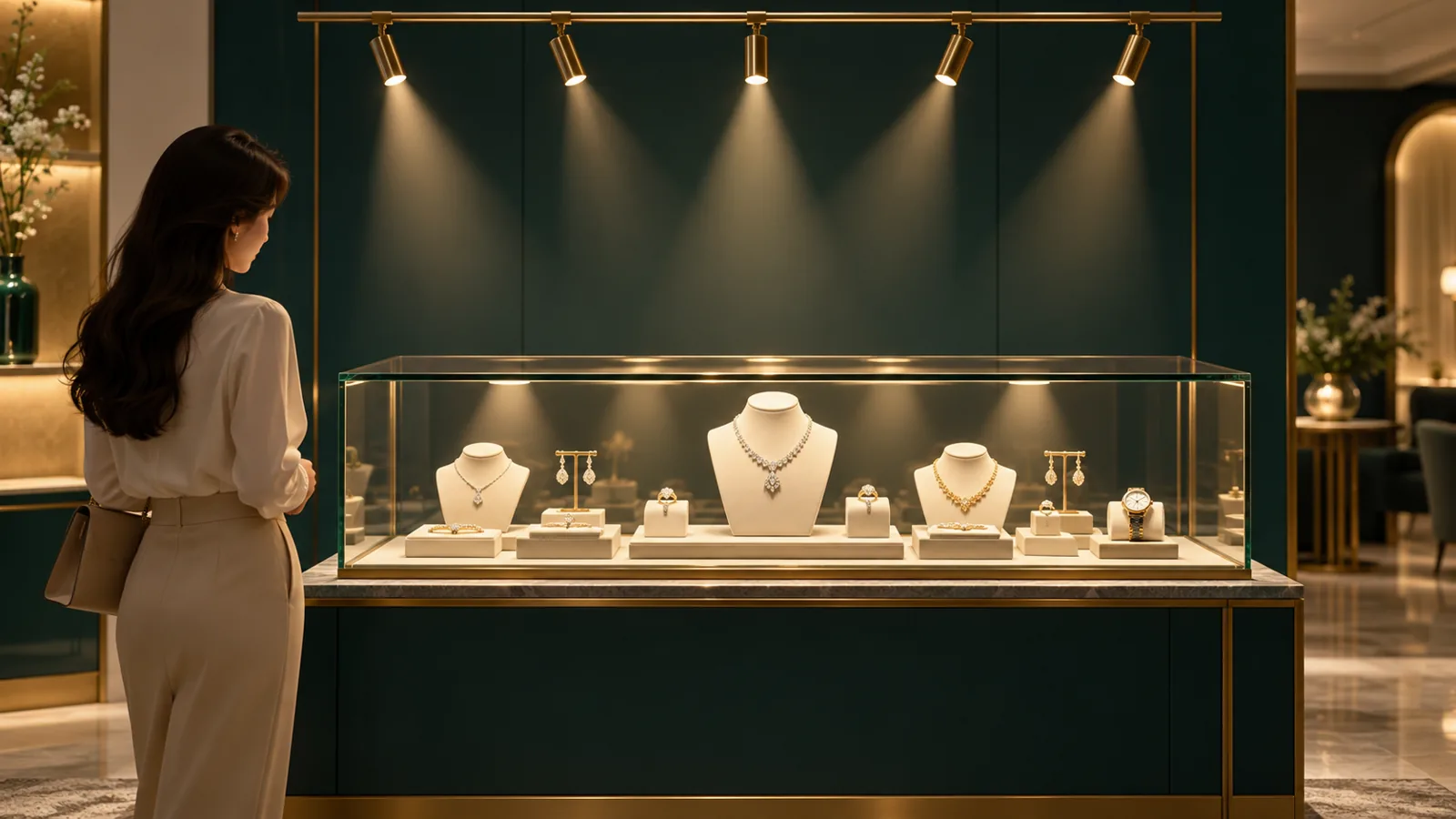
Ask for a representative mock-up with the actual glass, case trim and jewellery props. Switch on the case lighting and ceiling accents one at a time, then together. This reveals whether a hot spot comes from inside or outside the case. Take notes from several viewing positions rather than relying on a single photograph. Camera exposure can hide a glare source or exaggerate sparkle depending on the settings.
Select beams for the object and the display
A narrow beam can create dramatic sparkle on a specific object but may produce obvious hot spots or leave neighbouring pieces dark. A wider beam can make a display more even but reduce focus. The right choice depends on case dimensions, product scale, mounting height and whether the merchandising arrangement changes. Choose optics based on a mock-up, not a generic “jewelry beam angle.”
For a flexible ceiling layer, a COB LED track spotlight can be considered where the track and adaptor suit the project. A wall-washer downlight may serve wall displays or architectural surfaces, not necessarily the glass-top case itself. Product fit should be judged by the actual optical sample and installed geometry. Avoid rendering a fixture as if it were a different physical product; the visual mock-up should match the approved hardware.
Check aiming tolerances. A small change in track-head position can change the reflection seen in the glass. For multi-store rollout, record the approved positions, beam variants and aiming notes. Train installers to validate the final display rather than copying a ceiling layout blindly when case heights differ.
Colour quality needs product-level testing
Jewelry customers compare subtle colour and finish. Warm metal, cool metal, coloured stones and skin can all look different under the same lamp. Do not reduce the choice to “warm versus cool white” alone. Review samples under the actual luminaire and compare the appearance with the store’s desired presentation. If multiple light sources serve one case, check that they do not create a visible colour mismatch.
TM-30, alongside CRI and R9, provides useful colour-rendering measures, but no one number guarantees that every gemstone will look right. Our retail colour-quality guide explains what each metric can and cannot tell you. For a luxury environment, preserve the approved sample and colour specification through procurement and re-ordering. A replacement fitting with a different LED bin can be conspicuous in a row of displays.
Manage brightness and heat within the case
LED fixtures can be efficient, but case design still needs thermal review. Drivers, dense LED strips and enclosed volumes can raise temperatures and affect product or component life. The exact concern depends on fixture design, ventilation and displayed materials. Ask the case maker and lighting supplier to agree on access, heat management and cleaning before the joinery is finalised.
Keep the light source out of direct customer view where possible. A tiny exposed LED dot can be disproportionately distracting in an otherwise refined display. Diffusion, shielding and placement can help, but should not wash away the desired definition of the jewelry. Test the case both at full output and in the likely evening scene.
Balance display contrast across the whole store
One bright case can make the next case look dull even if both meet their own numeric target. Walk through the sales floor and compare adjacent displays. Is the central feature case clearly dominant? Are smaller cases readable without competing? Does the storefront look inviting from outside, or do reflections on the glazing hide the product?
Daylight can change these relationships. A front-window case may need different aiming or shading from a deeper interior case. Check the store in daytime and after dark. If controls are used to shift scenes, verify that colour appearance and sparkle remain acceptable at dimmed settings. Our retail mock-up approval guide is a useful companion for documenting the visual result.
Design for merchandising changes
Jewelry layouts change seasonally. Track spotlights can be re-aimed, but staff should know the approved limits; a fixture aimed into glass can quickly undo the original work. If case inserts and trays change, inspect reflections again. For a chain, provide a simple photographic aiming guide with the actual product and case geometry, not a generic marketing render.
Modular case lighting can make maintenance easier if connectors, power supplies and mounting details are documented. Ask whether a failed driver can be replaced without emptying or damaging the display. Where security is a concern, service access must be coordinated with store operations. The best design is one that can be maintained without rebuilding a custom case.
A mock-up approval sequence
- Choose representative real products: clear stones, coloured stones, white metal, yellow metal and watches if relevant.
- Install the planned glass, background and case-light components.
- Add the actual ceiling track spotlights and aim them from customer positions.
- Inspect reflections from close, distant, standing and seated viewpoints.
- Compare day and evening conditions, with storefront glazing and all layers active.
- Record fixture models, optics, colour, dimming level and aiming positions.
- Approve a physical reference before ordering or repeating the scheme.
When changes are made, alter one variable at a time. Lowering output may reduce a hot spot, but moving the optic could solve the problem while preserving sparkle. Changing case glass might be more consequential than changing lamp power. Keep a short decision record so a future branch can repeat the successful combination.
Questions to include in the RFQ
Provide case dimensions, glass type, ceiling height, track layout and product categories. Ask the supplier to state the proposed optic, output range, colour specification, driver and dimming method. Request maintenance details for both the ceiling and case layers. Ask how the sample will be approved and how substitutions will be controlled in production.
For OEM lighting, keep the optical sample, finish and driver as a single approved configuration. LCB can discuss suitable commercial LED fixture families and project customisation, but case reflection and final visual performance should be checked in a representative installation.
Review security and the sales process together
Luxury displays are also working environments. Sales associates open cases, move trays and present a piece outside the glass. The light that makes jewelry attractive inside a case may not be the best light for a face-to-face consultation. Mock up the handover point and the consultation table, including how an associate places a tray beneath the available light. Avoid a bright spotlight that follows the tray into a harsh reflection on a polished tabletop.
Security equipment and displays can affect the lighting geometry. Cameras, mirrors and case sensors may occupy the locations originally planned for a luminaire or power supply. Coordinate these systems before joinery is manufactured. Keep drivers and connectors serviceable without creating a visible access panel in the customer’s view. Document who can re-aim track heads after a display change, because an untrained adjustment can introduce glare into customer or camera sightlines.
For seasonal campaigns, prepare a simple aiming and scene checklist. The visual merchandiser can then compare the new arrangement with an approved reference: are stones visible from the customer side, is the glass clear of a reflected source, and is the overall store hierarchy still intact? This turns a one-off attractive mock-up into a repeatable operating practice.
Frequently asked questions
Should jewelry stores use the narrowest spotlight beam?
Not automatically. A very narrow beam may create sparkle but also hot spots and uneven displays. Choose through a mock-up at the actual mounting height.
Why does the glass look brighter than the jewelry?
It may be reflecting a ceiling luminaire toward the viewer. Check the source position, angle and shielding before simply increasing output inside the case.
Is high CRI enough for coloured stones?
No single metric guarantees every appearance. Compare representative products under the proposed sources and retain the approved sample.
Can one lighting scene work all day?
Sometimes, but daylight and storefront reflections often change. Test opening, peak daylight and evening conditions before deciding.
What matters most for a multi-store rollout?
Repeatable case geometry, approved fixtures and optics, colour consistency, aiming instructions and a documented mock-up standard.
If you are planning jewelry retail lighting, share your case drawings, glass details and representative product types. That information enables a more useful luminaire and mock-up discussion than a wattage request alone.
