 跳到内容

Quick answer: A good restaurant lighting scheme gives guests enough light to see food, faces and menus while allowing the dining atmosphere to change by time of day. Specify the luminaire, driver and control as one tested combination; then commission the actual low-output scenes with tables, finishes and glazing in place. A fixture described simply as “dimmable” is not proof that it will be smooth, quiet or comfortable at the level a restaurant needs.
Restaurants use light to create a sense of place, but people still have practical tasks. Guests should find a table, read a menu and see a companion; staff need to serve safely, clean and respond to a dropped item. A bright ceiling grid can flatten the atmosphere. A dramatic dark scene can make food and steps difficult to see. This guide focuses on the specification and commissioning decisions that help avoid both extremes.
Map the tasks before you choose the fixture
Walk the restaurant from entrance to host stand, table, bar, service path, restroom and exit. Write down what each zone needs at lunch, dinner, closing and cleaning. The dining table may need a gentle accent; the service station may need clearer task light; a glazed facade may need a different evening setting from an interior wall. These are separate needs even if they share a ceiling.
Lighting designer discussion published by the Illuminating Engineering Society emphasizes tailored table accents together with ambient and perimeter layers rather than relying on one source. Treat that as a design principle, not a universal numerical target for every venue. The right visual balance depends on restaurant style, table finish, menu format and guests.
Identify whether the seating layout changes. A fixed row of narrow spotlights can work for fixed tables and become awkward when a private-event layout moves them. Where furniture is flexible, choose distributions and aiming arrangements that tolerate that change, or plan an accessible re-aiming procedure.
Build separate layers for atmosphere and work
Ambient light gives orientation and soft background brightness. Recessed or surface-mounted downlights, concealed linear light and reflected light from walls can contribute. Ambient light should not become a direct source of glare at every seat. A deep or shielded aperture may help, but final comfort depends on location, finish and sightline.
Table accents help food and menus remain visible without turning the whole dining room into a bright workplace. Beam selection and mounting location matter. A table center can move during operations, so test realistic seating variations. A narrow spotlight aimed at the center of a table may create a bright plate and dark face; a softer beam or another layer may better balance the experience.
Vertical and decorative light gives the room depth. Wall features, artwork, shelves and architectural surfaces can be lit so guests have something pleasant to look at beyond the table. An adjustable COB track spotlight can be considered for accents where its optic, adapter and aiming fit the project. A wall-washer downlight may help with a vertical feature wall. Neither product should be assumed to meet a restaurant’s final glare or dimming brief without testing the specified configuration.
Operational light supports cleaning, maintenance and setting up. This can be a scene with more output than the dining scene, rather than a permanent high level. Staff need a reliable, obvious way to call it up and return to the guest scene.
Write scenes as descriptions, not only percentages
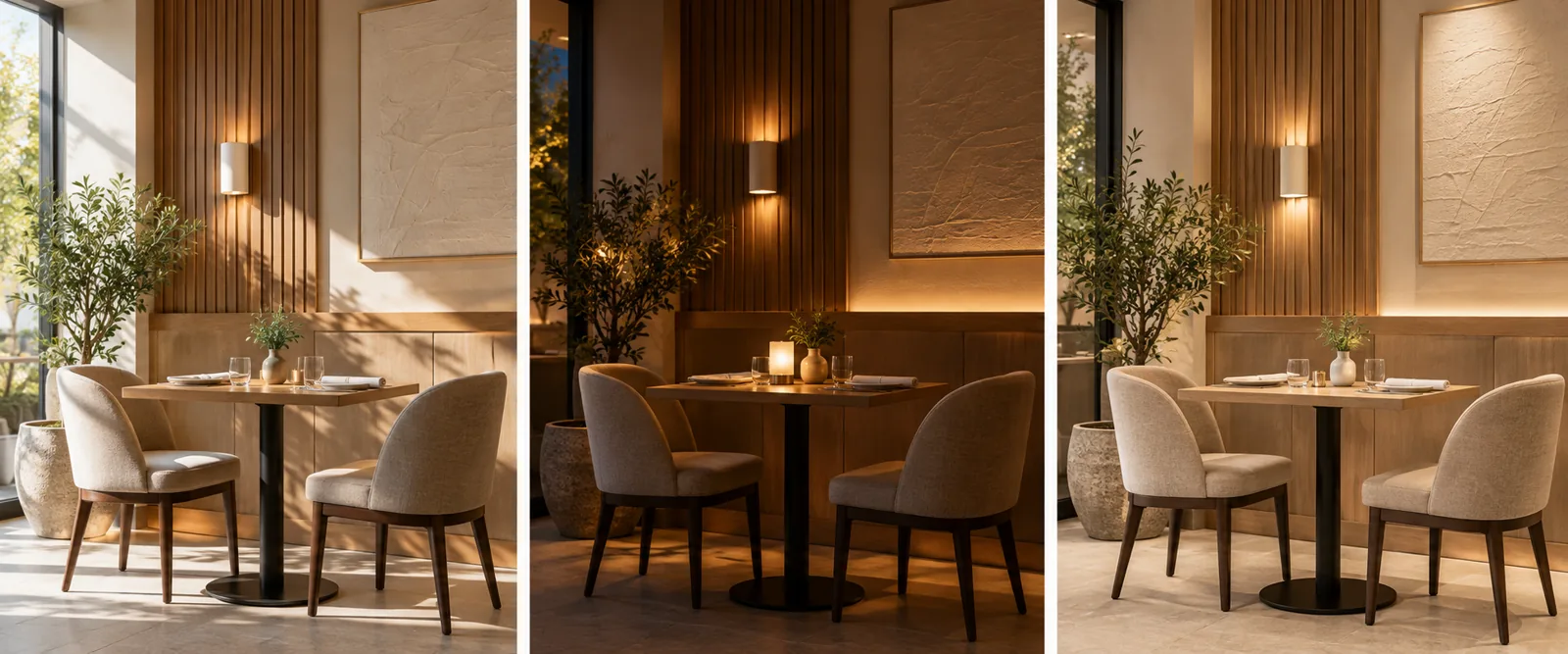
A control schedule that says “dinner: 30%” is ambiguous. Thirty percent of a driver command may not correspond to thirty percent of perceived brightness, and different luminaire types may respond differently. Describe the visual goal of each scene: table surface visible; guests’ faces readable; accent wall present but not dominant; window reflections controlled; service aisle safe. The installer can then commission output levels in the real room and record the final commands.
| Scene | Visual task | Review in mock-up |
|---|---|---|
| Day service | Balance strong daylight and indoor presentation | Tables near windows versus interior tables |
| Evening arrival | Visible entrance, host and wayfinding | Approach from outside and seat entry |
| Dinner | Comfortable faces, food and menus | Real tableware, menu and occupied seats |
| Closing | Staff circulation and clear exit | Guest departure and clearing routes |
| Cleaning | Full maintenance visibility | Switch location and safe reset to service mode |
The exact number of scenes can be fewer than this table. What matters is that they correspond to real operations. If a restaurant never uses a formal lunch scene, do not create one just to fill a control panel. If outdoor daylight changes rapidly at the facade, give that zone sufficient flexibility rather than forcing every table onto the same setting.
Why “dimmable” can still flicker at dinner level
The LED light source reacts quickly to the current delivered by its driver. A control and driver that work acceptably at full output may behave badly near the lowest useful setting. Visible flicker, stroboscopic effects, sudden jumps in light level, audible noise or failure to restart are all reasons to test the whole circuit. The U.S. Department of Energy’s flicker explanation distinguishes visible flicker, stroboscopic effects and other temporal light artifacts.
Ask the supplier to identify the actual driver and control method for the sample. Confirm the useful dimming range and the minimum stable level with the chosen number of fixtures on a circuit. Test both dimming down and returning up; a source that fades smoothly in one direction may not restart smoothly. Check for noise in the quietest guest area, not just in a workshop. Cameras and phones may reveal temporal artifacts in video, but they are not substitutes for proper measurement or direct observation.
For project specifications that need quantitative evidence, request relevant temporal-light-artifact data for the exact configuration and ask how it was measured. Our PstLM and SVM guide explains the terms. Do not assume that one data point at full output covers every dimmed scene.
Choose control architecture for the venue, not for a label
DALI, 0–10V and phase-cut dimming have different wiring, addressability and commissioning implications. The choice should follow the number of zones, scene complexity, retrofit constraints, service team and required interoperability. Our commercial dimming comparison covers the core differences. This article does not claim that a particular LCB fixture includes any one control option as standard; confirm the driver and order configuration.
For a small fixed restaurant, a simple control arrangement may be enough if it reliably reproduces the approved scenes. For a multi-zone venue that changes layouts or integrates with other systems, addressable control may justify its complexity. Whichever approach is chosen, document circuit boundaries, button labels, manual override behavior and who can adjust scene levels.
Some venues add color tuning or warm-dim effects. These should be evaluated with food, faces and materials, not only on a controller screen. A warm appearance is not a substitute for correct color rendering, and a dramatic shift can make a familiar dish look different. Verify the actual controls and LED package through the full operating range.
Watch for glazing, mirrors and low ceilings
Large windows create a different problem after dark: the dining room reflects back at guests, weakening the outside view. Bright exposed sources near glass can be especially distracting. An IES restaurant project case describes how source positioning, low-glare light and dimming were used to manage reflections in a glazed restaurant. Its solution is not a template; the principle is to check the reflected view after sunset.
With low ceilings, fixtures are closer to the eye. A compact downlight may still be visible from a seated position across the room, and a track head may sit in an awkward sightline. Check seated eye level at typical tables, not only the standing walkthrough. Mirrors and polished tiles may multiply source images. Move or shield the source where needed before adding a darker dimming scene that merely hides the problem.
In outdoor-adjacent dining, do not let a bright interior scene distract guests entering from a darker terrace. In a bar with reflective bottles, use accents carefully so labels are readable without creating harsh hotspots. Different zones can share a visual story while requiring different optics and control levels.
Mock-up and acceptance sequence
- Set a representative table. Use the actual top finish, glassware, plates and menu.
- Test seated viewpoints. Include guests facing each direction and staff approaching the table.
- Run each scene. Include daylight conditions and an after-dark test if glazing matters.
- Test the lowest useful level. Look for flicker, jumps, noise, unstable restart and unexpected color shift.
- Move a table if the plan is flexible. Check whether accents still land usefully.
- Record the approved configuration. Note fixture, optic, driver, control, addressing or circuit, scene commands and aiming.
Use a qualified installer for electrical work and confirm applicable local codes and emergency-lighting requirements separately. This article is a design and procurement checklist, not an electrical installation instruction. The handover should include a simple staff guide: which button recalls service, who may edit scenes, and how to return from cleaning mode.
Questions to put in the RFQ
- Which exact driver and control protocol are included in the quoted luminaire?
- What minimum stable dimming level was tested with the proposed controller and circuit load?
- Does the optic give comfortable seated views and a useful beam at the actual mounting height?
- How are a failed driver or LED board accessed without disrupting decorative finishes?
- Will replacement units match the accepted color and dimming behavior?
- Who provides scene programming, onsite adjustment and the as-built control schedule?
A low fixture price can be offset by control incompatibility, repeated visits or difficult maintenance. Compare complete scopes rather than only luminaire unit prices. Treat a sample and a short live trial as part of procurement for a venue that relies heavily on low-light atmosphere.
Frequently asked questions
Is warm light always best for restaurants?
Not always. The restaurant concept, daylight, food presentation, finishes and customer expectations all affect the decision. Test representative materials and food at the intended dining levels.
Can one dimming circuit serve the whole restaurant?
It can in some simple spaces, but separate zones are often useful for tables, host stand, wall features and cleaning. Design the circuit layout around tasks and scenes, not just convenience of wiring.
Does a DALI driver guarantee flicker-free dimming?
No. DALI describes a control approach; the actual LED driver, light engine, scene level and installation determine the visual result. Test the specified combination, especially at low output.
How do we avoid bright downlight spots on guests’ faces?
Review seated viewpoints and adjust fixture position, beam, shielding and complementary ambient light. Do not approve the scheme from an empty-room floor plan alone.
What should staff receive at handover?
Provide clearly labeled scene controls, a short operating guide, the approved scene schedule, fixture and driver details, and a contact or process for later adjustments.
Any visuals accompanying this article are conceptual illustrations, not photographs of a supplied LCB restaurant installation. Confirm product options, electrical compatibility and local requirements for the specific project.
