 跳到内容

Supermarket produce lighting should help shoppers see the color, texture and freshness cues of real food without creating harsh glare or an artificial-looking display. The most useful question is not simply “Which color temperature makes vegetables look bright?” It is how to put suitable light on the vertical and angled faces customers actually see, while keeping the aisle comfortable, efficient and easy to maintain.
This guide focuses on fresh-produce islands, wall bays and nearby shelving. A track-mounted linear product such as LCB’s LL1615 adjustable LED linear track light can be one starting point. The exact optic, output, track adapter and aiming range should be verified for the store, rather than assumed from a scene image.
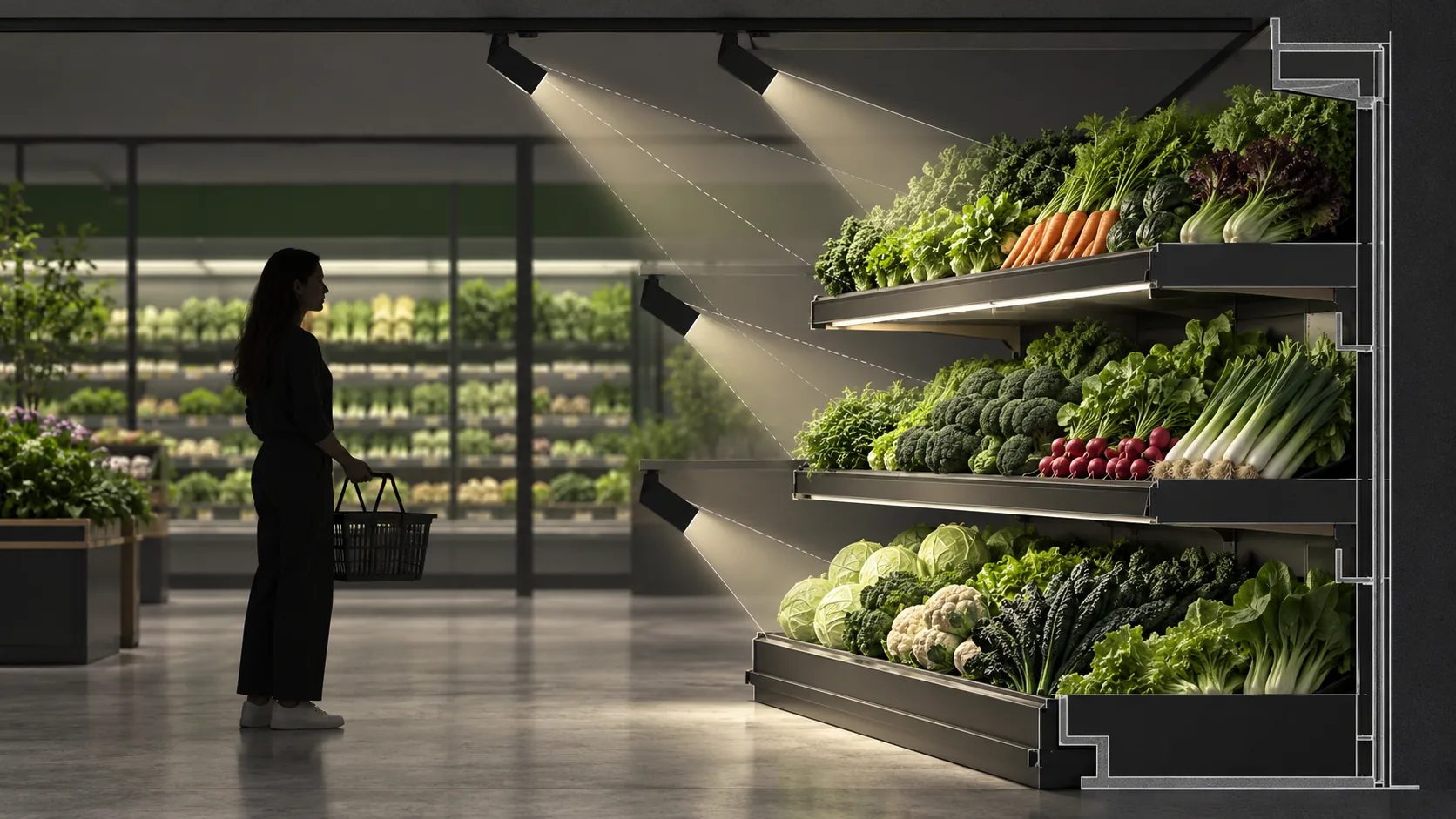
Begin with the food and display geometry
Produce departments contain several lighting tasks in a small area. A low island display presents upward-facing and angled surfaces; a tall wall display presents vertical shelves; refrigerated cases may include their own lighting and reflective glazing. A single overhead grid of fixtures may deliver enough average light to the floor while leaving the front of vegetables in shadow.
Map the customer route and the display heights. Identify which produce must be seen from the main aisle and which is examined close-up. Record shelf depth, canopy, fascia and any sprinkler, sign or exposed service that may block a beam. The layout should be drawn with merchandise in place, because empty fixture plans can hide shadow problems.
For a new store, ask the shopfitting team for sections of each display type. For a retrofit, take photographs at customer eye height during normal trading. Note where products appear dull, where packaging reflects too much light and where a bright luminaire is visible directly from the aisle.
Why vertical light matters
Shoppers view much of the produce from the side. Good horizontal illuminance on the floor does not prove the faces of fruit, vegetables or shelf labels are visible. Vertical and angled light can reveal color and shape more effectively. The design objective is to illuminate the merchandise surfaces, not merely the empty aisle.
Adjustable linear track lights can direct a broad ribbon of light toward displays. The benefit depends on the real beam and aiming position. A narrow accent may make one basket look dramatic while leaving adjacent baskets dim; an overly broad beam can spill into the aisle and create glare. Request a photometric file and test a representative produce bay.
On wall bays, compare top, middle and bottom shelves. A bright top row with a dark lower row is a common sign of poor positioning. For islands, check the front and back faces as well as the top. The best mounting strategy may differ between an island and a wall, even if the same fixture family is used.
Color: honest and appealing, not exaggerated
Produce has many saturated and subtle colors. Lighting should help shoppers distinguish them without making the display seem unnatural. Evaluate actual tomatoes, leafy greens, citrus and mixed-color items under the proposed source. Compare them with a neutral reference condition and observe the overall aisle, not just one fruit at close range.
Ask for the exact CCT and color-rendering information for the quoted version. Metrics provide a useful starting comparison, but they cannot replace a real sample with representative food. Also check color consistency between fixtures along a long shelf; noticeable shifts can make one section appear fresher than another even when the stock is identical.
A seasonal produce department may change dramatically in color. Avoid a scheme tuned only to one promotional crop. A balanced base light plus limited accent flexibility can cope better with changing displays than a highly specialized single-color effect across the whole department.
Control glare and reflections
A bright fitting directly in the customer’s line of sight can make the aisle uncomfortable and reduce visibility of the food. Check viewing directions from the main entrance, cross-aisles and checkout approach. When fixtures are mounted over low islands, beam aiming becomes particularly important because shoppers can see up into the optical aperture.
Glossy packaging, refrigerated-case glazing and wet surfaces can reflect luminaires. A design that looks good on open vegetables may be troublesome beside a glazed case. Use a mock-up with the actual materials and watch for reflections at normal shopping positions. Shielding, aiming and fixture location are often more effective than simply lowering the light level.
Staff also need usable light for stocking and cleaning. Test working positions, not just the promotional customer viewpoint. Aiming every fixture at the merchandise front may leave preparation or label areas poorly lit.
Choose the right fixture mix
Produce departments often benefit from more than one layer: general circulation light, controlled merchandise light and localized shelf or case lighting. An adjustable track-mounted linear fixture can provide broad directional coverage, while dedicated shelf lights can help deep wall bays. The supermarket shelf modular LED linear track spotlight is another product family to examine where the mounting and merchandise geometry suit it.
Do not fill every track position with the same head by habit. A long central island and a narrow wall bay do not necessarily need the same distribution. Use a fixture schedule that identifies the role, optic, aim, mounting position and control zone for each display type.
If the store is being refurbished while trading, installation access and disruption also matter. Track-mounted systems may offer adjustment flexibility, but verify the condition and capacity of the existing rail and the adapter compatibility before ordering.
Build a representative mock-up
Choose a bay containing several colors and shelf levels, ideally including a reflective surface. Install the proposed fixtures at their intended positions. Put real merchandise into the display, or realistic substitutes with similar color and texture, then inspect the bay from the main aisle and close-up. Observe it under daylight and evening trading conditions if daylight reaches the department.
Measure where appropriate, but use measurements to explain the visual result, not replace it. Note vertical light on the food-facing plane, brightness at the front and back of deep shelves, and any bright aperture visible to shoppers. Record the final aiming angle, output setting and product configuration. Photographs should use consistent exposure if they are used to compare alternatives.
Ask store staff what makes stocking and cleaning easier. They may point out shadows behind a fascia or a light that will be bumped during replenishment. A sample that looks impressive for an hour but is awkward to maintain is not a good rollout choice.
Operations and maintenance
Food retail environments are busy. Luminaires may collect dust or be exposed to cleaning activity. Check the cleaning instructions and suitable installation location for the selected product. Do not assume an IP rating or special food-area suitability unless it is documented for the exact unit. The lighting should be maintainable without contaminating displayed goods or disrupting refrigeration equipment.
Plan access for drivers, adapters and replacement modules. Stock spares for high-impact positions and keep the configuration code in the maintenance record. A replacement with a different optic or color can create a conspicuous bright patch across a produce bay.
Controls should reflect trading hours, cleaning and overnight stocking. If dimming is part of the plan, verify the exact driver and control system; do not rely on a generic “dimmable” label. Check that lower scenes do not distort the perceived color balance.
RFQ and approval checklist
| Project information | Supplier or designer response |
|---|---|
| Display plan, sections and photographs | Fixture placement and aiming proposal |
| Produce types and visual priorities | Exact color and optical options for sampling |
| Existing track and ceiling condition | Adapter, mounting and clearance confirmation |
| Operating hours and control scenes | Driver and control compatibility |
| Cleaning and maintenance method | Service procedure, spare list and installation limits |
| Rollout scope | Approved sample record and repeatable aiming schedule |
The approved sample should carry the exact optic, CCT, finish and adapter code. For a chain of stores, create a short visual standard that shows acceptable coverage and aiming. This is more reliable than telling every installer to “make it look bright.”
Make a store-level aiming standard
Produce departments are reset frequently. A layout that depends on one talented installer can degrade when fixtures are bumped or merchandise changes. Create a simple aiming standard using a plan and a few annotated photographs. Mark the intended center of each beam, the shelf level it serves and any customer viewing direction to protect from glare. Store teams should be able to tell when a head has drifted without needing to repeat a full lighting calculation.
Test the standard on both a busy promotional display and an ordinary mixed-produce bay. If the lighting only flatters the opening-day arrangement, it is too fragile for normal retail use. Record acceptable variations and when a lighting professional should be called—for example, when displays move substantially or a new fixture variant is introduced.
Include cleaning and spare instructions in the same short document. Consistent aiming, CCT and optic selection across replacement units will preserve the department’s visual quality better than a generic “replace with equivalent LED” note.
Common mistakes to avoid
- Designing only for floor illuminance. Assess the faces of produce and shelf fronts.
- Using one highly saturated color effect everywhere. Sample mixed produce and maintain an honest overall appearance.
- Ignoring reflections and direct views of the fixture. Test actual customer sightlines.
- Assuming a track adapter fits the existing rail. Verify the exact combination.
- Skipping staff and service needs. Consider stocking, cleaning and spare access before a rollout.
Compare one real bay at two times of day
A produce department beside a glazed storefront can look very different at midday and after sunset. During daylight hours, daylight may raise ambient brightness and change perceived food color; after dark, the electric lighting carries the whole visual task. Inspect a representative bay in both conditions before approving a rollout. Keep camera exposure fixed if photos are used for comparison, and note the control settings at each visit.
If daylight controls are proposed, test how they respond when clouds move or when a window display changes. The system should not create a distracting sequence of bright and dim shelves. Record the approved scenes so that maintenance staff can restore them after a driver or sensor replacement.
Frequently asked questions
What color temperature is best for fresh produce?
There is no single answer for every assortment and brand. Select candidate CCTs and compare real merchandise in the representative store environment. Consistency and natural appearance are more important than a generic number.
Should produce lighting be brighter than the main aisle?
It may need to create emphasis, but excessive contrast can cause discomfort and make surrounding areas seem dim. Evaluate the whole scene with normal operating levels and customer sightlines.
Can one track light cover both an island and a wall bay?
Possibly, if the selected optic and aiming range work for both geometries. Test each display type separately; the same family may need different configurations or positions.
Do I need dedicated shelf lights?
Deep or obstructed shelves may benefit from local lighting, but not every display does. Compare the visible merchandise in a mock-up and decide whether overhead light reaches the critical surfaces.
How do I avoid misleading product photos?
Approve a real fixture and an actual display mock-up. Concept images can communicate a design idea but cannot prove product appearance, light distribution or installation compatibility.
Practical next step
Send the produce department plan, display sections, existing track information and representative merchandise photos. Compare the proposed LL1615 adjustable LED linear track light with any shelf-specific option in a real bay. Approve the food-facing light, customer comfort and maintenance method together.
