 跳到内容

Serviceable LED luminaires are specified as much by their replacement plan as by their initial light output. A fitting can look excellent on opening day but become expensive to maintain if its driver cannot be reached, a matching LED board disappears, or the only repair is removing a long run from a finished ceiling. Buyers can reduce that risk by asking a few practical questions before approving a product.
This guide focuses on commercial track, linear and downlight projects. “Serviceable” does not mean every part can be replaced on site; sometimes a complete fixture swap is the sensible field method. The important point is to define the method, spare parts and documentation for the exact product. LCB’s Product Center provides product families to evaluate, while the final service strategy should be confirmed in the approved specification.
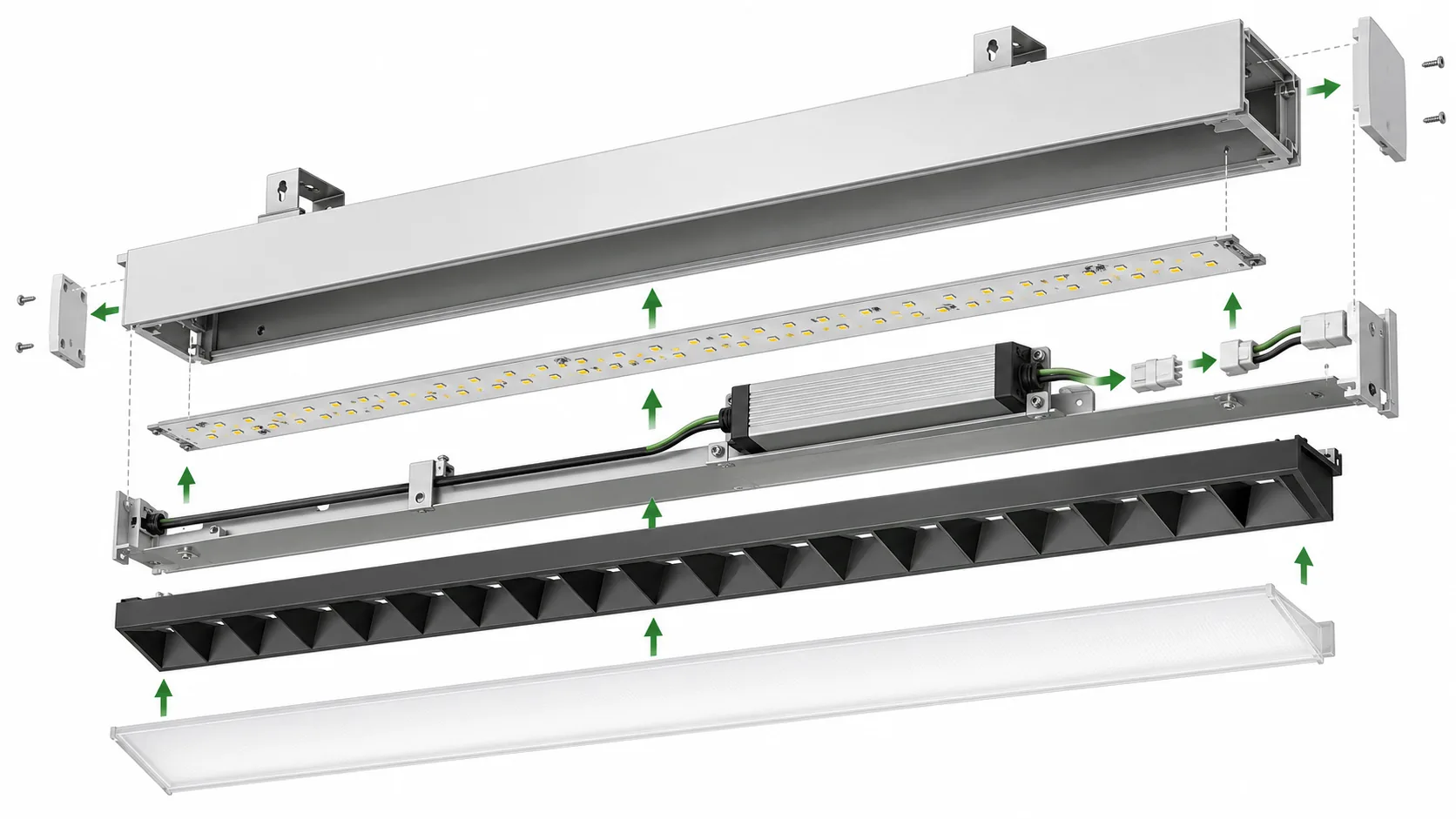
Define the replacement unit
Ask what a technician would replace when the light fails. It might be the driver, LED board, optic, connector, complete head or complete luminaire. Different answers create different inventory, labor and waste implications. Do not accept “easy to maintain” without a demonstration of the intended repair.
For a track spotlight, a complete head swap can be fast if the adapter fits and a matching spare is available. For a continuous linear system, removing one segment may be possible, but the joint and wiring design determine the time required. For a recessed downlight, the ceiling opening, springs and driver location affect access. A product that is technically modular may still be difficult to service in a crowded ceiling.
Write the intended field action into the project brief. If the owner expects separate driver replacement, require a drawing and method. If the owner accepts complete unit replacement, budget for matching spares and disposal.
Driver access: the first practical test
Drivers are common service items, but their locations vary. A driver may be inside the fixture, attached to an accessible housing, above a ceiling or in a remote serviceable space. Ask whether it can be reached without damage to finished surfaces or dismantling unrelated luminaires.
Inspect cable length, connector type, fixing method and the safe space needed to remove the driver. Check that a replacement driver has the correct electrical and control characteristics for the original LED board and system. A mechanically fitting substitute is not automatically a safe or visually equivalent one.
For linked lines, ask what happens if a driver in the middle of the run fails. Does the technician access only one module, or must several neighboring sections be opened? Our continuous-run driver-access guide
LED boards and optical parts
A separately replaceable LED board can be useful, but only if its matching electrical, thermal and optical properties are available. The replacement should preserve output, color appearance and compatibility with the existing driver. Ask for the board part number and whether the manufacturer will maintain a compatible supply or specify a documented successor.
Optics matter too. A cracked diffuser, missing grid or changed lens can alter the visible result even when the LEDs work. On a prominent wall or continuous ceiling line, one mismatched optic can stand out. Request part numbers for diffusers, lenses, grids and end caps when the design relies on a repeated appearance.
Do not assume a replacement part from a later revision is visually identical. For long projects, keep an approved sample and record the original configuration. When a substitute is proposed, compare it in a representative installed position.
Specify connectors and joints
Connectors can make a modular system easier to install and service, but they must be robust and documented. Ask whether they are keyed, accessible and rated for the intended electrical arrangement. For a long linear run, confirm how the joint is released and whether the next module remains supported while one is removed.
Check the visible outcome after a replacement. Can the module be aligned with neighboring sections? Is there a gasket, clip or finish part that may be damaged during removal? A spare luminaire without the small installation parts needed to refit it is not a useful spare.
Keep spare connectors and end treatments if they are unique to the system. These inexpensive parts can determine whether a service visit finishes in one trip.
Color matching over time
LED color and output can change with use. A new replacement installed among older units may appear different even when it shares the nominal CCT. The risk is greatest in uniform arrays, wall washing and continuous linear runs. Discuss this with the supplier before ordering a long-life project.
Options include holding matching spare units from the original batch, replacing a visible group together, or approving a successor through a mock-up. The right policy depends on the space and the expected replacement frequency. A back-of-house corridor may tolerate a difference that would be unacceptable across a flagship retail wall.
Record exact CCT, color specification, optic, driver setting and batch where available. Maintenance records should identify what was replaced and when so that future decisions are based on evidence.
Evaluate serviceability against the actual installation
A bench demonstration is not enough. Install a sample in the intended ceiling or rail, then perform a timed, safe replacement of the likely service item. Include the real ceiling height, access equipment and adjacent services. Record whether the technician can complete the task without damage and whether the replacement needs re-aiming or recommissioning.
For a grid LED linkable linear system, test a middle module and a joint. For a modular recessed downlight, test removal through the finished ceiling opening. These are product starting points; the exact service method is configuration-dependent.
Ask the facilities team to observe the demonstration. They can identify access problems that a design team may miss, especially in occupied sites where lifts, ladders or shut-downs disrupt operations.
Build a useful spare-parts schedule
| Record field | Why it matters |
|---|---|
| Location and fixture ID | Find the correct unit quickly |
| Complete luminaire configuration | Avoid a wrong optic, finish or control variant |
| Driver and LED board codes | Match the electrical and color behavior |
| Optic, diffuser and connector codes | Restore the visible result and joint |
| Replacement method and tools | Plan safe access and labor |
| Approved substitute policy | Control changes when originals are unavailable |
| Warranty and supplier contact | Handle claims without searching old emails |
The spare quantity should reflect criticality, installed population, access difficulty and supplier lead time. Do not copy a generic percentage without considering the project. A few hard-to-access focal luminaires may deserve more careful stockholding than many easily swapped back-of-house units.
What should go into the RFQ?
Request a service drawing, parts list, installation and removal instructions, warranty terms, expected availability of compatible replacements and a sample service demonstration. Ask whether any parts require factory-only replacement. If the driver or board is not field-replaceable, that is not automatically disqualifying—but the complete-unit replacement method and cost should be clear.
Require the supplier to identify the exact revision being quoted. A product family can change components over time. The quote should explain how a later revision would be matched to the installed population and what approval would be needed for a substitution.
Destination-market electrical rules and safe-work procedures still apply. This article is a purchasing checklist, not authorization for unqualified electrical work.
Consider total cost, not only repairability
A luminaire with more replaceable parts may cost more or require more complicated field work. A sealed but easily swapped head may be simpler in some retail applications. Compare the complete service event: part cost, labor, access, downtime, waste and risk of an appearance mismatch. Record these factors in an itemized total-cost worksheet alongside the initial purchase price.
Plan for the owner’s actual capacity. A facility team with trained electricians and spare inventory may benefit from component-level service. A small hotel may prefer a straightforward complete-unit swap through a local contractor. The best service strategy is one the owner can execute.
Test the real repair, then record its cost
Ask the supplier or installer to demonstrate a realistic repair on a sample installed in the project condition. Time the operation, list the tools and note whether it needs a lift, ceiling opening or store shutdown. Include removal, replacement, reconnection, re-aiming and control verification. A five-minute bench swap can become a much longer field event when access is limited.
Repeat the demonstration for the most likely failure path and for a visible cosmetic part such as a diffuser or optic. If the latter cannot be replaced without damaging the luminaire, a complete spare may be needed even though the LED board is modular. Record which small clips, seals or connectors should be stocked with the primary spare.
Use the result in the total-cost review. A slightly higher initial price may be justified by lower repair labor, or a complete-unit swap may prove more practical than component repair. The evidence should come from the owner’s installation and maintenance capacity, not from a generic brochure claim.
Common mistakes to avoid
- Assuming “modular” means field-serviceable. Ask for a real replacement demonstration.
- Stocking drivers but not optics or connectors. Small missing parts can block a repair.
- Ignoring color matching. A new unit may look different beside aged neighbors.
- Storing only a generic model name. Record the exact configuration and revision.
- Designing access after the ceiling is finished. Test the worst location early.
Make an obsolescence plan
Commercial LED products evolve during a building’s life. Ask the supplier how it handles a discontinued driver, board or optic. The answer might be a documented successor, a reserved spare stock, or a policy to replace a visible group together. Any successor should be checked for electrical compatibility, size, output, color and beam before it is treated as equivalent.
Store the approved sample and current technical file with the owner, not only with the installing contractor. If the product changes years later, that reference makes a replacement evaluation much faster. Include the exact part code and revision in the asset register, and update it after each repair. Good records are inexpensive compared with tracing an unknown fitting after the project team has moved on.
Frequently asked questions
Are replaceable LED boards always better?
No. They can reduce the parts replaced, but only if compatible boards are available and the field method is safe and practical. Compare total service cost and visual consistency.
How long should spare parts remain available?
Agree an availability plan that suits the project’s expected life and maintenance strategy. Request written terms or a documented successor policy rather than assuming indefinite supply.
Can I replace only a failed driver?
Only if the product is designed for that method and the correct driver is available. Follow the supplier’s instructions and qualified local electrical procedures.
What if the original luminaire is discontinued?
Use the approved substitute process: compare electrical compatibility, dimensions, optics, color and appearance in a representative installation before a large replacement.
Should I keep complete spare luminaires?
For critical or highly visible areas, complete matching spares may be valuable even when components are replaceable. Decide quantity using site criticality, lead time and access cost.
Practical next step
Select one representative product and ask the supplier to show how it is serviced in the actual installation condition. Record the parts and labor required, then compare that evidence across candidates. A clear replacement plan is a stronger asset than a vague claim that an LED luminaire lasts a long time.
