 跳到内容

Quick answer: A pharmacy retail lighting plan should treat the sales floor, shelf faces, service counter and staff work areas as different visual tasks. Provide even aisle visibility, test whether labels can be read on real packaging, keep bright fittings out of customer and staff screen reflections, and make maintenance access part of the fixture choice. A good design is checked in the actual space with sample luminaires and representative merchandise, not approved from an attractive rendering alone.
Featured image: concept illustration only. It is not an LCB installation, a compliant pharmacy layout or a photometric calculation.
A pharmacy combines the visual demands of a small shop with a service counter and back-of-house workstations. A bright central aisle can still leave vertical shelves dull. An accent fitting may make a display attractive while casting a strong highlight over a customer-facing screen. A long ceiling run may look orderly but make access to a driver awkward after the store opens. These details matter to buyers because they determine how useful the installed lighting will be, long after the initial photograph is taken.
This guide is for pharmacy operators, retail designers, contractors and OEM buyers comparing commercial LED linear lights, downlights and track spotlights. It focuses on lighting decisions and handover checks. It does not prescribe medication-handling procedures, clinical light levels or a universal specification for every jurisdiction. Obtain the applicable local requirements and a room-specific design from qualified professionals.
Map the visual tasks before choosing fittings
Start with a plan that identifies customer aisles, high and low shelving, promotional displays, the queue, service counters, point-of-sale screens, any consultation area and staff-side work surfaces. Mark the entrance and windows because daylight changes how bright the interior appears during the day. Note ceiling height, shelf height, aisle width and the position of equipment that could block or reflect light.
The Illuminating Engineering Society’s recommended practice for retail spaces discusses both horizontal and vertical illuminance and uniformity. Its public summary does not supply a ready-made pharmacy number. The important buying lesson is that a floor reading alone cannot describe how labels appear on upright shelves or whether a counter screen reflects a luminaire. Ask the designer to evaluate the surfaces people actually look at.
Walk the proposed layout in the order a customer would use it: entrance, main aisle, shelving, service point and exit. Then repeat from the staff position. The two views are different. A beam that looks fine from the aisle may shine directly into the eyes of someone behind the counter. Record the problem locations on a drawing before asking for product alternatives.
Make shelf fronts readable without creating hot spots
Many pharmacy shelves hold small boxes, bottles and shelf-edge tickets. Their fronts are vertical, so an ambient scheme that illuminates only the floor can leave the important information comparatively flat. The aim is not to make every shelf equally bright; it is to give the customer a clear visual path and enough light on the merchandise and labels that matter to the store layout. Check top, middle and bottom shelves separately.
Linear ambient luminaires can help establish a consistent base layer. Adjustable track spotlights can provide accent on a selected display, but the aiming angle and beam must match the shelving. A narrow beam aimed too close can create a bright patch on one product and leave adjacent items comparatively dark. A wide beam may waste light on the aisle or a glossy sign. Request photometric data for the actual optical option and test the arrangement on sample shelving.
Our retail aisle lighting article explains how to review both sides of an aisle. For a different fixture type, the COB LED track spotlight page shows a product platform that can be discussed for adjustable accent lighting. Confirm the chosen model, beam, track compatibility and mounting details from its current technical data before specifying it for a project.
Mock up representative packages rather than an empty shelf. White cartons, glossy foil, dark bottles and clear plastics react differently to a source. Photograph the shelf from normal customer positions, but also inspect it directly: a phone camera can adjust its exposure and make uneven lighting look more balanced than it feels in person. Check that labels are visible without a bright reflected line crossing them.
Protect the service counter from screen glare
The counter is often where paper, a keyboard, a display and face-to-face communication share one compact space. More overhead light is not automatically better. If a bright linear fitting reflects in the POS or staff monitor, the screen may be harder to read even while the countertop is bright. The US Occupational Safety and Health Administration advises arranging workstations and lighting to avoid reflected glare on display screens, including from overhead fixtures and windows.
Check the screen from the staff member’s normal eye position and from the customer side where appropriate. If the fitting is reflected, review its position, distribution, diffuser and output before adding a task light. Moving a ceiling row or shifting a monitor can sometimes solve a specific reflection. If a task light is useful for paper work, place it so it illuminates the documents without shining into the display or the customer’s eyes.
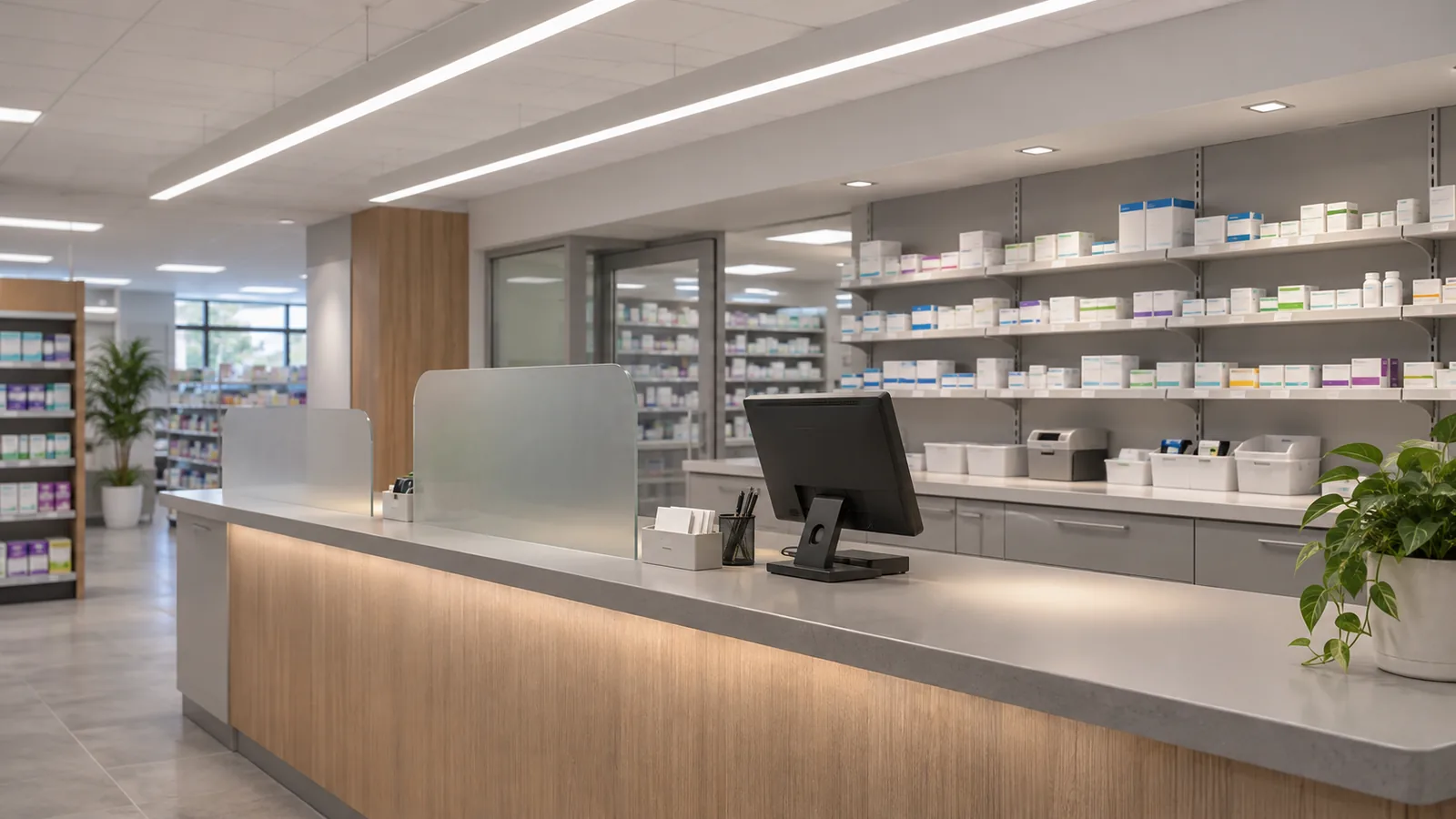
The same issue appears in other retail settings, so our checkout screen-glare checklist is a useful companion. At a pharmacy counter, also examine the queue area and the customer-facing side of any screen. The final layout must work during the busiest operating conditions, not just when the counter is empty.
Use color quality deliberately
Package colors and signage help people navigate a shop. However, the light source’s color temperature and its color rendering are different characteristics. Choosing a cooler-looking CCT does not by itself guarantee that printed colors will appear faithful. The US Department of Energy explains in its LED basics that CCT describes the appearance of the light, while color fidelity describes how the source affects the appearance of objects. It also notes that a single CRI value is an imperfect description of color rendition.
Ask for the proposed source’s color data and compare physical samples against the store’s real packaging, finishes and signage. More important than selecting one fashionable CCT is keeping adjacent zones visually coherent and avoiding an obvious mismatch between replacement batches. If the project includes more than one fixture family, review their appearance together. A warm accent next to a much cooler ambient run can make a shelf look inconsistent unless the contrast is intentional.
Do not claim that a specific CCT improves health outcomes or makes medicine safer. Those statements need evidence outside a lighting procurement decision. For this article, the relevant question is practical: can customers and staff see the intended materials comfortably, and does the lighting preserve the store’s visual identity?
Choose zones that match operating hours
A small shop may not need a complicated networked control system, but it still benefits from deliberate zones. Entrance and window-side lighting can respond differently from a deep aisle. Accent lighting on a promotion may be independent of the ambient layer. Staff work areas may remain in use while the sales floor is closed for cleaning or stocking. Define those use cases before selecting the driver and control method.
Make the controls understandable to staff. A clear set of labeled scenes can be more reliable than a large number of obscure dimming channels. If sensors or schedules are proposed, specify which lights they operate, the override behavior and what happens at the opening and closing times. Test the actual driver-controller combination at full output and at the intended reduced levels. A dimming claim from a catalogue does not confirm every combination will behave well.
Plan maintenance before a fitting is approved
The store cannot afford a design that is difficult to clean, re-aim or repair during normal operation. Ask how the diffuser is removed, how an LED module or driver is identified, and whether a replacement can be reached without dismantling shelving. Confirm access above the ceiling where a suspended linear system is proposed. If a track spotlight must be re-aimed after a merchandise change, the aiming mechanism should be straightforward and secure.
Request a list of spare parts and the configuration details that distinguish the approved version from similar products. Record the optic, finish, driver, control interface and mounting hardware. If the project uses a custom OEM version, retain a signed sample and a technical drawing. This makes future replacements less dependent on someone’s memory of the original order.
Maintenance also affects appearance. A replacement fitting with a different CCT or optic can make one aisle look noticeably different. Keep a clear record of the installed family and approved substitutes. If the manufacturer changes a component, ask whether photometric or color data have changed before using it in a highly visible area.
What to include in a supplier request
Send the floor plan, ceiling height, shelf dimensions, counter layout, screen positions and photographs of the existing space. Show where daylight enters and whether blinds or other controls are present. Identify the merchandise areas that need accent and the staff tasks that need separate light. State the available electrical supply and any existing control infrastructure, but let the installer confirm it on site.
Ask each supplier for a proposed layout, selected fixture and optic, photometric files, driver and control compatibility, mounting drawings, service access, sample availability and warranty terms. Ask them to flag assumptions. If an item is not yet decided, it should be a question in the proposal rather than an invented product parameter. The LCB lighting platforms can be reviewed against these questions for a project-specific quotation.
Compare bids using the same room drawing and tasks. A lower fixture price can be offset by more fittings, extra installation work or a maintenance approach that is difficult to execute. Conversely, a more elaborate control system may bring little value if staff only need a few reliable scenes. The comparison should include the installed result and its handover requirements, not only an equipment list.
A simple on-site acceptance test
- Walk the aisles: inspect top, middle and bottom shelves with representative products in place. Look for dark gaps, distracting bright patches and readable shelf-edge tickets.
- Stand at the counter: review paper tasks and every screen from the normal working positions. Repeat with daylight coming through the windows.
- Check customer views: look back toward the counter and along the main circulation route for direct glare from exposed sources.
- Run every scene: confirm labels, sensor behavior, overrides and any scheduled closing mode with the people who will use them.
- Review handover: keep the final layout, fixture schedule, aiming notes, approved sample information, control settings and spare-parts list.
Frequently asked questions
What is the best LED lighting for a pharmacy retail floor?
There is no universal fixture type. A useful scheme combines comfortable ambient light, adequate visibility of vertical shelf fronts and carefully aimed accent light where the store needs it. The right combination depends on the layout, finishes, ceiling, merchandise and available controls. Test the proposed fixtures in the actual conditions.
Can track spotlights replace all general lighting?
They can be flexible accents, but relying on a small number of narrow beams for the whole shop may create uneven aisles and bright hot spots. Assess the proposed layout through photometric data and a mock-up. In many projects, a separate ambient layer makes the result easier to balance.
Should pharmacy lighting use one color temperature everywhere?
Consistent appearance across adjacent areas is usually a good starting point, but a deliberate accent may differ. Agree on the visual intent, compare samples of all proposed fixture families and document the approved color specification. Color temperature alone does not describe color fidelity.
How do we stop LED lights reflecting in a POS screen?
Look at the screen from the operator’s position under both electric light and daylight. Adjust the screen or fitting position, select an appropriate distribution or diffuser, and separate counter lighting if needed. Test the installed arrangement before accepting it.
What documents should a contractor hand over?
At minimum, retain the final fixture schedule and locations, approved product configurations, photometric files, control settings, aiming notes, warranty information and replacement-part references. A brief walk-through with staff helps ensure the scenes are used as intended.
Make the lighting support the whole store
Pharmacy lighting works best when the design moves from tasks to zones and only then to products. Check shelf fronts as well as floors, protect the counter from reflected glare, compare color appearance using real merchandise and make replacement access practical. For a new store or refurbishment, send LCB the layout and application details to discuss a fixture proposal that can be checked against the actual project.
