 跳到内容
跳到内容 
Quick answer: To light both sides of a retail aisle from one track position, begin with the shelves—not the fixture. Record the mounting height, aisle width, shelf height and merchandise reflectance; set separate targets for the left display, right display and walking surface; then aim and verify each light panel independently. A dual-panel linear track light can reduce ceiling clutter and give both sides their own aiming direction, but it still needs a photometric check and on-site commissioning.
If you are planning a supermarket, fashion store, pharmacy or showroom, the most expensive lighting mistake is often invisible on the reflected ceiling plan. A layout may meet the requested floor illuminance while the products on the vertical shelves remain flat, dark or uneven. Customers do not shop from the floor. They look at labels, colours, textures and faces. Your design therefore has to deliver useful vertical light without producing glare in the customer’s normal line of sight.
We wrote this guide to help project owners, designers, contractors and buyers make that decision before ordering. It explains what to measure, how to compare one wide fixture with two independently aimed panels, what information to request from a supplier and how to commission the installation. The goal is not to persuade you that one luminaire fits every aisle. It is to help you select the arrangement that gives your project the best visual result with the least rework.
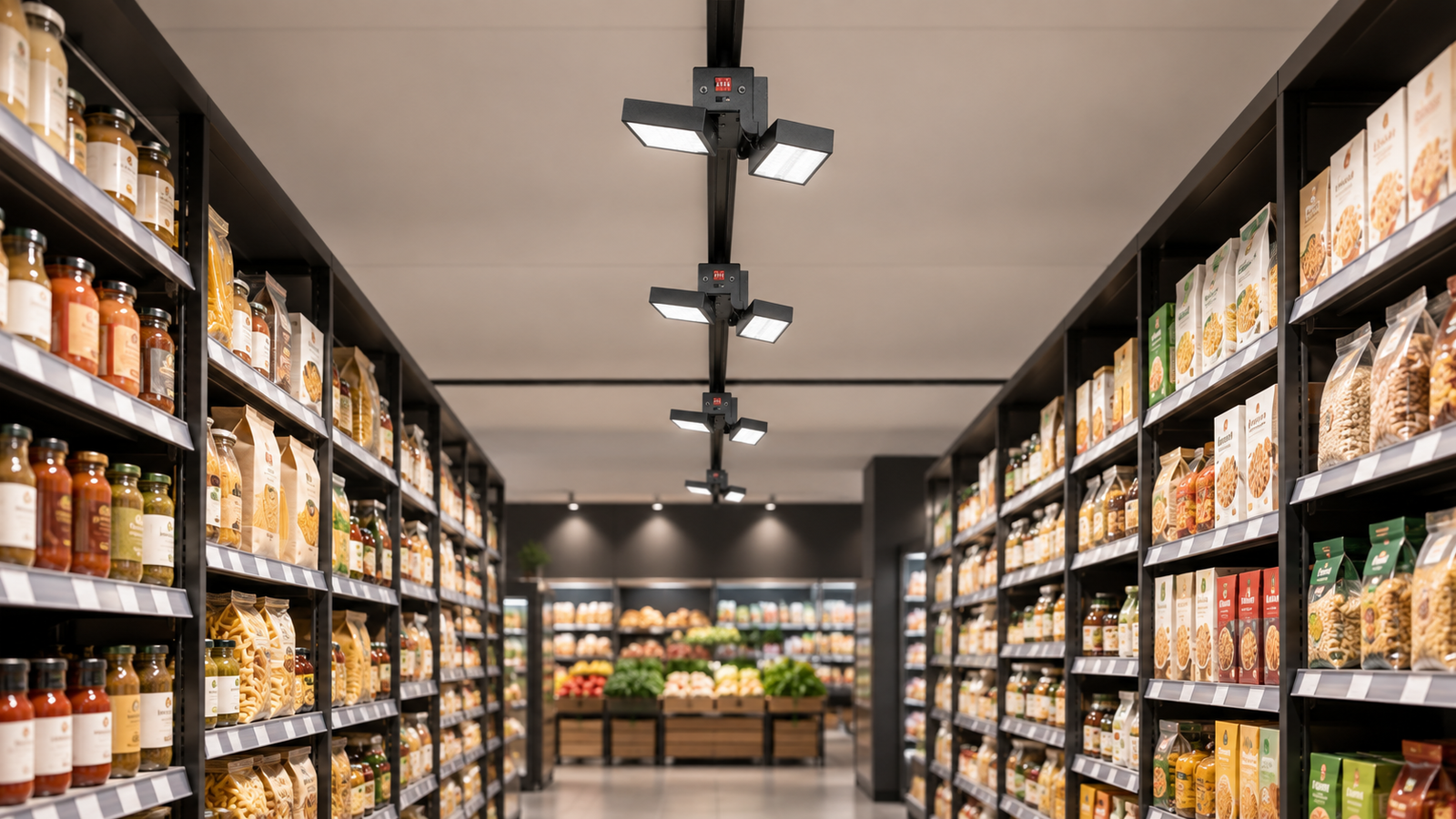
1. Start With the Visual Task, Not the Wattage
A wattage is an electrical input, not a lighting result. Two luminaires with the same wattage can produce very different shelf illumination because of optical efficiency, beam distribution, mounting height and aiming. Before comparing products, divide the aisle into three practical tasks:
- Left vertical target: shelf fronts, packaging, signage and merchandise on one side.
- Right vertical target: the opposite display, which may have a different height or reflectance.
- Horizontal and circulation target: floor, trolley route and any work surface that must remain safe and comfortable.
Write these targets on the plan. If an end cap or promotion table needs more emphasis, mark it as a fourth zone. This simple step prevents a common failure: using a broad downward beam that makes the floor bright but leaves the upper and lower shelves visibly weaker.
Information to collect before product selection
- finished ceiling and track mounting height;
- clear aisle width and the distance from track centre to each shelf face;
- height and depth of the shelving;
- merchandise colours, gloss and packaging reflectance;
- target horizontal and vertical illuminance;
- required uniformity and accent contrast;
- existing track profile, circuits, voltage and control method;
- hours of operation and maintenance access;
- areas where shoppers or staff can see the light source directly.
If several of these values are unknown, do not compensate by adding more watts. Ask for a site survey, a dimensioned drawing or a trial installation. More output can increase glare and energy use without solving poor aiming.
2. Why One Fixed Beam Often Struggles in a Two-Sided Aisle
A conventional linear track luminaire generally has one principal direction. It can provide a useful wide distribution, but a single optical plane cannot always serve two vertical surfaces and the floor equally well. Tilting the whole fixture toward one shelf improves that side while reducing light on the other. Keeping it horizontal improves symmetry but may send too much light to the floor.
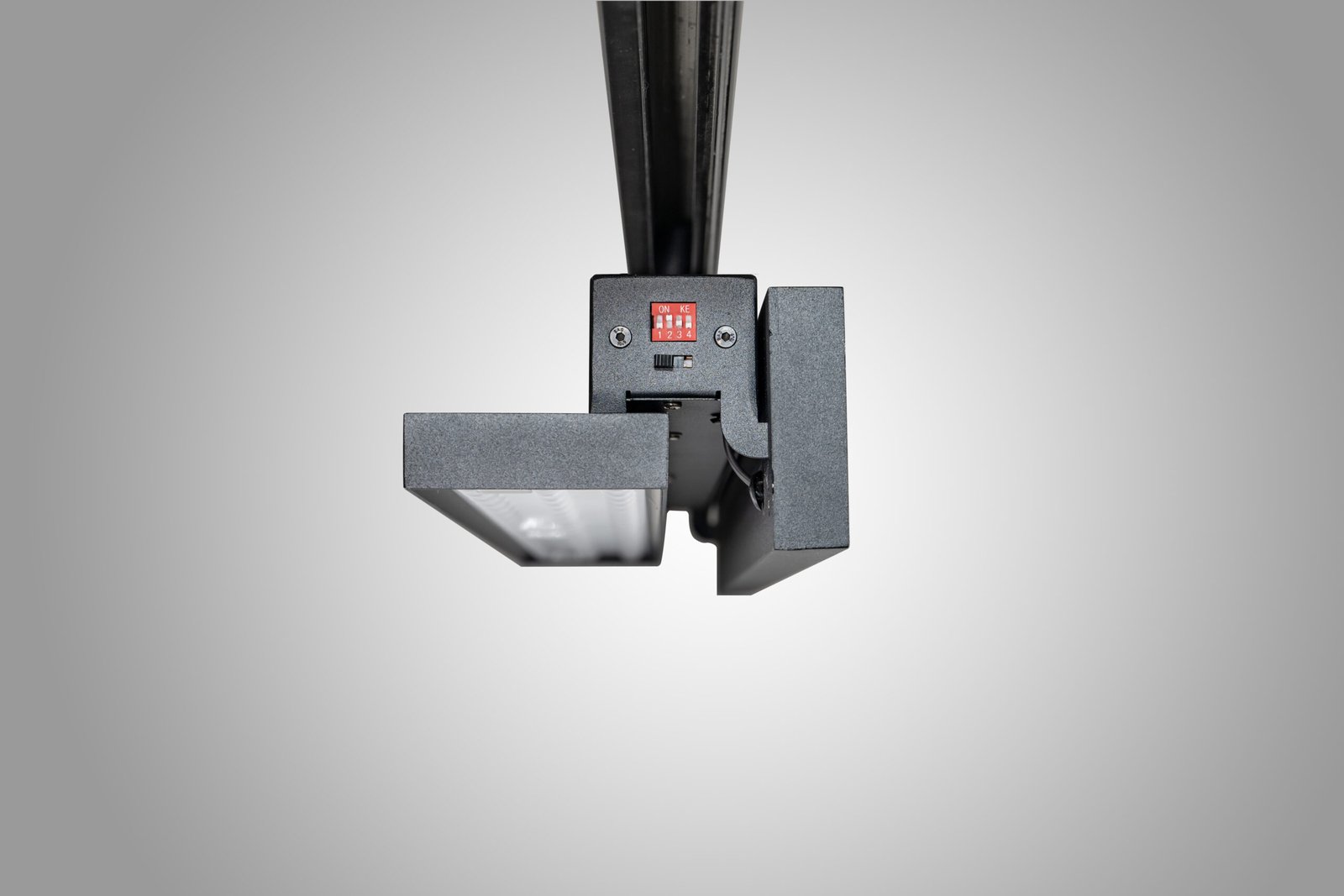
A dual-panel design changes the adjustment logic. Instead of moving the entire luminaire as one piece, each panel can be aimed toward a separate target. One panel may be tilted toward the upper and middle shelves on the left while the second panel serves the opposite shelving or contributes to circulation light. The benefit is not simply “two lights in one.” The real benefit is two controllable distributions sharing one track adapter and one ceiling position.
That flexibility is most valuable when:
- the aisle is centred beneath or close to the track;
- both shelf faces need useful vertical illumination;
- store layouts or seasonal displays change;
- the ceiling should remain visually clean;
- installation access or available track positions are limited;
- the project team wants to re-aim light without moving the track rail.
It is less useful when the track is far outside the aisle, the target needs a very narrow accent beam, or the existing rail cannot support the luminaire mechanically or electrically. In those cases, separate spotlights, asymmetric wall washers or a different track position may be the safer choice.
3. Build a Simple Aisle Geometry Before You Request a Quote
You do not need a finished lighting model to make an intelligent first selection. A section drawing through the aisle is enough to reveal most risks. Draw the floor, track, shelf faces and normal eye height. Add lines from the approximate centre of each panel to its target zone. Check whether the light path crosses a shopper’s eye or produces a severe grazing angle on glossy packaging.
Use the section to answer four questions:
- Can each panel physically tilt far enough toward its target?
- Will the luminaire body or the other panel block part of the beam?
- Does the projected beam cover the required shelf height at the actual distance?
- Can customers see the bright optical surface when walking in either direction?
For museum track lighting, the Canadian Conservation Institute also emphasises that track position and incidence angle affect glare, reflections and surface appearance. The same geometry principle matters in retail even though the visual target is merchandise rather than artwork. You can review its track-lighting placement note as a useful reference, then confirm the final retail layout against your own project requirements.
4. Select 60° or 90° From the Coverage You Need
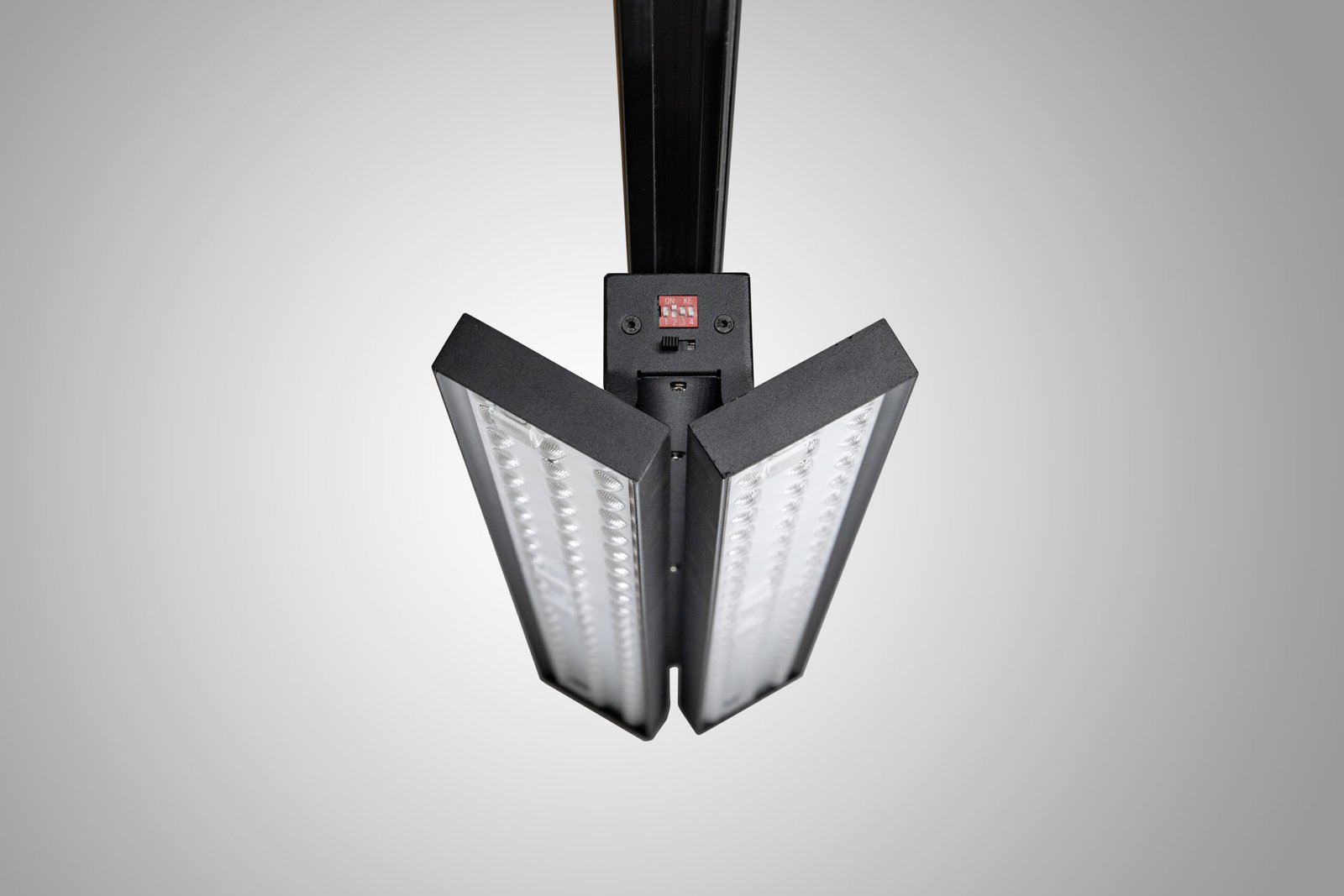
Our adjustable dual-panel LED track linear light is available with 60° and 90° beam options. A 60° distribution generally concentrates more light within a smaller area, while a 90° distribution spreads it more broadly. Neither is automatically better. The correct choice depends on distance to the shelf, target size, spacing and the illuminance required on the vertical plane.
| Project condition | Useful starting point | What to verify |
|---|---|---|
| Longer throw or a defined shelf zone | Consider 60° | Beam overlap, hot spots and intensity at the shelf |
| Low mounting height or broad close target | Consider 90° | Glare, spill light and sufficient vertical illuminance |
| Different targets on each side | Model both panels separately | Whether one optic serves both tasks or a custom combination is needed |
| Frequent layout changes | Choose the more forgiving verified layout | Performance after shelves or displays move |
Do not choose only from a beam-angle label. Ask for the actual polar curve, IES or LDT file and a calculation using the proposed mounting height. Beam angle describes part of the distribution; it does not tell you everything about edge softness, peak intensity, optical losses or glare.
5. Match the Power Package to the Calculation
The LL1615 dual-panel family currently includes 27 W, 40 W, 50 W and 60 W versions, with published nominal lumen outputs from approximately 4,393 lm to 9,079 lm depending on the model. These numbers are useful for initial comparison, but they are not a substitute for illuminance at the merchandise.
We recommend choosing the lowest verified power package that meets the maintained targets after allowing for the project’s maintenance assumptions. This usually gives you better control of energy, glare and thermal load than selecting the highest wattage “for safety.” If the space later needs less light, a correct control strategy is better than permanently operating an oversized luminaire.
When comparing supplier data, confirm:
- whether lumen output is measured for the complete luminaire;
- the tolerance and the test temperature;
- output for each CCT, CRI and optic combination;
- driver efficiency and power factor;
- dimming or switching behaviour required by the project;
- photometric files for the exact ordered configuration;
- thermal and lifetime information for the intended operating hours.
You can review the current model table on our adjustable dual-panel LED track linear light page. For a tender, ask us to confirm the final datasheet and test files against your order code rather than copying a general family value into the specification.
6. Use Independent Aiming Deliberately
The fixture body can rotate on the track and each panel can tilt independently. That range gives the commissioning team many possible positions, which is an advantage only when the final aim is documented. “Adjustable” should not mean “leave every installer to guess.”
A practical commissioning sequence is:
- Set all luminaires to a neutral reference position.
- Aim the first panel toward the centre of the left shelf target.
- Walk the aisle in both directions and check direct view of the optics.
- Measure vertical illuminance at upper, middle and lower shelf levels.
- Adjust tilt and spacing to reduce bright bands and dark gaps.
- Repeat the process for the second panel and right shelf.
- Check the floor and any central display after both panels are operating.
- Photograph or record the final aiming positions for future maintenance.
Do not judge the result from directly below the luminaire. Stand where customers choose products and where staff restock shelves. Check glossy packages, screens, polished shelves and labels. A layout that looks uniform in a rendered plan can still create reflected glare at eye level.
7. Compare One Dual-Panel Fixture With Two Separate Track Heads
A dual-panel luminaire may reduce the number of adapters and ceiling objects, but it is not always the lowest-cost or most flexible answer. Compare complete project outcomes.
| Decision factor | One dual-panel linear fixture | Two separate track heads |
|---|---|---|
| Ceiling appearance | Cleaner, fewer attachment points | More individual objects on the track |
| Aiming | Two directions from one position | Independent position and direction for each head |
| Electrical grouping | Usually treated as one luminaire configuration | May offer more circuit-level separation |
| Maintenance | One fixture to remove and service | One head can be replaced without removing the other |
| Target type | Efficient for broad linear shelf zones | Often better for small focal accents |
Request a small comparison calculation if the project is large. Include fixture quantity, connected load, track loading, installation time, controls and expected maintenance—not only the unit price. A slightly higher-priced luminaire can reduce labour and clutter, but only if its distribution genuinely replaces the alternative heads.
8. Confirm Track and Control Compatibility Before Ordering
Never approve a track luminaire from a photograph of the adapter. Similar-looking tracks may differ in conductor layout, dimensions, polarity, circuit selection and mechanical rating. For Europe or Australia, the project team should identify the exact rail brand and model, supply a section drawing or sample, and state the local voltage and required approvals.
Your pre-order checklist should include:
- track brand, profile and number of conductors;
- single-circuit or multi-circuit operation;
- adapter orientation and locking method;
- mechanical load permitted by the rail and suspension;
- input voltage and frequency;
- switched, phase, 0–10 V, DALI or other control requirement;
- emergency-lighting or monitoring interfaces, if applicable;
- required CE, RoHS, SAA or project-specific documentation;
- sample fit test on the actual rail before bulk production.
Our broader commercial track-lighting selection guide explains why compatibility, driver performance and optical choice should be verified together.
9. Run a Mock-Up Before the Rollout
A one-bay mock-up is one of the most cost-effective steps in a chain-store project. Install the proposed track height, shelf finish and representative merchandise. Test both beam options or power packages if the calculation leaves uncertainty. Ask design, operations and maintenance staff to review the same mock-up.
Record:
- vertical illuminance at multiple shelf heights;
- floor illuminance and uniformity;
- visible glare from both walking directions;
- reflections on glossy products and screens;
- colour appearance of priority merchandise;
- ease of aiming and whether the position holds securely;
- temperature, noise and dimming behaviour after warm-up;
- time needed to install, aim and label each fixture.
If the store format will be repeated, convert the approved settings into a commissioning sheet. That creates consistency across installers and prevents the next location from starting again by trial and error.
10. RFQ Information That Produces a Useful Proposal
To receive a meaningful quotation, send more than a target quantity. Include a reflected ceiling plan, section drawing, shelf elevation, track information, operating voltage, desired CCT and CRI, control protocol, required certifications, target delivery date and installation country. State whether you need IES/LDT files, DIALux support, samples or custom finishes.
We use that information to identify technical risks before production. If dimensions or performance assumptions are incomplete, we would rather highlight them early than provide a fast quotation that later requires changes. Our RFQ and sample approval checklist can help you organise the project package.
Frequently Asked Questions
Can both panels point in the same direction?
Yes, the panels can be aligned for a broader or stronger contribution toward one zone, subject to the mechanical range and verified photometric result. The final position should avoid self-obstruction and excessive glare.
Can one panel light a shelf and the other light the floor?
That is a practical use case. Treat the two targets separately in the calculation and commissioning process, because their distances, required coverage and acceptable intensity are different.
Does a dual-panel fixture always replace two luminaires?
No. It may replace two broad-distribution heads in a suitable layout, but it may not replace two independently positioned narrow spotlights. Compare distributions and target illuminance rather than counting heads.
Which beam angle should I order?
Use 60° or 90° only as a starting selection. Provide mounting height, aisle geometry and target illuminance so the supplier or lighting designer can model the exact configuration.
How many fixtures will my aisle need?
Quantity depends on photometric distribution, mounting height, spacing, reflectance and target uniformity. Request an IES/LDT-based calculation and verify a representative bay before the full rollout.
Final Decision Framework
A good retail aisle lighting design is not the one with the highest lumen figure or the greatest number of fixtures. It is the one that makes merchandise easy to see, keeps the walking route comfortable, adapts to operational changes and can be installed consistently across the project.
Use the dual-panel concept when two broad target zones must be controlled from one track position. Verify the track, model both panels, select power and beam angle from the calculation, then commission the installation from the customer’s viewpoint. If you share your plan and shelf section with us, we can help you compare options and identify the questions that should be resolved before sample approval.

