 跳到内容

Quick answer: A car showroom needs light that reveals vehicle shape and color while keeping bright luminaires from appearing as distracting streaks across paint, windscreens and display screens. Start with a vehicle and customer-view mock-up, then choose beam shape, mounting position and aiming. Do not approve the scheme from floor illuminance or a ceiling rendering alone.
Cars are large, curved and reflective. A glossy bonnet can show a whole row of ceiling lights as if it were a mirror; a dark roof can hide its contour if every beam lands on the floor. Customers also examine upholstery, wheels, documents and digital displays. A useful showroom scheme therefore balances broad ambient light, controlled vehicle accents and practical task light. This guide is for lighting buyers, designers and contractors preparing a specification or comparing luminaire samples.
Design from customer viewpoints, not only the reflected ceiling plan
List where customers first see a vehicle: through the shopfront, at the entrance, while walking around its side, from the driver’s seat and at the handover desk. The sales team may have a different view from a consultation table. A luminaire can make the front quarter panel look excellent while producing a bright line in the windshield from another position. Those are not contradictory test results; they are different sightlines.
Mark several viewing points on the floor plan. At each point, ask what should be visible: body curvature, finish quality, cabin detail, signage or the salesperson’s face. Treat glossy paint, glass and high-gloss floor tiles as potential reflective surfaces. The test is not simply whether there is enough light. It is whether the useful visual information remains legible without distracting reflected source images.
For a showroom with frequently moved cars, avoid a lighting arrangement that succeeds only at one exact parking position. Define display zones and an aiming procedure. Record the beam and aiming positions that work for a representative vehicle size, then check the extremes of the product range.
Build three layers of light
Ambient light makes the showroom navigable and keeps the space from looking like a series of isolated pools. Linear systems or carefully spaced downlights can support this layer. The choice depends on ceiling architecture, maintenance access, whether the lighting grid must move with the sales floor, and the desired visual identity.
Vehicle accent light draws attention to key cars and reveals body surfaces. Adjustable COB track spotlights may be candidates where the rail and adapter are compatible and the selected beam can be aimed without creating an objectionable reflected hotspot. Broad or oval distributions may be useful for certain surfaces; a narrow beam can emphasize a small feature but should not be spread across an entire car without testing.
People and task light supports discussions at desks, paperwork, keys, screens and delivery checks. Good vehicle presentation is not a reason to leave faces or documents dark. Equally, bright desk lighting should not spill into the driver’s eye line or the adjacent vehicle. Give task zones separate control where the project requires different operating hours or scenes.
These layers should not all be at maximum output to prove the room is “bright.” A commissioning visit can balance them after the furniture and cars are present. Lighting-controls advice in the U.S. Department of Energy’s LED and controls guidance reinforces the need to coordinate luminaires with control and commissioning decisions, rather than treating fixtures as isolated components.
Understand reflections before choosing beam angles
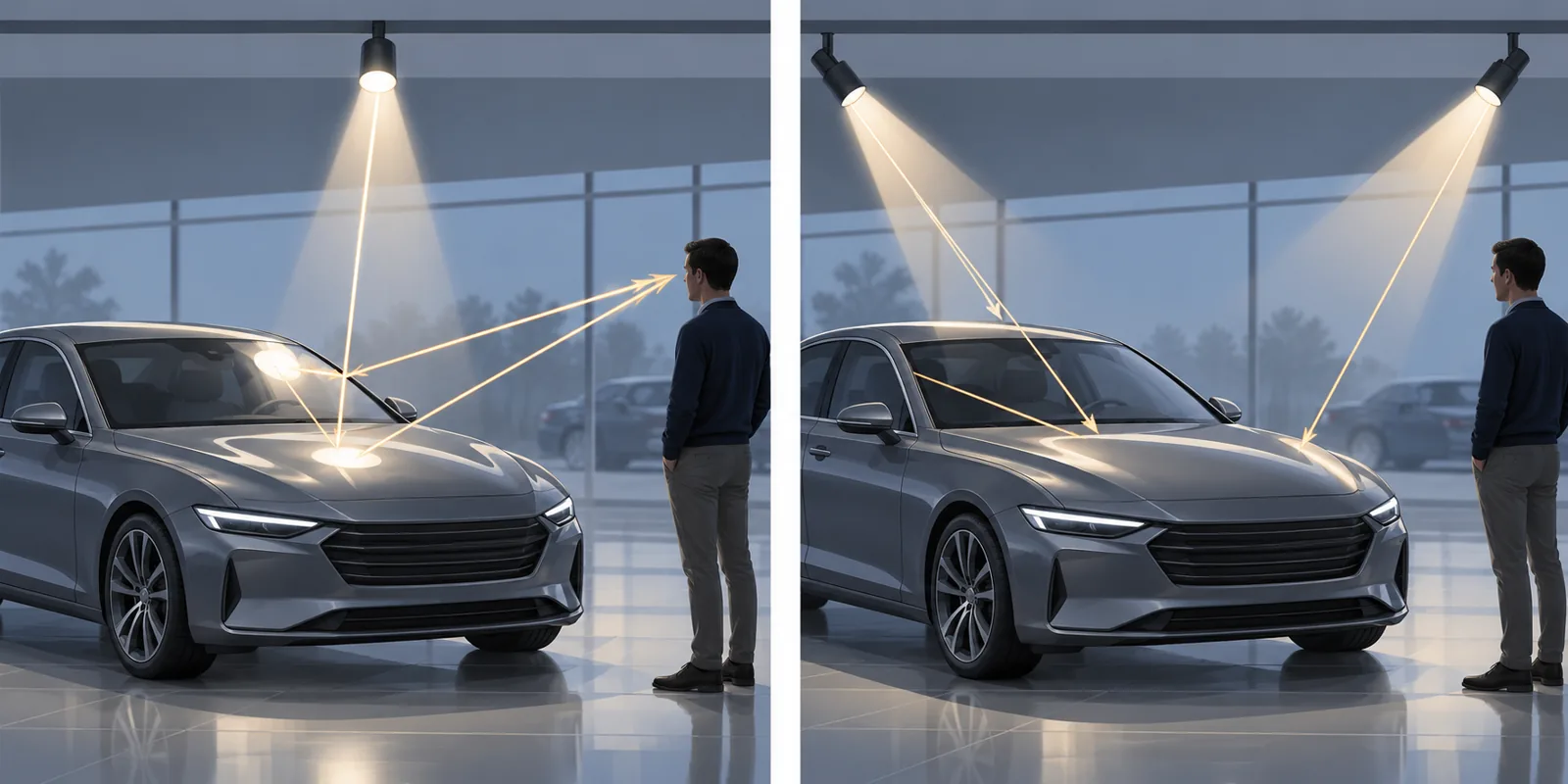
A reflection appears when the source, surface and observer align. On a curved car body this alignment changes continuously as the customer moves. High-output light alone cannot solve it. Large luminous areas may form long highlights; small intense apertures may become sharp dots. Either can be attractive in a controlled editorial photo and uncomfortable in a live showroom.
Use a physical mock-up with a glossy dark vehicle if possible, because it makes reflected source images easy to see. Add a light-colored car to check whether the scheme still reveals form. Observe the roof, bonnet, side panels, windscreen and rear glass from normal walking routes. Note where a line of luminaires repeats across the paint. If the effect is too strong, change fixture location, beam, shielding or aiming before increasing quantity.
Do not equate a nominal beam-angle number with the whole optical result. Two luminaires with the same advertised angle can have different spill, peak intensity and cutoff. Ask for the distribution data for the exact optic and compare samples on a vehicle. Our IES/LDT validation checklist explains how to request useful photometric files without assuming that a file alone predicts every reflection.
Use adjustable lighting without creating an unmaintainable scheme
A track system gives the showroom freedom to change displays, but that freedom needs rules. Verify the installed rail profile and circuit before specifying a fixture adapter. Confirm the mechanical capacity and any site restrictions with the rail manufacturer and qualified installer. Check the fixture’s body and adapter clearance in the actual ceiling; a spotlight may fit electrically yet obstruct a sprinkler, sign or service panel.
Aim and document each group of heads after the cars are in place. A simple annotated plan can show fixture position, target area, beam/optic, aiming reference and control zone. Train the merchandising team on what may be adjusted without losing the overall lighting balance. If cars move weekly, agree on a quick re-aiming check; if cars rarely move, lock down the approved scene. The track-rail load checklist covers part of the mechanical review.
Linear track lighting can provide broader coverage of an aisle or display zone. If considering an adjustable LED linear track light, verify the actual optical distribution and fixture appearance; do not assume it will behave like a spotlight or that a stock scene image represents the specified model. Use real samples for approval.
Check color under the final finish and controls
Vehicle paint, leather and textiles are reasons to ask for good color rendering, but a single color score does not guarantee that every finish will look right. Review a range of colors: black, white, silver, a saturated paint and interior trim. Ask for color information for the exact LED configuration. Compare the same car under showroom lighting and at an entrance where daylight affects perception. Strong daylight can make a fixed electric-light scene look different at noon and at dusk.
Color consistency matters across a large ceiling and across future replacement orders. A single visibly cooler replacement head can stand out in a neat track run. Request the manufacturer’s reorder and binning process, not just a general quality promise. If dimming is planned, test the selected driver and controls at the actual scene levels; flicker or color shift can appear when the display scene is reduced.
There is no universally correct color temperature for every showroom. The brand concept, daylight, floor and wall finishes, vehicle palette and customer expectation all matter. Decide with a mock-up instead of copying a number from an unrelated project.
Plan daylight, glass facades and screens together
Many showrooms are designed to be seen through large glazed fronts. Daylight changes throughout the day, while evening visitors may see reflections of the interior itself in the glass. Consider what the main vehicle looks like from outside both during daylight and after dark. Avoid a facade scene that overwhelms the sales floor or creates glare for someone looking through the window.
Tablet screens, vehicle infotainment displays and digital signage create a second reflection problem. Do not place a bright fixture so it reflects directly in common screen viewing positions. Test with the screens powered on, not just with blank glossy surfaces. A small adjustment in luminaire position or desk orientation can sometimes be more effective than a larger change in output.
Where daylight-responsive controls are used, commission them with real furniture and vehicles present. A sensor blocked by a display banner or aimed at a dark car roof may not behave as intended. Set zones around the actual daylight pattern and confirm that frequent changes in cloud cover do not produce distracting rapid dimming.
Mock-up and acceptance checklist
| Check | Look from | Acceptance evidence |
|---|---|---|
| Paint and body shape | Entrance, front quarter, side walk | Useful contours without unwanted repeated source images |
| Windscreen and displays | Driver seat and normal screen positions | Readable glass and screens without dominant glare |
| Color appearance | Beside vehicle and from facade | Representative paints and trim acceptable in day and evening scenes |
| Sales task | Desk, handover and document stations | Faces, papers and keys visible without distracting spill |
| Controls and re-aiming | Staff operating position | Approved scenes and aiming map that staff can reproduce |
Write down what the mock-up actually demonstrates. A photograph may record appearance, but it should not replace the written fixture list and aiming notes. If a supplier changes the optic, LED board, driver or adapter after approval, ask whether the original acceptance remains valid. A different-looking or differently performing unit should not silently enter a later rollout under the same informal description.
Buying questions for OEM and multi-site programs
- Can the supplier provide the exact optic and driver used in the sample, not only a family brochure?
- Is the proposed track adapter compatible with the installed rail and circuit, and who verifies it?
- What ceiling clearance and service access are needed for the actual fixture?
- Can replacement units be color-matched and will the chosen finish remain available?
- How will each site receive the approved aiming plan and control scene?
- What happens when a store changes vehicle positions or adds a display screen?
Price comparison should use an equivalent scope. A quote that excludes compatible adapters, aiming labor or control integration is not directly comparable with a complete one. Request sample approval before volume production and agree which changes require a new mock-up.
Frequently asked questions
Are track spotlights suitable for car showrooms?
They can be useful for flexible vehicle accents when the rail, adapter, beam and aiming are verified. They are not a complete lighting design by themselves; ambient and task layers still matter.
What is the best beam angle for a car?
There is no single angle for every vehicle or mounting height. The useful choice depends on the distance to the target, desired feature, surface reflectance and optic distribution. Test the actual beam on representative cars.
Why do LED strips appear across paint?
Glossy curved paint reflects luminous surfaces. Long linear sources can appear as repeated lines or bands from certain viewpoints. Adjust their position, shielding and relative brightness, or use a different distribution after a physical test.
Should the showroom and sales desks share one dimming zone?
Not automatically. Vehicle presentation and paperwork have different tasks and may require different operating scenes. Coordinate control zones with layout and customer routes.
Can an IES file replace a showroom mock-up?
No. Photometric data helps compare and model distribution, but the final reflections on cars, glass and screens depend on real surfaces and viewing positions. Use both analysis and a physical or full-scale sample.
The images for this article are explanatory concepts, not photographs of a supplied LCB showroom project. Product details, compatibility and compliance must be confirmed for the specific order and installation.
