 跳到内容

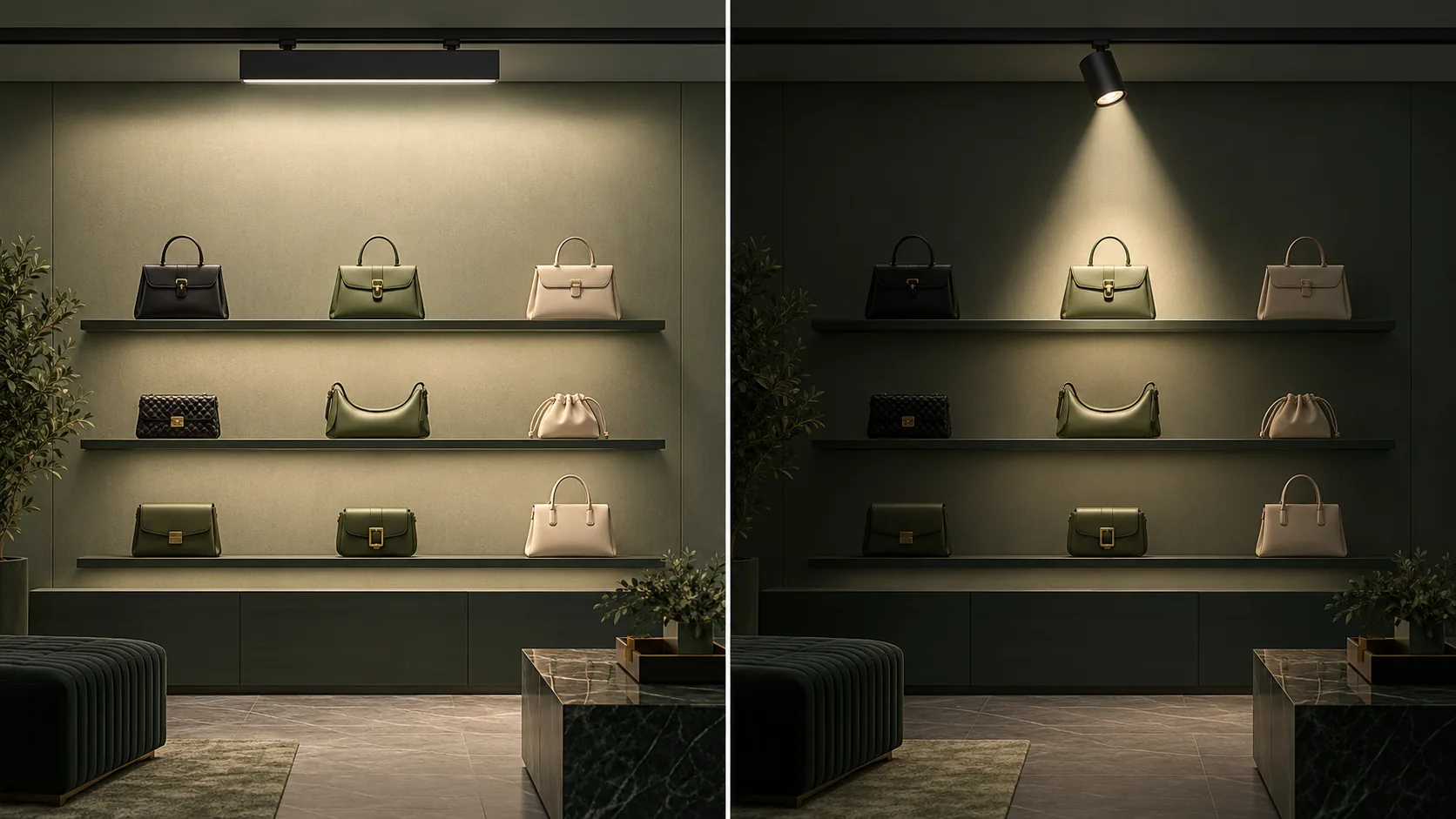
Track wall washer vs spotlight: choose a wall washer when the main job is to illuminate a broad vertical surface evenly; choose a COB spotlight when the job is to draw attention to a particular product or small display. Many retail feature walls need both. The decision should be based on the merchandise, wall geometry, aiming positions, ceiling height and maintenance plan—not on which fixture looks more dramatic in a rendering.
This guide compares the two beam strategies for boutiques, showrooms and other commercial interiors. It is a planning framework, not a substitute for a calculation using the exact fitting and a sample installation. LCB’s track wall washer and COB LED track spotlight are product starting points; confirm the currently quoted optical and electrical variants before approving a project.
First define the visual job of the wall
A “feature wall” is not one lighting task. It might be a flat branded backdrop, a run of shelves, a hanging rail, framed art, irregular mannequins or a mix of those. A uniform wall of light can make a space feel larger and help a brand surface read clearly from the entrance. A pool of accent light can make one item stand out. Neither effect is automatically better; the useful effect depends on where the customer’s eye should go.
Walk the store plan from the customer’s approach path. Identify the part of the wall that must remain visible when fixtures, shelves and people are in place. Mark the top and bottom of the merchandise zone, not merely the full architectural wall. A scheme that looks beautifully uniform on an empty wall may leave a shelf front or hanging garment in shadow once merchandising is installed.
For each zone, write a one-sentence intent. Examples include “make the entire graphic backdrop legible,” “highlight three hero products,” and “keep garment colors consistent across a long rail.” This simple step prevents the specification from becoming a list of wattages with no visual outcome.
What a track wall washer does
A wall washer is designed to spread light over a broad vertical area. It is useful when consistent wall brightness is the primary aim: long graphics, panels, broad display surfaces and certain shelf systems. The goal is not necessarily perfect laboratory uniformity. The practical goal is to avoid distracting scallops, hard-edged bright spots and dark gaps across the area that customers see.
Wall-washing performance changes with mounting distance, aiming angle, spacing between luminaires and the wall’s texture and finish. A textured wall can reveal small variations that a smooth matte surface hides. Glossy panels may create reflected glare even if a lighting calculation shows good coverage. For that reason, request a photometric file for the exact optic and test the luminaire against the actual or representative wall finish.
A wall washer cannot solve every merchandising problem. If a large product projects outward from the wall, it may cast a shadow onto the surface behind it. A continuous wash can also flatten a display that needs hierarchy. That is where a separate accent layer becomes valuable.
What a COB track spotlight does
A COB spotlight concentrates light into a more defined beam. It can emphasize a mannequin, a bag, an artwork or a small product grouping. Its adjustable head can help a store respond to changing displays, provided there is enough movement range and the adapter is compatible with the installed track. Some optics offer a narrower visual accent; others are broader and softer. The exact beam is a product option to verify, not something to infer from “COB.”
Spotlights introduce their own risks. Point several narrow beams at a long rail and the result may be bright-dark-bright along the merchandise. Aim too steeply and the fitting can create an uncomfortable glare path or hard shadow. Add too many heads and the ceiling looks cluttered while connected load and maintenance points increase.
One focused beam may be exactly right for a changing hero display. It is usually not an efficient substitute for a wide, even wash across a long graphic wall. A broader spotlight can cover more area, but then it should be assessed as a distribution choice, not as proof that all spotlights and wall washers are interchangeable.
Comparison at a glance
| Design question | Track wall washer | COB track spotlight |
|---|---|---|
| Primary visual effect | Broad vertical coverage | Defined accent and hierarchy |
| Best starting use | Long walls, graphics, broad displays | Hero products, mannequins, focal objects |
| Common failure | Scallops or poor top-to-bottom coverage | Patchy pools, glare or hard shadows |
| Layout variable to test | Setback, spacing and wall finish | Beam, aim and target size |
| Future merchandising changes | Stable background layer | Re-aimable emphasis layer |
This is a comparison of lighting roles, not a claim that one product category is always more efficient or more comfortable. Those outcomes depend on the selected fixture, room, controls and operating schedule.
Plan the track position before choosing a beam
The track is the physical starting point. Record its distance from the wall, mounting height, circuit type, feed position and structural fixing. Then check the actual target plane. If the goal is a full-height wall wash, the needed geometry differs from a beam aimed at a display table or shelf near eye level. A track installed for accent lighting may be too close, too far or badly positioned for a clean wash.
Do not assume an existing rail accepts every new adapter. Confirm mechanical fit, electrical compatibility, polarity or circuit selection where applicable, and the clearance needed for any driver housing or swiveling head. For refits, obtain a sample adapter and test it on a representative section of the existing track before ordering a store-wide quantity.
Show the track and the merchandise in the same drawing. A plan that shows only ceiling positions misses the relationship between beam and product. Include shopfitting dimensions, shelf depths, fascia height, sign position and any architectural obstruction that can interrupt the light.
Use two lighting layers when the brand needs both consistency and drama
A useful retail solution often has a quiet base of vertical illumination plus a smaller number of accents. The wall-wash layer makes the background readable and keeps product colors reasonably consistent across the wall. Spotlights then emphasize a seasonal launch, a mannequin or a premium object. This makes hierarchy possible without leaving the rest of the feature wall in darkness.
Put the layers on controls that reflect their jobs. A fixed background level and re-aimable accents can be easier to manage than a long rail of identical spots. If dimming or separate circuits are required, specify the exact adapter, track, driver and control method. “Dimmable” by itself is not a complete controls schedule.
For a changing store format, label the aiming positions and record the approved scene. Store teams can then refresh displays without accidentally turning every spotlight toward the same shelf or creating a glare problem at the entrance.
Check color appearance on the actual goods
Retail light is judged on merchandise, not just on the white wall behind it. Test representative fabrics, packaging, skin tones or produce under the proposed lamp and optic. Compare items across the washed zone and the accent zone. A noticeable color shift between layers can make a product look inconsistent when customers move it from display to fitting room or checkout.
Ask for the exact color specification for every quoted variant and sample the intended CCT in the actual setting. Color-rendering metrics are useful comparison inputs, but they cannot substitute for looking at critical merchandise under the proposed system. If replacement heads will be added later, agree a color-matching and spare strategy now.
Mock-up: the fastest way to avoid a wrong rollout
Build a representative bay with the real wall finish and real merchandise. Install the proposed wall washer and spotlight at their intended track positions. View it from the entrance, aisle, close-up shopping position and the point where customers approach the display. Photograph the result with the camera settings recorded, but judge it in person too; automated camera exposure can hide bright spots and dark gaps.
Change one variable at a time: setback, spacing, beam choice or aiming angle. Record the final position and product code. Test a normal operating scene and the strongest promotional scene. Check whether the visual effect is maintained when adjacent lights are dimmed, because a standalone mock-up can make a product look more impressive than it will in the finished store.
Pay attention to installation details that affect appearance: adapter orientation, head position, visible cable, finish color and whether the rail itself creates a clean line. If a fixture is expected to rotate frequently, verify that adjustment remains smooth and secure after repeated use.
What to include in the RFQ
Send the supplier a plan and elevation of the feature wall, the merchandise zone, the proposed track position and photographs of the actual finish. State whether the priority is uniform background light, focused accents or a layered scheme. Request the current datasheet, IES or LDT file for the selected optic, adapter compatibility information, control and driver details, installation instructions and sample availability.
For a multi-store program, add a repeatable aiming and acceptance method. The quote should identify the exact finish, optics, CCT, controls, adapter and accessories—not just a family name. Ask what changes if the track system or local electrical requirement differs between markets. Avoid treating a generic product photo as proof of the configuration you are purchasing.
Where the wall is part of a gallery or architectural feature and a ceiling-recessed solution is preferred, compare the recessed wall-washer downlight as a separate installation strategy. It may be visually quieter, but it changes ceiling coordination and service access.
Common mistakes
- Using a spotlight array to simulate a broad wall wash. This can create visible pools and gaps. Test a wall-washer optic if continuity is the goal.
- Washing an empty wall but ignoring the merchandise. Include shelving, rails and objects in the mock-up.
- Specifying only wattage and CCT. Beam, mounting geometry and product-facing light matter at least as much.
- Assuming all track adapters fit. Verify the installed track physically and electrically.
- Skipping the controls scene. The layered effect must work at normal operating levels, not only at full output.
Frequently asked questions
Can a wide-beam COB spotlight replace a wall washer?
Sometimes it can cover a modest area adequately, but the distributions are not identical by definition. Compare photometry and a full-scale wall mock-up for the actual distance, wall finish and target height.
How far from the wall should the track be?
There is no universal setback. It depends on mounting height, wall height, optic and target zone. Use the selected fitting’s photometry to make an initial layout, then verify a sample on the real or representative wall.
Should the accent lights be brighter than the wall wash?
They should create the intended hierarchy without uncomfortable contrast. The useful ratio depends on the merchandise and ambient environment. Test the whole scene in operation instead of using a single generic ratio.
Can the same rail support both types of fitting?
Potentially, but confirm adapter and electrical compatibility, circuit capacity, control method and physical clearance for the exact fixtures. Do not assume compatibility from similar-looking rails.
What if the display changes every season?
Keep a stable background layer and choose re-aimable accents for changing focal products. Record approved aiming positions and train the store team to reset them safely.
Next step
Before ordering, send a feature-wall elevation, merchandise dimensions and track details. Compare an exact wall-washer option with an exact COB track spotlight option in one representative bay. The best design is the one that makes the intended goods legible and appealing from the customer’s real viewing positions.
