 跳到内容
跳到内容 
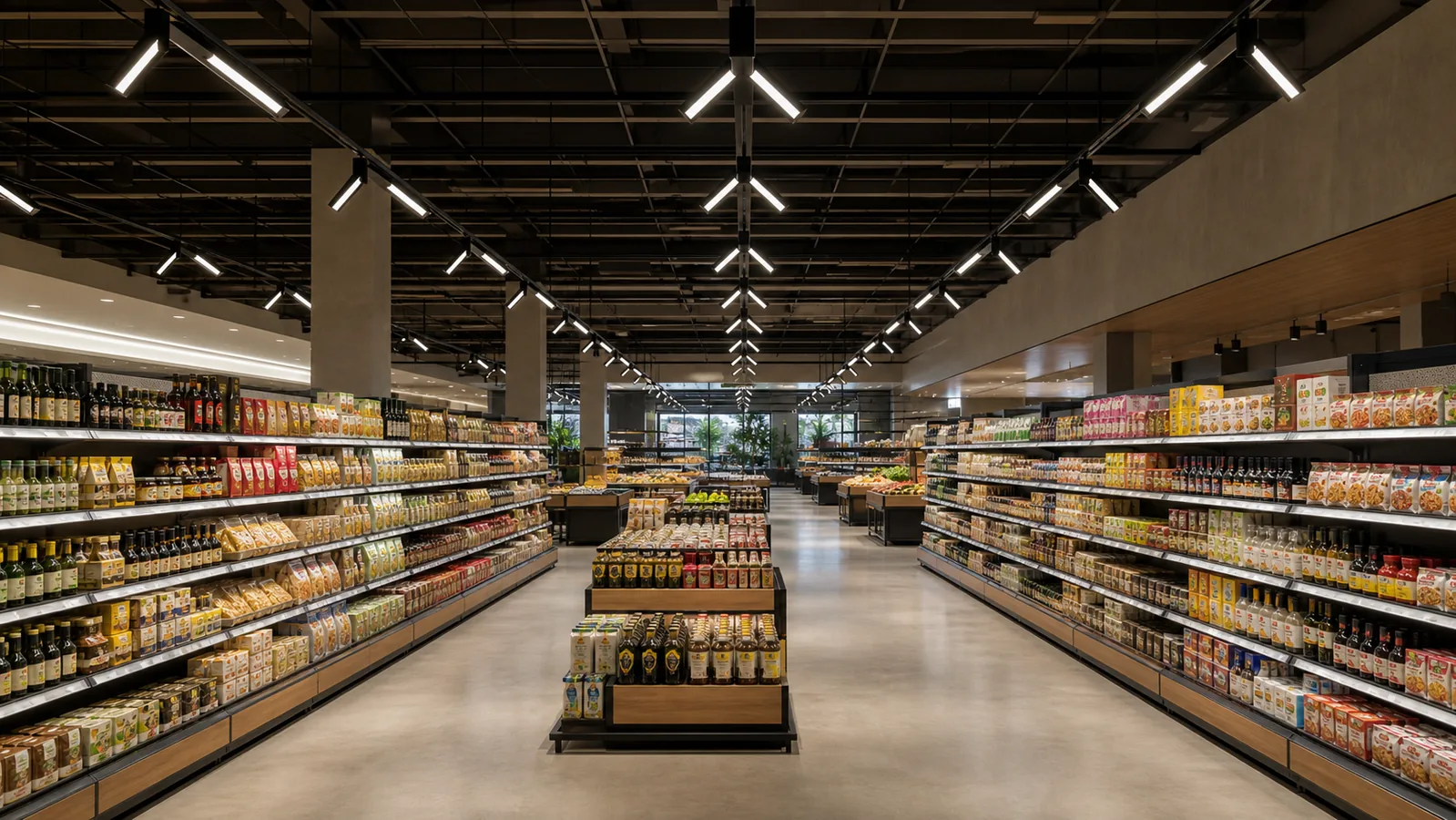
Linear track lights are becoming a practical choice for retail stores that need more consistent aisle and shelf illumination without giving up the flexibility of a track system. Compared with a conventional round spotlight, a linear light source spreads illumination over a longer area. When that linear fixture uses two independently adjustable panels, one track position can serve both sides of an aisle—or combine broad ambient coverage with focused merchandise lighting.
This guide explains where a dual-panel design works best, how to plan the layout, and which specifications retail lighting buyers should confirm before ordering.
What Are Linear Track Lights?
A linear track light combines an elongated LED light engine with a track adapter. Like other track-mounted luminaires, it can be repositioned along a compatible track and aimed after installation. The difference is the shape of the luminous area: instead of producing a concentrated circular beam, a linear fixture is designed to distribute light across shelves, racks, counters, or wider floor zones.
This makes linear track lighting useful in supermarkets, convenience stores, showrooms, pharmacies, fashion stores, warehouse retail, and other spaces where merchandise is arranged in long rows. It can help reduce the visual patchiness created when narrow spotlights are spaced too far apart.
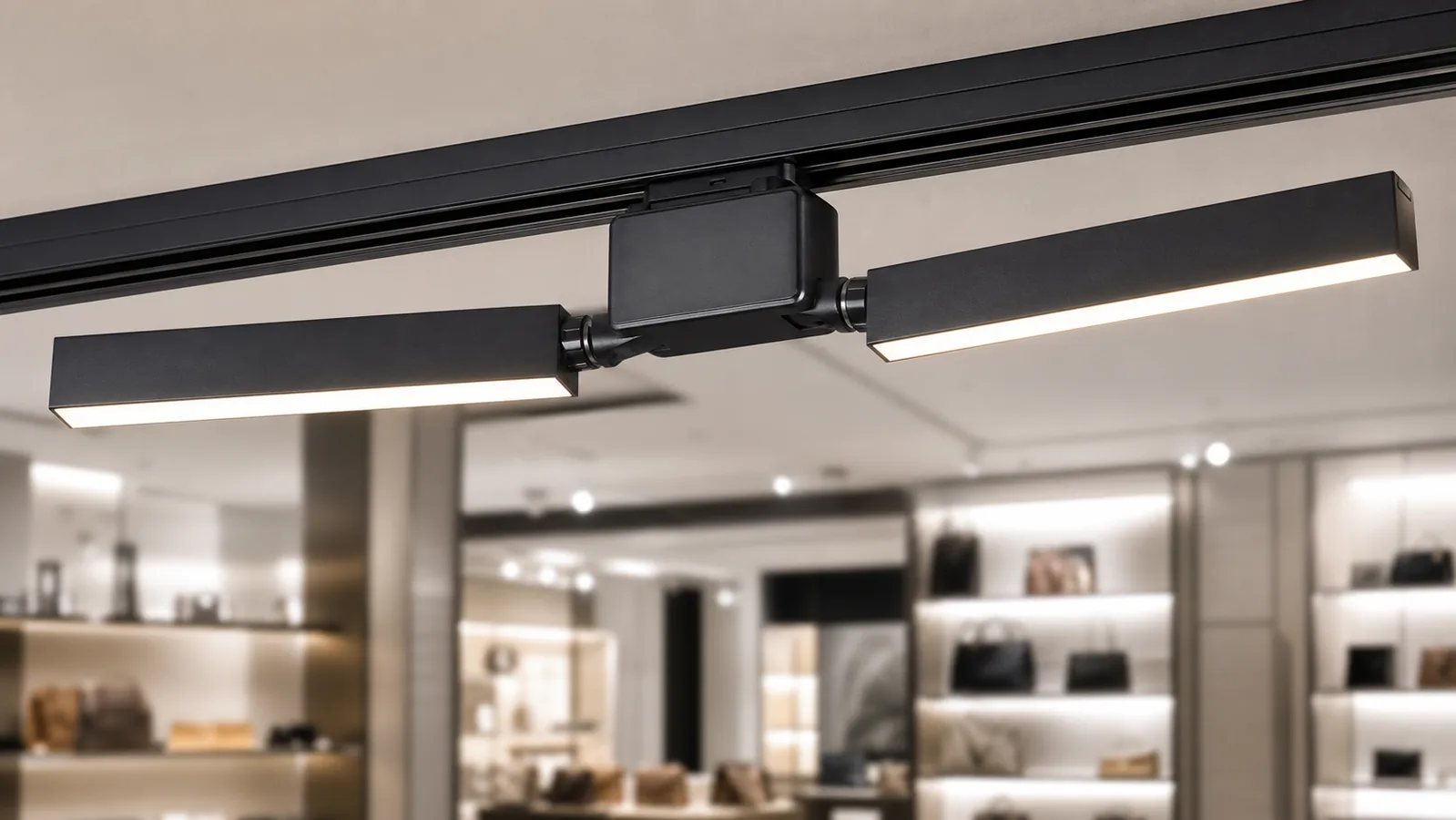
A dual-panel linear track light adds another degree of control. Its two light-emitting panels can be adjusted separately, so a designer can aim each panel toward a different target.
Why a Dual-Panel Design Works for Retail Aisles
Retail lighting is not only about achieving a target lux level on the floor. Products are normally viewed on vertical shelf faces, so useful illumination must reach labels, colors, packaging, and display surfaces from top to bottom.
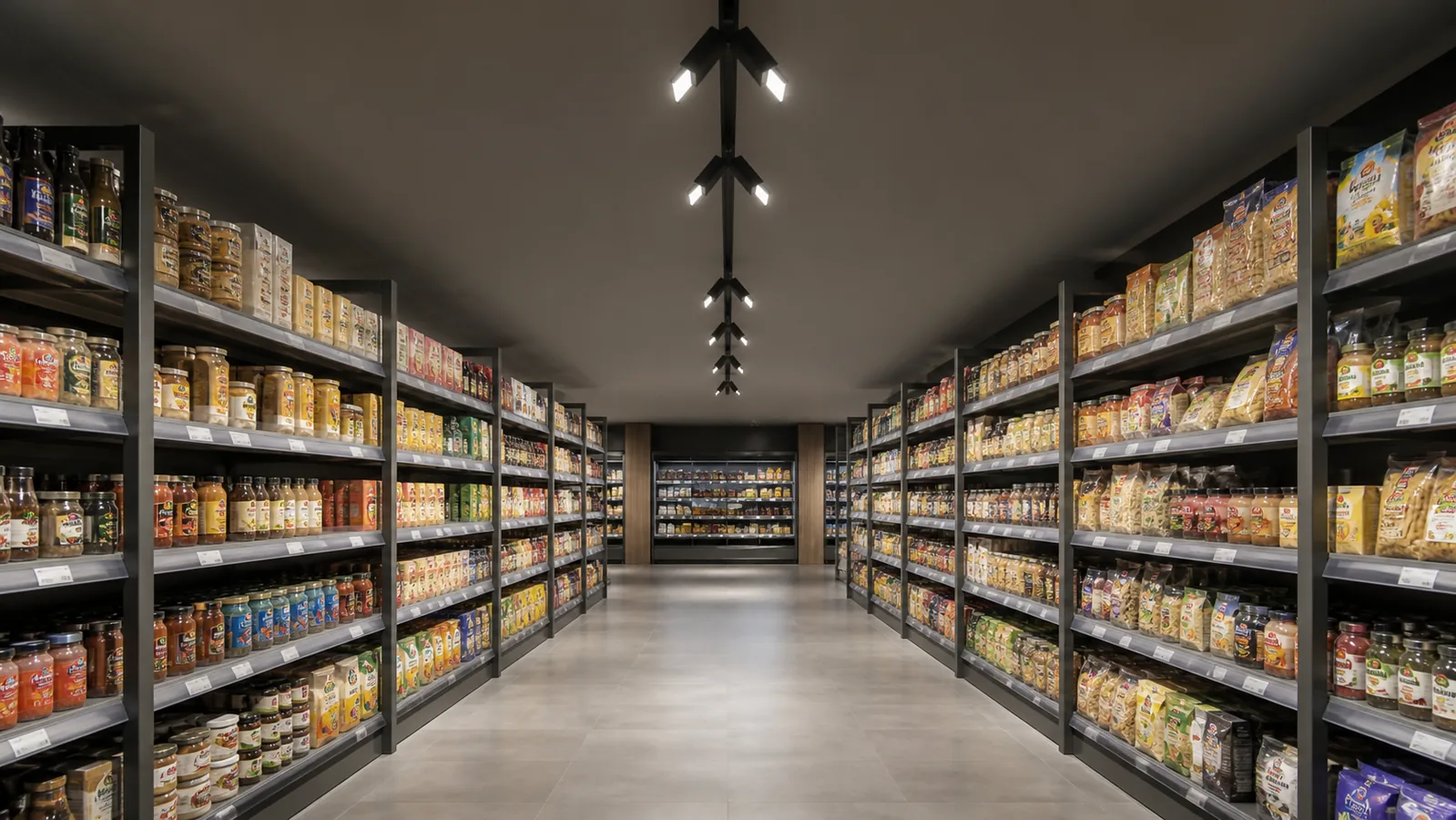
In a typical aisle, a single dual-panel fixture can be positioned above the centerline and aimed outward:
- Panel one illuminates the left-hand shelf face.
- Panel two illuminates the right-hand shelf face.
- The overlap between the two distributions keeps the central aisle comfortable and navigable.
Because the panels can be aimed independently, the same luminaire can also support asymmetrical layouts. One panel may wash a high wall bay while the other provides general light over a promotional island. This flexibility is particularly valuable when store displays change seasonally.
Planning Coverage, Spacing, and Aiming
There is no universal spacing rule for linear track lights. The correct layout depends on mounting height, aisle width, shelf height, beam distribution, output, surface reflectance, and the required uniformity. A photometric calculation using the manufacturer’s IES or LDT file is the most reliable way to verify a project.
Start with the merchandise, not the floor
Identify the surfaces customers need to see: shelf fronts, gondola end caps, wall displays, counters, or hanging garments. Then aim the panels so the main light reaches those vertical targets without placing a harsh reflection in the customer’s normal viewing direction.
Match beam distribution to aisle geometry
A narrower distribution can be useful at greater mounting heights or for concentrated wall displays. Wider distributions can create smoother coverage in lower ceilings and broad aisles. For a dual-panel fixture, the angle between the two panels is just as important as the nominal beam angle.
Check uniformity and glare together
Reducing fixture spacing may improve uniformity, but excessive brightness at high viewing angles can create discomfort. Review shielding, diffuser quality, aiming angle, and luminance—not only total lumens. Mock-ups are especially helpful in stores with glossy packaging, glass doors, or polished floors.
Dual-Panel Linear Track Lights vs. Conventional Track Spotlights
The two fixture types solve different lighting tasks. Track spotlights are effective for highlighting a mannequin, sign, feature table, or premium product. Linear track lights are generally better suited to continuous merchandise rows and broader visual fields.
| Design factor | Dual-panel linear track light | Traditional track spotlight |
|---|---|---|
| Typical coverage | Elongated, broad, or two-directional | Concentrated circular or oval beam |
| Best retail task | Aisles, shelves, wall bays, general merchandise | Accent displays, signs, mannequins, focal products |
| Aiming flexibility | Two independently adjustable panels | One adjustable light head |
| Visual rhythm | Continuous and uniform | Dramatic and contrast-driven |
Many stores benefit from a hybrid approach: linear fixtures provide the base layer, while spotlights add contrast at promotional zones. For a fuller comparison, see our guide to dual-panel track lights versus traditional track spotlights.
Where Linear Track Lighting Performs Well
Supermarkets and grocery aisles
Long shelving runs need clear labels and consistent color appearance. Dual-panel fixtures placed over aisle centerlines can direct light to both shelf faces while keeping the ceiling layout orderly.
Convenience stores and pharmacies
Compact stores often mix wall shelving, freestanding gondolas, and checkout displays. Adjustable panels make it easier to respond to these different orientations without installing a separate fixed luminaire for every zone.
Fashion and lifestyle retail
Linear distributions can illuminate garment racks and wall bays evenly. Spotlights can then be added where stronger modeling or visual hierarchy is required.
Warehouse retail and showrooms
Higher ceilings and wide displays demand enough output and controlled distribution. Track mounting also preserves flexibility when shelving or product categories are reorganized.
Choosing Wattage and Light Output
Higher wattage does not automatically produce a better retail environment. The appropriate output should be selected from the mounting height, target illuminance, spacing, beam distribution, and existing ambient light.
For projects that use selectable-power models, 27 W, 40 W, 50 W, and 60 W settings can help standardize one fixture family across several zones. Lower settings may suit lower ceilings or circulation areas, while higher settings may be required for tall shelves and elevated tracks. See our practical guide to selecting track light wattage.
A DIP switch used for wattage selection is not the same as a dimming control. Power should be switched off before changing a selectable-power setting, and the driver, wiring, and control protocol must match the project specification.
Color Quality, CCT, and Visual Comfort
Color rendering matters because customers judge products by appearance. Confirm the specified CRI and review color fidelity and gamut data when accurate product colors are critical. The Illuminating Engineering Society’s TM-30 guidance can provide a more complete view of color rendition than a single CRI number.
Correlated color temperature should support the merchandise and brand atmosphere. Warm-neutral light may suit hospitality-led retail and fashion, while neutral white is common in supermarkets and general merchandise. Consistency between batches is as important as the selected CCT.
For visual comfort, evaluate diffuser appearance, shielding, flicker performance, and glare at realistic viewing angles. The store mock-up should include the actual ceiling height, shelves, and reflective packaging whenever possible.
Track Adapter and System Compatibility
A track-mounted fixture must match the electrical and mechanical track system used on site. “Three-phase” or “three-circuit” descriptions do not guarantee that every adapter fits every track profile. Confirm the adapter brand or standard, conductor arrangement, voltage, load capacity, and control requirements before production.
For international projects, review our three-phase track adapter compatibility guide. A sample fitting test is a sensible step when the existing track brand cannot be verified from drawings.
Retail Lighting Procurement Checklist
Before approving a dual-panel linear track light, request the following information from the supplier:
- IES or LDT photometric files for the exact wattage and optic
- Fixture efficacy, delivered lumens, beam distribution, and power factor
- CRI, CCT, color consistency, and relevant TM-30 data where needed
- Driver brand, flicker data, dimming protocol, and surge protection
- Track adapter type and confirmed compatibility
- Panel rotation range and mechanical locking method
- Thermal design, operating temperature, warranty, and lifetime basis
- Safety and EMC certifications required by the destination market
- Production sample, packaging details, lead time, and spare-parts policy
The IES Recommended Practice for Lighting Retail Spaces is a useful reference for project teams developing more detailed criteria.
Final Recommendation
Linear track lights are a strong option when a retail project needs broad, adaptable merchandise illumination from a flexible track infrastructure. A dual-panel design is especially effective in aisles because it can direct light toward two shelf faces from one mounting position.
The best result still depends on photometric validation. Select the wattage and distribution from the real geometry, confirm track compatibility, and evaluate glare and color quality with a sample. At Lowcarbon, we support OEM and ODM retail lighting projects with configurable wattage, optics, finishes, adapters, and project-specific documentation. Contact our team to discuss your store layout or request a sample.
Frequently Asked Questions
Are linear track lights suitable for supermarkets?
Yes. Their elongated distribution can provide consistent illumination along shelves and product rows. Dual-panel versions are particularly useful when one track line must serve both sides of an aisle.
What is the advantage of a dual-panel track light?
Two independently adjustable panels can illuminate different targets from one track adapter. This increases layout flexibility and can reduce the number of fixture positions needed for two-directional coverage.
How far apart should linear track lights be installed?
Spacing depends on mounting height, output, beam distribution, aisle width, shelf height, and the required uniformity. Use the exact fixture’s photometric file to calculate spacing rather than relying on a universal rule.
Can linear track lights replace track spotlights?
They can replace spotlights for broad shelf or aisle coverage, but spotlights remain useful for high-contrast accents. Many retail stores combine both fixture types.
Which color temperature is best for retail stores?
The answer depends on the merchandise and brand. Warm-neutral light can create an inviting atmosphere, while neutral white is widely used for clear visibility in supermarkets and general retail. Color consistency and rendering quality should also be specified.
Can selectable-wattage track lights be dimmed?
Not necessarily. A wattage-selection switch sets the fixture’s maximum power and is different from a dimming interface. Dimming requires a compatible driver and control protocol.

