 跳到内容
跳到内容 
Choosing retail track lighting is rarely as simple as comparing wattage or lumens. A buyer may ask for “the brighter fixture,” but the real question is where the light must go. Do you need long, even illumination across two shelf faces? Or do you need a controlled beam that makes one mannequin, sign or promotional product stand out?
This matters because the wrong optical format can create dark shelf zones, excessive contrast or a ceiling crowded with luminaires. It can also make future store changes harder.
At Lowcarbon, we manufacture both broad-coverage and accent-oriented LED lighting. Our practical view is that a dual-panel track light is not a universal replacement for a traditional track spotlight. Each has a different job. This guide compares the two formats objectively and explains when a mixed design delivers the best commercial result.
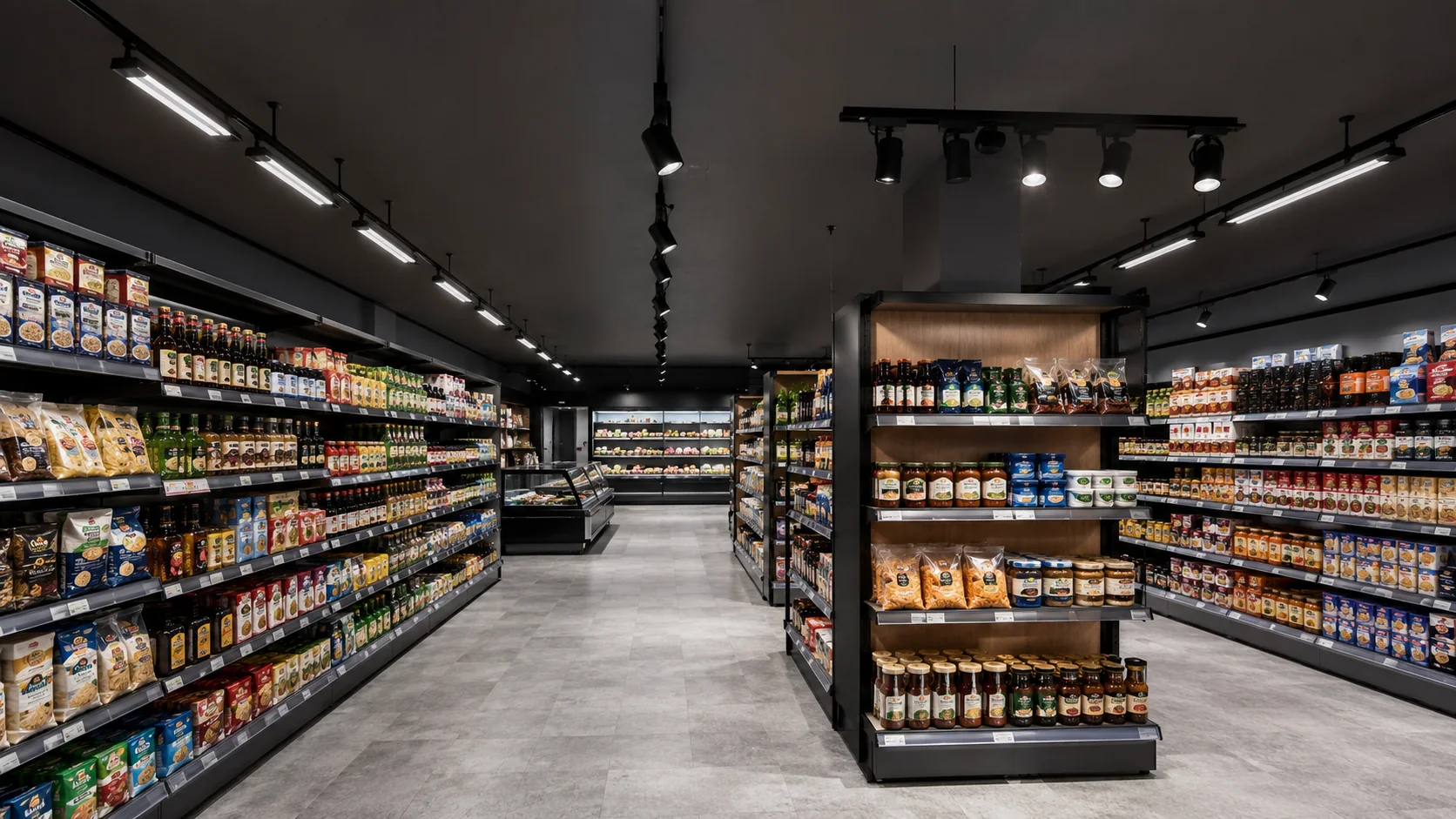
Conceptual retail scene showing broad linear coverage supported by focused track spotlights.
What Is the Functional Difference?
A dual-panel track light uses two elongated LED panels on one track-mounted body. Each panel can be aimed independently, so one fixture can send light in two directions or overlap both panels onto a wider target. The linear luminous surface and relatively wide beam are suited to shelves, aisles and large merchandise zones.
Our LL1615 adjustable dual-panel LED linear track light is designed around this idea. Its body rotates through 350°, while each panel tilts ±90°. Published options include 60° and 90° beam angles and four DIP-switch wattage settings: 27W, 40W, 50W and 60W. These details must still be confirmed against the exact driver, adapter and market configuration ordered.
A traditional track spotlight normally has one compact cylindrical or box-shaped head with a round beam. Narrow, medium, wide-flood or zoom optics let the designer place light on a smaller target. This format is especially effective when contrast, visual hierarchy and precise aiming are more important than broad uniformity.
Official guidance from ERCO on track spotlights describes them as movable luminaires for flexible accent lighting in shops and galleries. Some spotlight families also provide zoom beams; ERCO Parscan, for example, lists 15° to 65°. This illustrates the spotlight’s core advantage: optical precision.
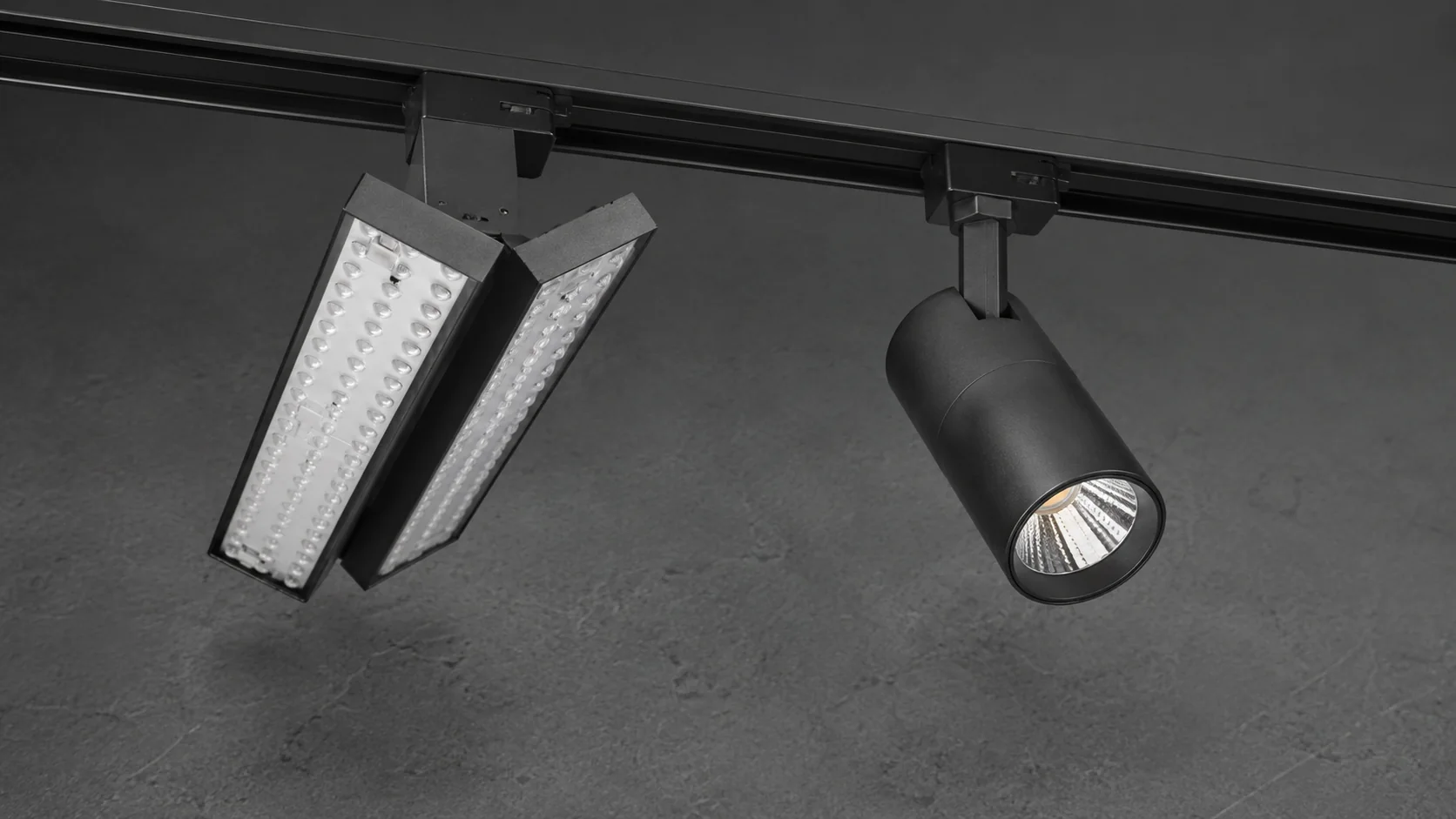
The two fixture formats have different emitting areas and beam-control priorities.
Dual-Panel Track Light vs Traditional Track Spotlights: Detailed Comparison
| Selection point | Dual-panel linear track light | Traditional track spotlight |
|---|---|---|
| Beam character | Broad, elongated coverage from two panels | Round, controlled spot or flood beam |
| Main purpose | Uniform shelf, aisle and open-area lighting | Accent, display and visual-hierarchy lighting |
| Aiming | Two independently adjustable luminous panels | One adjustable head per fixture |
| Coverage per track point | Can illuminate two shelf faces or one wide zone | Usually illuminates one defined target |
| Contrast | Lower to moderate; supports visual comfort and continuity | Moderate to high; attracts attention to selected merchandise |
| Uniformity | Often easier across long linear merchandising runs | Requires careful spacing and beam overlap for uniform coverage |
| Fixture quantity | May reduce the number of track points in suitable aisle layouts | More heads may be needed for large continuous areas |
| Layout flexibility | Strong when shelves stay in long, repeatable zones | Strong when displays move or individual targets change often |
| Ceiling appearance | Larger fixture, but potentially fewer units | Smaller heads, but a high quantity can create visual clutter |
| Best applications | Supermarkets, warehouse retail, shelf aisles, broad wall bays | Fashion displays, galleries, windows, counters, signage, hero products |
| Main limitation | Less precise than a narrow-beam spotlight | Can produce patchy general lighting or require many fixtures |
The fixture count row needs careful interpretation. A dual-panel product may replace several spotlights on continuous shelving, but there is no fixed replacement ratio. Mounting height, aisle width, target illuminance, optics and spacing all change the result. Request an IES or LDT file and run a project calculation before finalizing quantities.
The Illuminating Engineering Society’s recommended practice for retail spaces treats retail lighting as more than a single lux value. Horizontal and vertical illuminance, uniformity, lighting quality and energy efficiency all need attention. A specification should therefore compare delivered light on merchandise—not only lumens on a datasheet.
Where Dual-Panel Track Lights Perform Better
The strongest use case is a long aisle with products on both sides. One panel can aim left and the other right, putting light on the vertical merchandise surfaces customers actually see.
Dual-panel track lights are especially practical for:
- supermarket and hypermarket aisles;
- home-improvement and warehouse-style stores;
- long gondola runs and double-sided shelving;
- broad wall bays with many products;
- spaces that need both shelf-face and walkway illumination;
- projects that want adjustable output from a shared SKU.
For distributors, the DIP switch can add commercial value. The same LL1615 platform can be set to 27W, 40W, 50W or 60W. This can simplify inventory when several store types use the same housing but need different outputs. It also gives contractors a commissioning option if a site differs from the plan. Record the final setting, and make adjustments only according to the instructions with power safely isolated.
The two panels also improve field aiming: they may serve opposite shelves, or divide light between a wall bay and walkway. Broad coverage still needs glare control. Avoid aiming bright panels into normal sightlines, especially near checkouts or at low mounting heights.
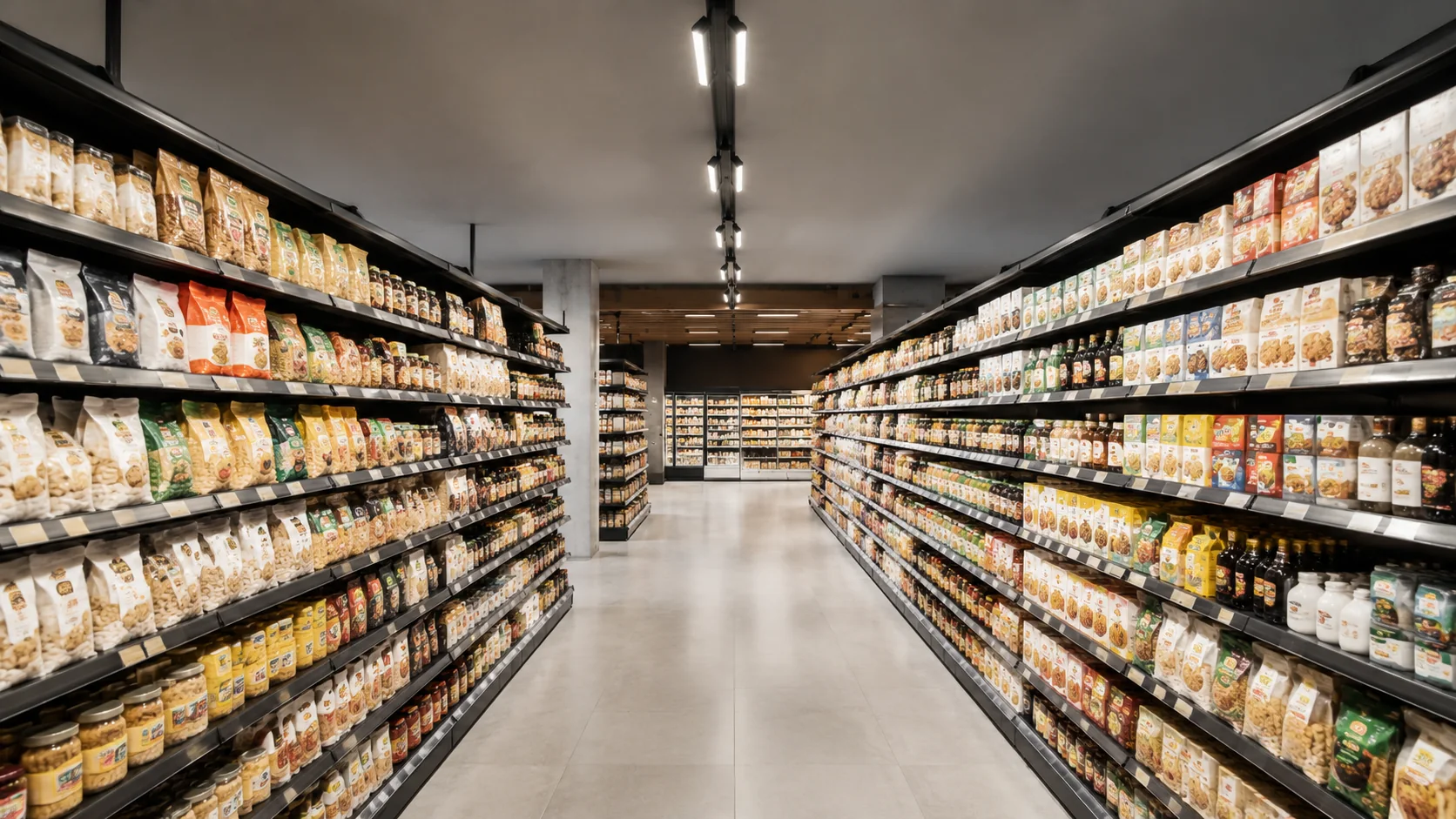
Conceptual aisle application: two adjustable panels direct light toward both merchandise rows.
Where Traditional Track Spotlights Remain the Better Choice
Traditional spotlights are better when the goal is focus. A narrow or medium beam raises one object’s brightness relative to its surroundings, helping a new product or promotion stand out.
Choose track spotlights for:
- shop windows and mannequins;
- hero products and seasonal promotional islands;
- artwork, signage and architectural details;
- jewelry, cosmetics and small counters requiring precise aiming;
- boutiques where contrast is part of the brand atmosphere;
- stores with frequently changing individual display targets.
ERCO’s lighting guidance notes that spotlights illuminate limited areas and are used mainly for accent lighting. It also illustrates an aiming angle around 30° for artwork to reduce shadows and reflections. Store conditions vary, but the principle remains: aiming is part of spotlight performance.
A few compact spotlights can look clean. Using many narrow beams for general shelf lighting, however, can leave scallops and dark gaps while adding adapters and installation points. Compare whether a dual-panel format serves the zone more directly.
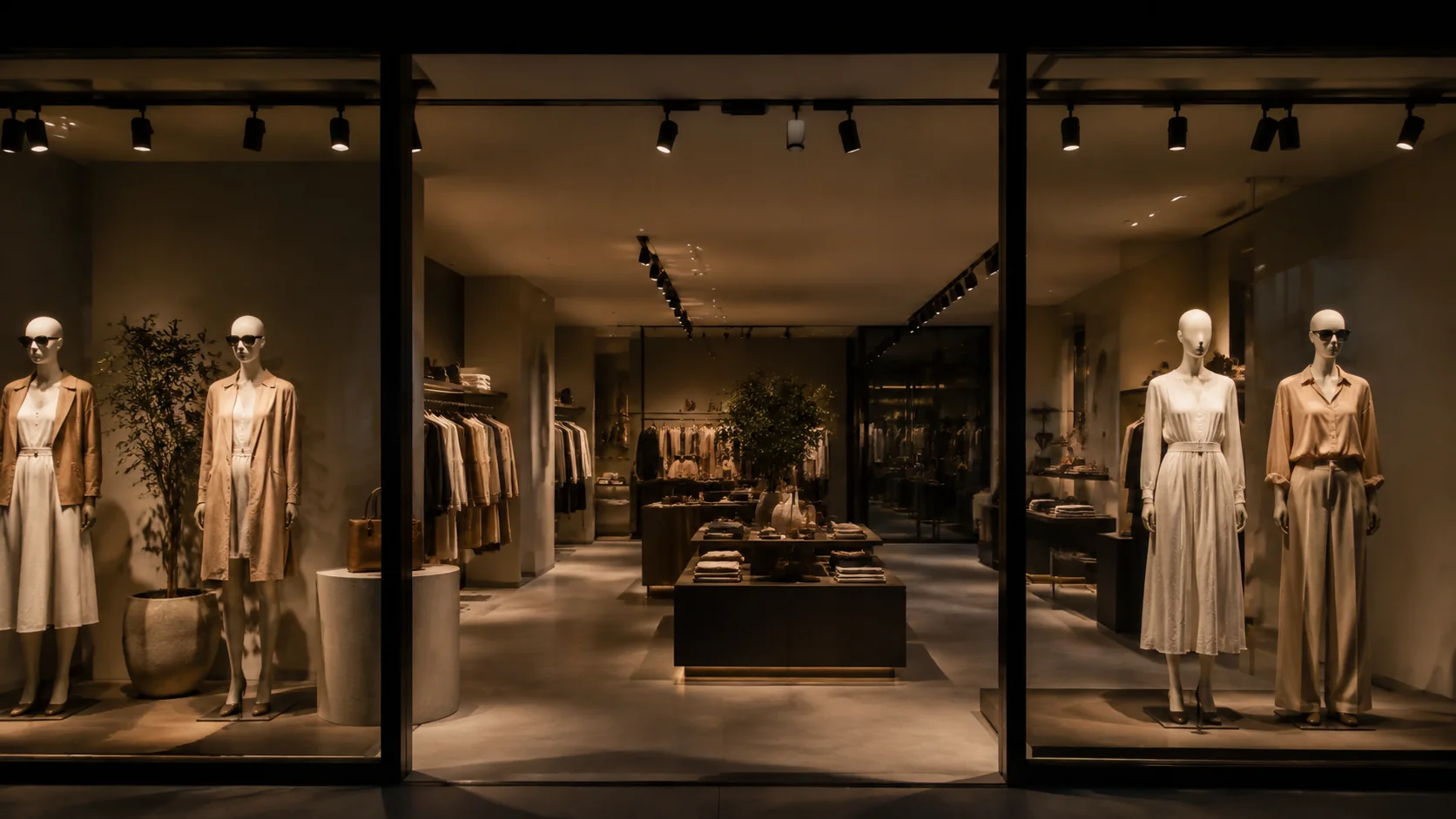
Traditional spotlights remain effective for mannequins, windows and other high-priority display targets.
Why a Hybrid Retail Track Lighting Design Often Wins
Many stores do not need one fixture type throughout. Divide the space by lighting task.
Use dual-panel lights for aisle and merchandise coverage, then add spotlights at entrances, end caps and promotional islands. This combines comfortable navigation with selected areas of higher contrast.
This layered strategy aligns with the IES distinction between ambient and accent lighting: ambient light supports general illumination, safety and wayfinding, while accent light highlights objects and directs attention. In retail terms, the dual-panel fixture can establish the readable base layer and the spotlight can create the visual “punctuation.”
A hybrid system also supports merchandising changes. Broad-coverage fixtures stay with permanent aisles, while spotlights are re-aimed when a campaign moves. Keep all adapters compatible with the specified track and circuit; our guide to 3-phase track adapter compatibility explains why physical fit alone is insufficient.
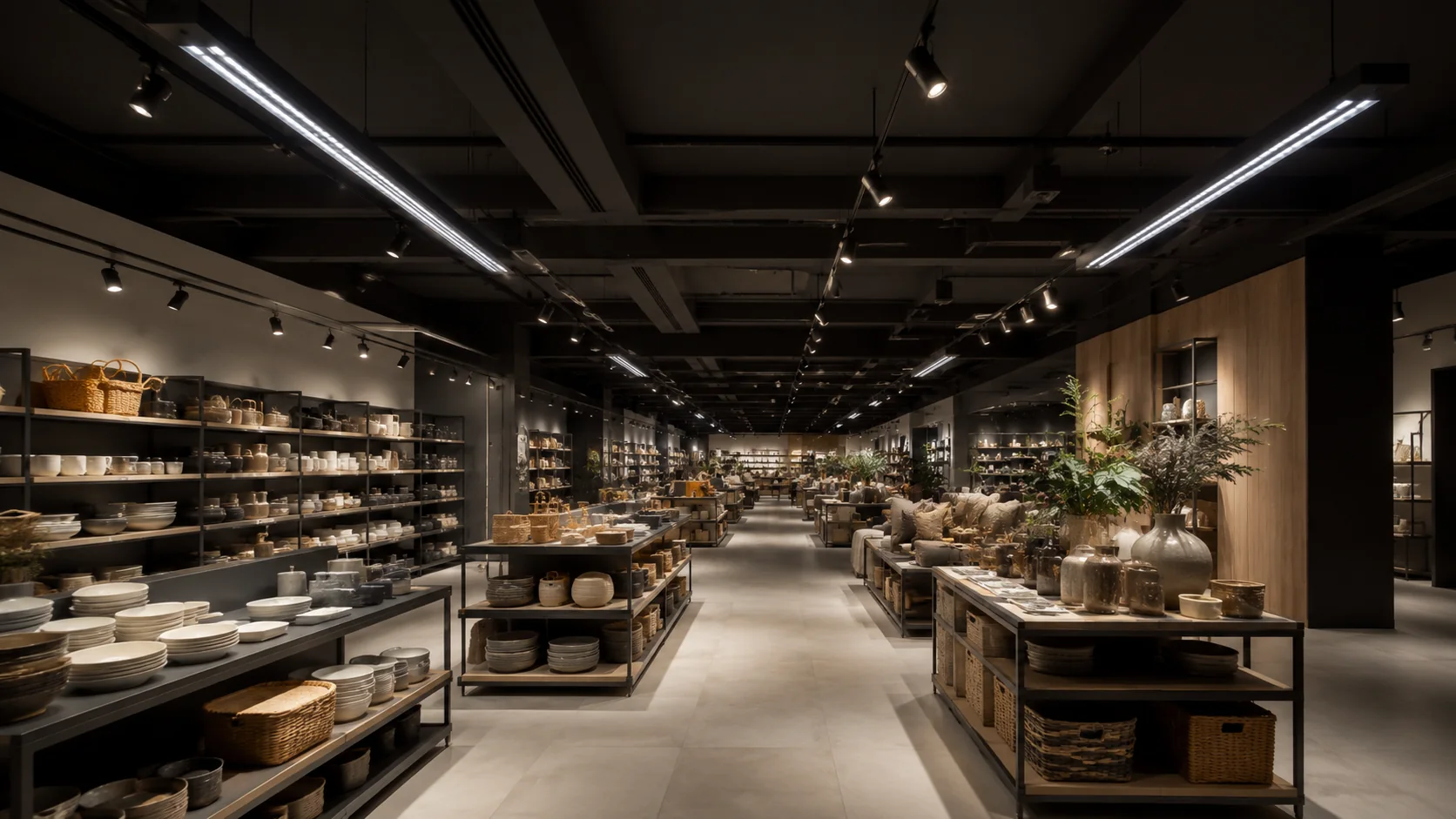
A hybrid layout uses broad-coverage luminaires for merchandise zones and spotlights for focal displays.
A Practical Procurement Checklist
Before comparing quotations, give each supplier the same project information:
- Define target surfaces. Mark shelves, floors, walls, counters and promotional displays.
- Provide dimensions. Include track height, aisle width, shelf height and target distance.
- Set goals. State horizontal and vertical illuminance, uniformity and acceptable contrast.
- Compare photometry. Request IES or LDT files for the exact configuration.
- Review glare. Check customer sightlines and luminous-panel visibility.
- Confirm colour quality. Choose CCT and CRI for the merchandise, then review samples. IES TM-30 guidance shows why colour rendition involves more than one number.
- Verify compatibility. Confirm track profile, phase, ratings, polarity and adapter version.
- Calculate installed cost. Include quantity, adapters, labour, commissioning and spares.
- Build a mock-up. Test one aisle and accent display before full approval.
- Document settings. Record DIP wattage, aiming and circuit assignments.
If the main challenge is choosing output, see our guide to selecting 27W, 40W, 50W or 60W track-light wattage. For a broader project workflow, start with How to Choose Commercial Track Lighting for Retail Stores.
Final Recommendation
Choose a dual-panel track light for broad, adjustable aisle and shelf coverage. Choose traditional spotlights for precise beams, strong contrast and changing display targets. For many large stores, the best answer is a hybrid: linear coverage for the base layer and spotlights for attention.
Lowcarbon can support OEM/ODM buyers with configuration review, photometric files and LL1615 sample evaluation. Send us your track type, ceiling height, aisle dimensions, shelf layout, target illuminance, CCT and CRI. We can then compare solutions instead of recommending from wattage alone.
Frequently Asked Questions
Can one dual-panel track light replace two traditional spotlights?
Sometimes, but there is no universal one-to-two rule. A dual-panel fixture can cover two shelf faces from one track point, while two spotlights can aim at two separate targets. The correct quantity depends on photometry, spacing, mounting height and the required illuminance.
Are dual-panel track lights suitable for fashion stores?
Yes for broad wall bays, circulation areas or general merchandise coverage. Traditional spotlights are usually better for mannequins, window displays and premium products that need controlled contrast. A hybrid layout is often appropriate.
Which fixture is better for supermarket aisles?
Dual-panel linear track lights are often more efficient for continuous shelves because their two panels can aim toward both sides of an aisle. Confirm the result through an aisle mock-up and photometric calculation.
Do higher lumens always mean better retail lighting?
No. Delivered illuminance, beam distribution, vertical light on products, glare, uniformity and colour quality all affect the result. A high-lumen fixture with the wrong optic may waste light outside the target.
Can dual-panel and spotlight fixtures share the same track?
They can if both adapters are electrically and mechanically approved for the specified track system and circuit. Never assume compatibility from appearance alone; verify the exact track and adapter combination.
What information should I send for a lighting recommendation?
Send a plan or sketch, track height, aisle and shelf dimensions, target illuminance, track brand/profile, input voltage, preferred CCT/CRI, control requirement and project quantity. Photos of the existing space are also helpful.

