
LED linear lighting uses elongated light sources to create continuous or extended lines of illumination. Unlike a spotlight, which concentrates light in a relatively small area, an LED linear light distributes useful light along shelves, desks, corridors, architectural features, or large work zones.
The category includes complete commercial luminaires, modular trunking systems, suspended pendants, recessed light lines, surface-mounted fixtures, wall washers, and high-bay products. This guide explains how they differ and which specifications matter when selecting a system.
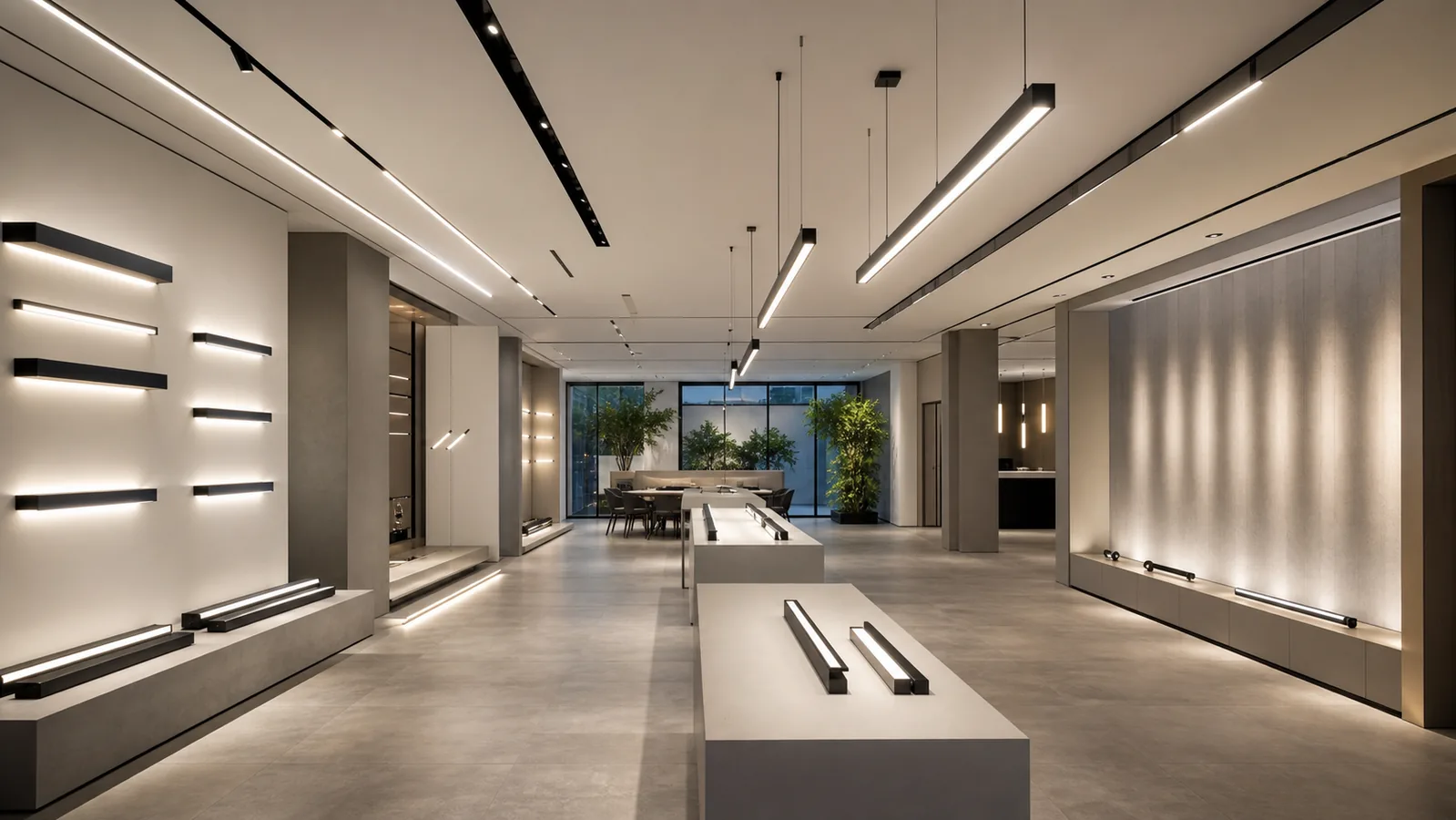
What Makes a Light “Linear”?
The defining feature is the long luminous aperture. An aluminum or steel housing normally contains an LED board, driver, thermal path, and optical system. The components may form a single fixture or connect end to end to create a continuous run.
Linear lighting should not be confused automatically with flexible LED tape. Tape light is a component that usually needs a profile, diffuser, power supply, and installation system. A commercial linear luminaire is delivered as an engineered fixture with defined photometry, thermal performance, electrical protection, and mounting hardware.
Common Types of LED Linear Lights
- Suspended linear lights: hung on aircraft cables for offices, classrooms, showrooms, and collaborative spaces.
- Recessed linear lights: integrated into a ceiling or wall for a clean architectural line.
- Surface-mounted fixtures: fixed directly to a finished ceiling where a recess is unavailable.
- Linear track and trunking systems: mounted on a powered rail for flexible commercial layouts.
- Linear high bays: high-output fixtures for warehouses, factories, and sports facilities.
- Outdoor or wet-location linear fixtures: sealed products designed for moisture, dust, and temperature exposure.
Our detailed linear-light mounting comparison explains the installation differences.
How LED Linear Lighting Works
LED packages convert electrical energy into light. A driver supplies the correct current, while the housing moves heat away from the LED board. A diffuser, lens, reflector, or louver shapes the distribution and controls visual comfort.
These parts must work as a system. High LED efficacy cannot compensate for an inefficient optic, excessive operating temperature, or a poor-quality driver. Read our guide to how LED linear lights work for a component-level explanation.
Benefits in Commercial Projects
Linear fixtures can produce smooth coverage with fewer dark gaps than isolated point sources. Long visual lines also help organize ceilings and guide movement through corridors, offices, retail aisles, and public spaces.
Other benefits include modular lengths, multiple mounting options, selectable wattage, direct/indirect distributions, dimming, emergency integration, and the ability to create L, T, cross, rectangular, or continuous configurations. The actual options depend on the fixture family.
Key Specifications to Compare
Compare delivered lumens, efficacy, wattage, beam distribution, CRI, CCT, color consistency, glare control, flicker, driver lifetime, surge protection, dimming protocol, ingress protection, and certification. For continuous systems, also confirm connector types, maximum run length, feed locations, and suspension spacing.
Do not select from watts alone. A photometric file shows where the light goes, while a thermal and lifetime statement explains the conditions behind the rated life.
Where Linear Lighting Is Used
Office projects use suspended and recessed fixtures above workstations and meeting rooms. Retail stores use linear light for shelves, aisles, counters, and visual merchandising. Warehouses use high-output linear fixtures between racks. Hospitality projects use architectural light lines to define reception desks, corridors, and public areas.
See our commercial linear lighting applications guide for project-specific selection advice.
Final Selection Advice
Start with the visual task and space geometry. Define the target surfaces, mounting height, required illuminance, uniformity, glare limit, controls, and maintenance conditions. Then compare photometric data for products that meet those requirements.
At Lowcarbon, we support OEM and ODM lighting projects with configurable dimensions, output, optics, drivers, finishes, and packaging. Contact our team to discuss a linear-lighting specification or request project documentation.
Frequently Asked Questions
What is an LED linear light?
It is an elongated LED luminaire designed to distribute light along a line or over an extended area. It may be suspended, recessed, surface mounted, track mounted, or configured as a continuous system.
Is linear lighting suitable for offices?
Yes. Properly selected linear fixtures can provide uniform task lighting, organized ceiling layouts, dimming, and direct/indirect illumination. Glare and flicker should be evaluated for workstation use.
Can LED linear lights form continuous runs?
Many product families can connect end to end. Confirm the connector system, maximum electrical run, feed position, expansion allowance, and suspension spacing with the manufacturer.
Are LED strips the same as linear fixtures?
No. LED tape is generally a component. A complete linear fixture includes a housing, optic, driver, thermal design, wiring, and mounting system.
