 跳到内容
跳到内容 
Commercial linear lighting can provide ambient light, task illumination, visual guidance, merchandise lighting, architectural emphasis, or high-output industrial coverage. The same fixture is rarely ideal for every application.
This guide explains how project priorities change across offices, retail stores, warehouses, education, hospitality, and public spaces.
Office Linear Lighting
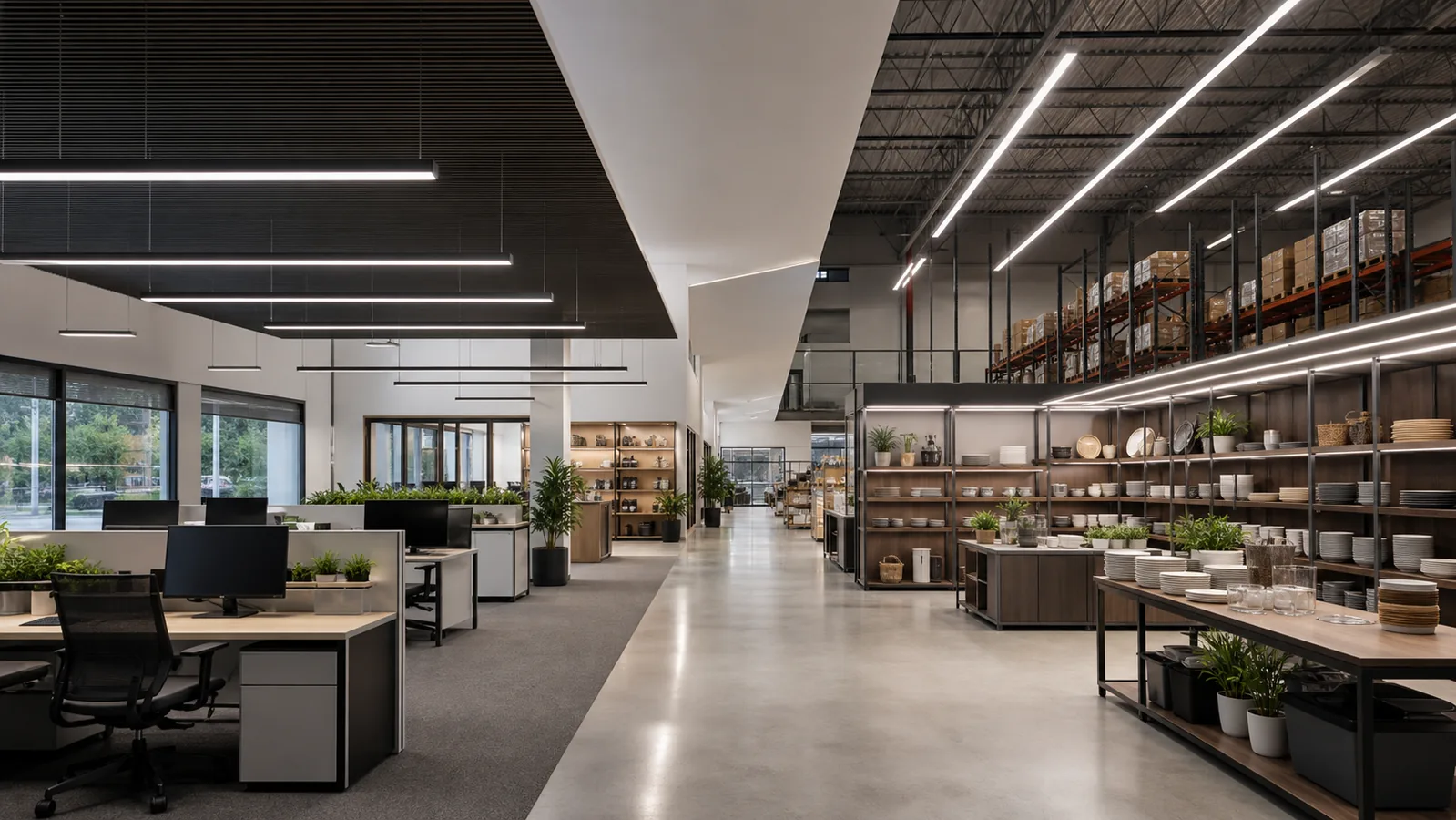
Offices need comfortable workplane illumination, low glare, good vertical light, flicker control, and integration with daylight and occupancy controls. Suspended direct/indirect fixtures can brighten both desks and ceilings, while recessed lines create a minimal appearance.
Coordinate rows with workstation orientation and screens. Confirm dimming, emergency lighting, acoustic elements, and future space-planning flexibility.
Retail Stores and Showrooms
Retail lighting must reveal products, labels, colors, textures, and displays. Linear fixtures are useful over aisles, shelving, counters, wall bays, and continuous merchandise runs. Track-mounted linear products add flexibility when layouts change.
Combine broad linear coverage with spotlights where stronger contrast is needed. Our linear track lights for retail stores guide explains aisle design in more detail.
Warehouses and Logistics Centers
Warehouses need visibility between racks, at picking faces, on floors, and at workstations. Linear high-bay fixtures suit long aisles and can use aisle distributions to place light efficiently.
Check mounting height, rack geometry, controls, ambient temperature, dust, impact risk, emergency operation, and maintenance access. Sensors can reduce energy in intermittently occupied aisles.
Education and Libraries
Classrooms need visual comfort for reading, writing, screens, and faces. Libraries need even shelf illumination and comfortable study areas. Linear systems can organize ceilings and provide continuous coverage.
Review glare, flicker, acoustic coordination, daylight control, scene settings, and maintenance during occupied hours.
Hospitality and Public Spaces
Hotels, restaurants, lounges, reception areas, and corridors use linear light as both illumination and architecture. Warm CCTs, dimming, clean joins, custom shapes, and finish quality often matter as much as maximum efficacy.
For public circulation, coordinate emergency requirements, wayfinding, cleaning, access, and long operating hours.
Industrial and Specialized Areas
Factories and service areas may need higher task levels, robust housings, chemical resistance, sealed construction, or special temperature ratings. Food processing, parking, cold storage, and hazardous locations require products designed for those environments.
An IP rating alone does not prove suitability for impact, corrosion, washdown, heat, or hazardous atmospheres. Confirm all relevant ratings.
Application Selection Matrix
| Application | Typical priority | Common linear solution |
|---|---|---|
| Office | Glare, controls, comfort | Suspended direct/indirect or recessed |
| Retail | Vertical light and flexibility | Track, trunking, or continuous linear |
| Warehouse | Height, aisles, energy | Linear high bay |
| Education | Comfort, flicker, daylight | Suspended or recessed |
| Hospitality | Atmosphere and dimming | Architectural suspended/recessed |
| Industrial | Environment and durability | Sealed or specialized linear fixture |
Project Checklist
For every application, confirm task surfaces, illuminance, uniformity, mounting height, distribution, glare, CCT, CRI, controls, environment, certification, maintenance, and budget. Model the exact product and approve a sample when appearance is critical.
Start with What Is LED Linear Lighting? or use our fixture selection guide. Contact Lowcarbon for OEM/ODM project support.
Frequently Asked Questions
Where are LED linear lights commonly used?
Common applications include offices, retail stores, warehouses, schools, hotels, showrooms, corridors, factories, and public spaces.
Are the same linear lights suitable for offices and warehouses?
Usually not. Mounting height, distribution, glare, output, environment, and controls differ significantly.
Can commercial linear lighting be customized?
Many manufacturers offer custom lengths, wattage, CCT, optics, finishes, joins, drivers, and packaging, subject to testing and order requirements.
Do commercial projects need photometric files?
Yes. IES or LDT files allow designers to verify output, distribution, spacing, uniformity, and target illumination.

