 跳到内容

OEM LED lighting MOQ and lead time are not fixed numbers attached to a broad product category. They change with the degree of customization, availability of components, sample approval, testing, packaging and the production schedule. A buyer who asks only “What is your minimum order quantity and fastest delivery?” is likely to receive a vague answer. A buyer who sends a precise specification can get a more useful commercial response.
This guide explains what moves the quote for commercial luminaires and how to prepare a request that a manufacturer can evaluate. LCB supports OEM/ODM development across its commercial LED product ranges; the exact MOQ and lead time for any project must be confirmed in the current quotation, not inferred from a generic article.
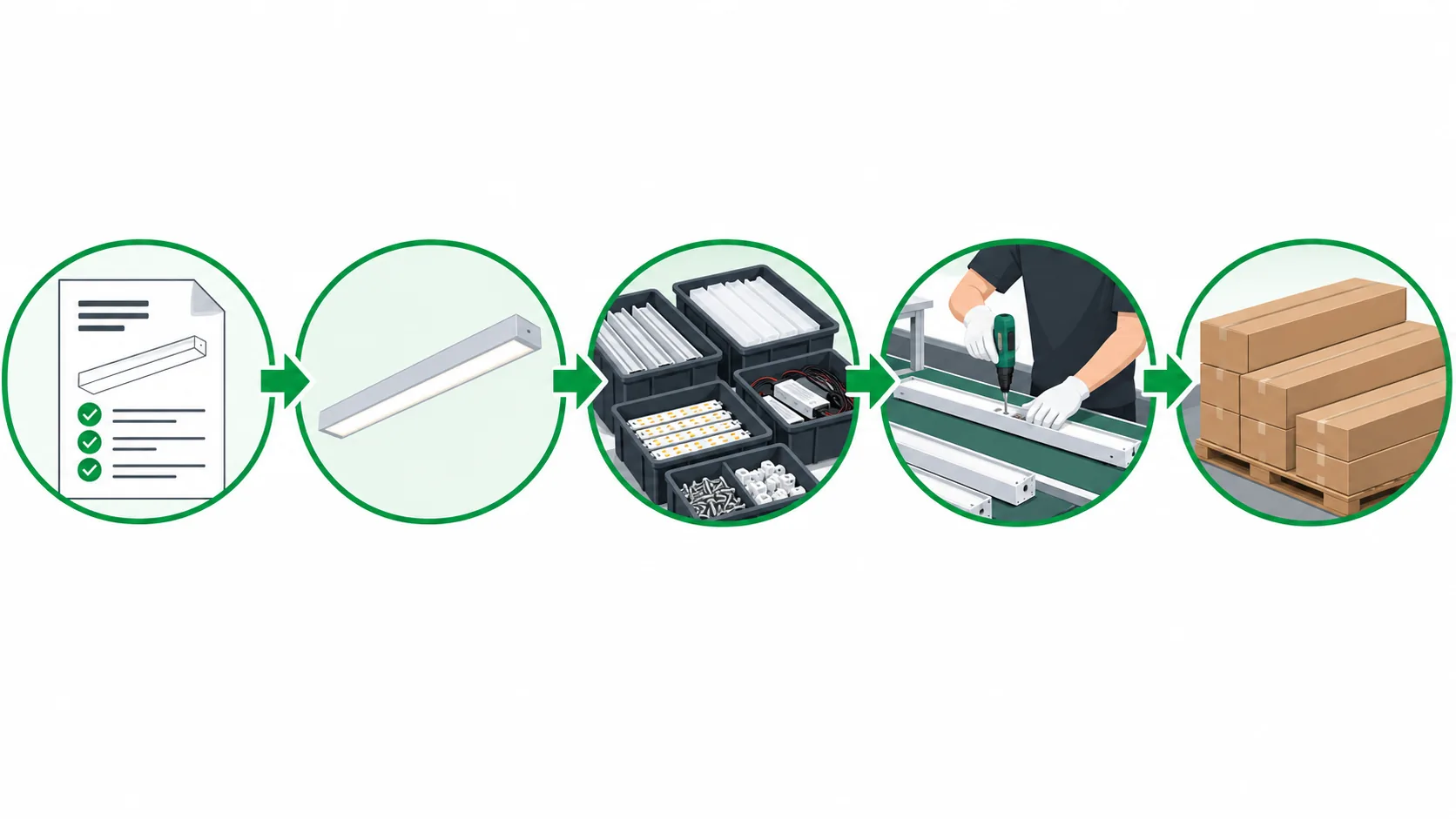
Separate standard supply from true customization
“Custom” can mean many things. A standard luminaire in an existing finish and optic may need only a normal production allocation. A change to a driver, CCT, beam, track adapter or cable length may need different purchased components and a sample. A new housing or optical design can require engineering, tooling and a longer validation process. These are different commercial cases and should not be treated as one MOQ.
List changes in three columns: unchanged standard features, selectable existing options, and genuinely new requirements. This lets the supplier identify which items are already qualified and which need work. It also helps the buyer decide whether a nearly suitable standard variant would meet the project without unnecessary cost or delay.
For a multi-site program, define what must be identical across every location and what can vary. A common housing with a few approved drivers or adapters may be more practical than many one-off SKUs. That decision should be made before requesting a price ladder.
What usually changes MOQ?
MOQ can be driven by component purchasing, production setup, color finishing, packaging print runs or dedicated tooling. It may be quoted per model, per finish, per optical combination or per order—these are not equivalent. Ask the supplier to state the unit of MOQ explicitly.
A unique powder-coat color may have its own batch threshold. A special driver or track adapter might be limited by the component supplier’s pack quantity. Branded packaging can have a separate print MOQ even when the luminaire itself is available in a smaller batch. Custom tooling may have an upfront cost rather than a larger unit MOQ, or both.
Do not assume that a larger total order automatically satisfies the minimum for every variant. If the project has five wattages and three finishes, the supplier may need a workable quantity for each combination. Consolidating configurations where possible can simplify both production and future spare-parts management.
What usually changes lead time?
Lead time has several stages: engineering review, sample build, sample approval, component procurement, production, testing, packaging and dispatch. A supplier may quote a production period that starts only after all components and approvals are ready. Buyers should ask for the start condition and each milestone, not just one number of days.
Long-lead drivers, LEDs, optics and packaging can determine the critical path. A late change to the finish or control protocol may reset component ordering. Shipping mode, customs documentation and destination-market requirements add time after factory completion. A realistic plan separates factory readiness from delivery to site.
Build a small schedule with decision deadlines. If the project needs a store opening date, work backward from installation, shipping, quality acceptance and production. Protect time for sample revisions; the first sample may not be the final approved configuration.
Send an RFQ that can be answered precisely
Include the intended application, quantity by variant, destination markets, installation method, existing track or ceiling constraints, power and control needs, optical target, color appearance, finish, packaging, branding, testing/documentation requirements and target delivery schedule. Drawings and photographs of the actual installation are more useful than adjectives such as “premium” or “high quality.”
Mark which requirements are fixed and which are flexible. If a specified component is unavailable, can the supplier offer an approved equivalent? If a custom finish delays the project, is a standard finish acceptable for the first phase? Clear flexibility lets the supplier propose alternatives without quietly substituting a critical feature.
Do not ask for a firm mass-production quote before resolving a major technical ambiguity. The supplier can give a budgetary range first, then a firm offer after the sample, bill of materials and test scope are agreed. Label those stages honestly.
Use a price ladder rather than one number
For a project with uncertain demand, request prices at several realistic quantities. The price ladder should identify tooling, sample charges, packaging setup and freight separately from the unit price. It should state whether repeat orders use the same price and what conditions might change it.
A low price at a quantity the buyer will never order is not a useful benchmark. Compare the quantities you actually expect, including spare units and staged deliveries. If the project may grow, ask how additional stores or later phases would be supplied and whether the same components will remain available.
Record currency, incoterms, payment schedule and quotation validity. Those commercial terms can affect the apparent difference between suppliers as much as the factory unit price.
The golden sample is a commercial control
An approved physical sample is not only a design aid. It defines what the purchase order means: housing, finish, optics, color, driver, adapter, label, packaging and installation details. Photograph it, record its configuration code and retain it if the rollout is large. Link the production order to the approved sample and written drawings.
For customized lighting, agree what can change without a new approval. A driver substitution may alter dimming behavior; a different LED board can alter color and output; a revised lens can alter the beam. A “same appearance” statement is not enough when performance is important. Our golden-sample approval guide covers the handoff in more detail.
If a buyer is supplying a brand or client specification, confirm who signs the sample approval. An internal supplier sign-off should not silently replace the project designer’s acceptance.
Testing and documentation need their own schedule
A project may need photometry, color data, electrical evidence, installation drawings, labels and destination-market documentation. Some information can be provided from an existing qualified design; new variants may require additional work. Ask the supplier to identify what is available now, what will be generated and when it will be ready.
Do not use certification logos or compliance claims from a different product family as proof for a customized variant. The relevant requirement depends on the destination market and exact configuration. Agree the evidence before the order so that documentation does not become a surprise delay at shipment.
A practical quotation comparison table
| Question | What the answer should specify |
|---|---|
| MOQ | Per model, variant, finish, packaging run or total order? |
| Sample | Cost, build time, number of revisions and approval owner |
| Unit price | Quantity tiers and exact included configuration |
| One-time costs | Tooling, engineering, printing and testing |
| Lead time | Start condition and milestones to factory-ready date |
| Shipment | Incoterm, packaging, dispatch and delivery assumptions |
| Repeat orders | Component availability, price validity and change control |
Comparing offers in this structure makes it harder for a low headline price to hide missing accessories or approval work. It also exposes which supplier has actually understood the project.
How buyers can reduce risk without over-ordering
Start with a representative sample and a pilot quantity when the project allows it. Use that phase to confirm installation, light distribution and packaging. But do not split an order into many tiny batches without discussing the production impact; repeated setups can add cost and increase variation.
Consolidate the options that are not meaningful to the customer. Keep flexibility where it creates value—such as a needed adapter or optical choice—and simplify cosmetic variations where possible. Establish a change-control process so that a late design decision does not silently shift the delivery date.
For staged site openings, provide a forecast. A supplier can plan components more effectively with credible expected volumes and dates, even if purchase orders are released in phases. Forecasts should be labeled as forecasts rather than guaranteed orders.
Agree a change-control gate
Customized lighting projects often slip because approval decisions remain informal. Establish a written gate after the golden sample: the exact bill of materials, mechanical drawing, optic, CCT, driver, adapter, finish, label and packaging are frozen for the quoted production batch. A change after that gate should state its reason, cost, schedule effect and whether fresh testing or sample approval is needed.
This protects both buyer and supplier. The buyer knows what will arrive; the supplier can purchase components and schedule production without guessing. It also avoids a common dispute in which a small-looking request—such as a new dimming driver—changes electrical behavior and lead time more than expected.
For projects with several destinations, identify which variant belongs to each market and how cartons will be labeled. A batch can be on time at the factory yet late for installation if the wrong adapter, document or label was packed for the first site. Add a pre-shipment review against the approved variant list.
Common mistakes to avoid
- Asking for one MOQ without defining the variant. State the model, finish, optic, driver and packaging.
- Confusing production time with delivery time. Include approval, procurement and shipping.
- Changing specifications after sample approval without a schedule update. Use written change control.
- Comparing unit prices that exclude different items. Itemize accessories and one-time costs.
- Assuming existing test evidence covers a new configuration. Confirm the exact variant and market.
Ask for an achievable first-order plan
If the full program volume is uncertain, give the supplier a credible opening quantity and a separate forecast for later phases. Ask whether components can be reserved, which options must be frozen, and whether a pilot batch can be produced without losing color and finish consistency. Clarify the commercial treatment of spare units: they may be part of the first batch even if they are not installed immediately.
For a fast opening, identify which customization matters most to the customer. A special optic or adapter may be essential, while branded packaging could be postponed. This does not mean accepting a lower standard; it means ordering the critical technical configuration first and avoiding a cosmetic bottleneck that provides little on-site value.
Frequently asked questions
Can a manufacturer accept a small OEM lighting order?
Possibly, depending on the product and customization. A standard configuration with simple branding is different from a new housing or dedicated component. Send a detailed RFQ and ask which elements drive the minimum.
Does a custom finish always require a higher MOQ?
Not always, but finishing setup or material batch size can create a separate threshold or cost. Ask for a standard-finish and custom-finish comparison.
When does lead time start?
That must be written in the quote. It often starts after sample approval, deposit and component availability, but terms vary. Request a milestone schedule rather than relying on one headline duration.
Can I order one sample before committing to MOQ?
Many projects begin with a paid or agreed sample stage. Confirm its price, scope, timing and whether it is representative of the eventual production configuration.
What if I need several track adapters for different countries?
List each installed rail and destination market. The adapters may require separate validation and variant quantities. Do not assume a single visually similar adapter works everywhere.
Practical next step
Send your project brief, quantity by variant and delivery milestones through the LCB contact page. Ask for a quote that separates standard options, custom work, sample approval, MOQ and lead time. That structure makes the response easier to compare and the finished product easier to approve.
