 跳到内容

“The production unit should match the sample” sounds clear until two people remember the sample differently. One recalls the beam, another the housing finish, and the purchase order names only wattage and CCT. A golden sample is useful because it turns a product conversation into a controlled reference—but only if the sample is identified, documented and tied to objective acceptance criteria.
For OEM LED lighting, the approved reference may cover the visible finish, optic, electrical behavior, controls, labels and packaging. It should not be a mysterious object in a cupboard. This guide explains how project buyers can use golden samples to reduce production surprises without asking a factory to reproduce an undocumented prototype indefinitely.

Define exactly what the sample represents
Start with a unique sample ID and revision. Record product family, model code, rated input, LED board, optic, driver, output setting, CCT, color-rendering target, housing finish, adapter or mounting hardware and control method. If the sample is pre-production, note which parts are final and which remain provisional. A production run should not be approved against a sample whose critical elements are still “to be confirmed.”
Photograph all sides under consistent light, including labels, connectors, mounting details and packaging. Attach a datasheet and drawing with dimensions and tolerances. For measurable characteristics—electrical power, output, dimensions, finish color, control behavior—define how they will be tested. The physical sample is a reference, not a complete specification by itself.
Approve the assembled product, not an isolated component
LED packages, lenses, drivers and housings can all meet their own component specifications while the finished luminaire misses the project intent. A diffuser substitution can change apparent brightness; a driver setting can change power and thermal behavior; a powder-coat variation can make adjacent fixtures look mismatched. Approve the assembly as installed, including accessories that affect fit and appearance.
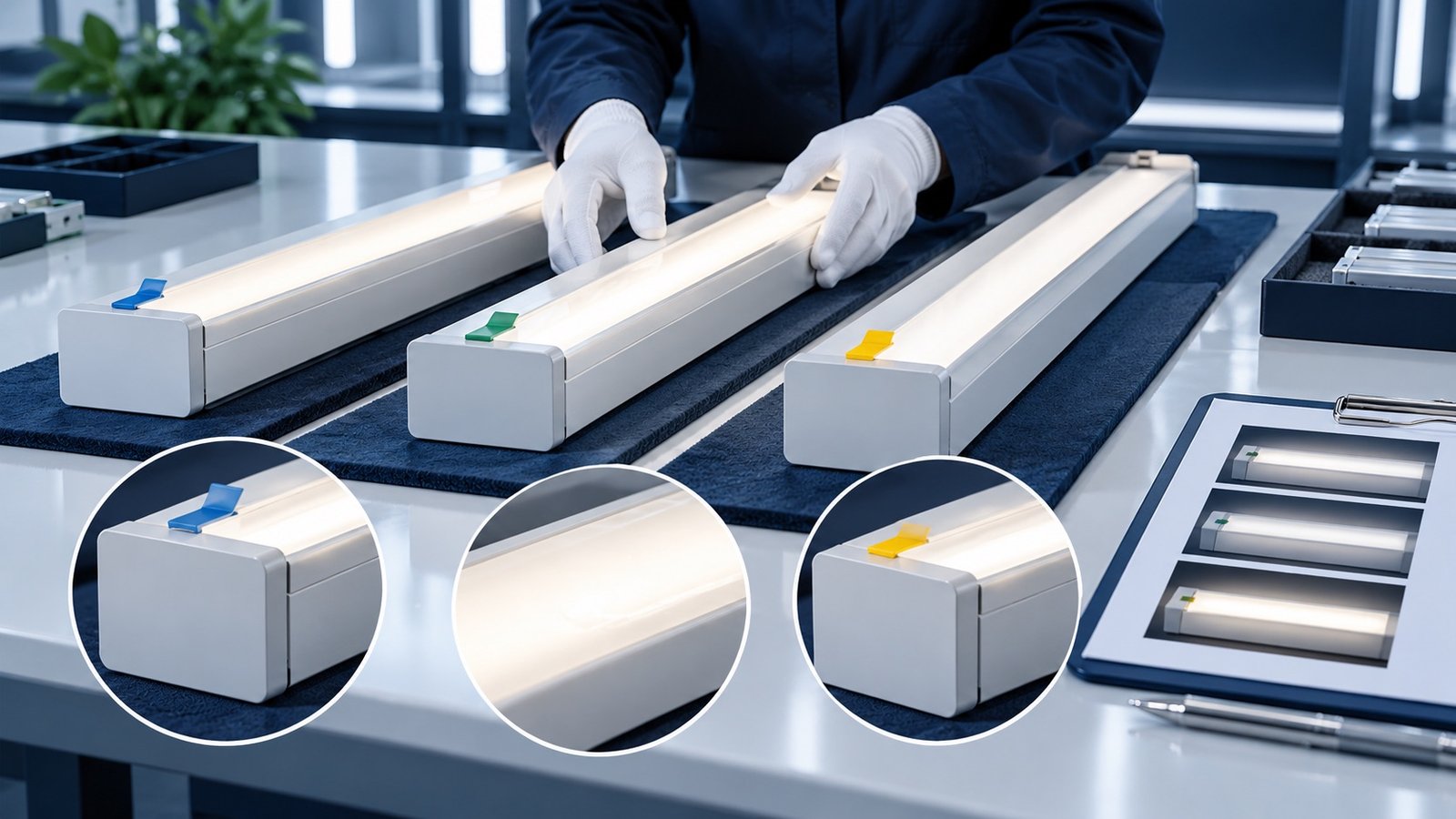
For a track luminaire, verify adapter fit and aiming behavior on the intended rail. For a linear system, inspect joints, end caps and visible seams across multiple connected modules. For a downlight, use a sample in a representative ceiling cutout and check the trim, clips and driver access. This prevents “same main unit, different accessory” substitutions from undermining the approved result.
Make approval a signed decision
One person’s emailed “looks fine” can be misunderstood as approval of everything. Use a short approval sheet with the sample ID, revision, date, approvers and open items. State whether approval is for appearance only, function only or the full production configuration. Where a sample needs a correction, issue a revised sample or an explicit change record. Do not leave handwritten notes unattached to the purchase documentation.
Keep one approved sample with the buyer and one with the supplier where practical. Protect them from damage and label them clearly. If a sample is operated repeatedly, it may age or get scratched; retain records that distinguish the original acceptance state from later wear.
Connect the sample to drawings and test files
Link the golden sample to the approved bill of materials, drawing revision, photometric file where applicable and test report. The purchasing team should know which documents govern the order. If the supplier measures a prototype and then changes the lens before production, the old photometric file may no longer represent the approved unit. If a metal profile changes dimension, the original installation drawing may no longer be reliable.
Use a configuration matrix for options. A black and white housing may share an electrical core, but both finishes should be approved if visible quality is important. Different wattages, optics or control protocols may need separate samples. The aim is not to multiply paperwork for its own sake; it is to prevent a single “golden sample” label from covering several materially different products.
Plan pre-production and in-process checks
Before the full run, review a first production unit made with the intended materials and production process. Compare it to the approved sample, not to a marketing rendering. Inspect finish, dimensions, labels, electrical function, optic and packaging. If the first article is accepted, the supplier can use it to set in-process checkpoints.
Agree which characteristics are checked on every unit and which are checked by sample. The sampling plan should reflect the consequence of defects. A cosmetic scratch and a wiring fault do not carry the same risk. Ask for traceability to production lot and key components so that any problem can be investigated without treating every shipment as identical.
Control changes rather than pretending they never happen
Components become unavailable, processes are refined and regulations change. A credible OEM agreement defines which changes require notice and approval. Typical triggers include LED package, driver, optic, diffuser, thermal interface, housing geometry, coating process and critical supplier. The response may be a new sample, updated test, comparison report or a documented equivalence decision. The buyer should approve the outcome before the changed batch ships where the change affects the project specification.
For repeat orders, reference the original approved configuration and ask whether anything has changed since the last lot. Keep a change log with dates and affected serial or lot ranges. A replacement fixture ordered years later may not be visually identical to an aged installed unit; a controlled change record at least tells you what was built.
Include packaging in the approved standard
A perfect unit that arrives damaged does not meet the project need. Inspect the sample as packed, especially for long linear fixtures and delicate optics. Record carton contents, labels, protective supports and accessory separation. If packaging is changed for a different shipping route, approve the new method. The same principle applies to installation instructions and spare parts: they are part of the delivered product experience.
Lowcarbon’s product center introduces three commercial lighting families; its manufacturing overview describes sample approval and coordinated production. For an OEM brief, send the intended application, target market, quantity, options and approval priorities through the project inquiry form.
A sample approval form that people will actually use
Keep the form short enough to complete at a review table. It should have project name, sample ID, model revision, date, inspected quantity, approval scope and a list of critical characteristics. For each characteristic, mark accepted, accepted with condition or rejected. Attach measured values where required. Include photos of details that are easy to confuse, such as connector orientation or the exact finish of an end cap. The approver should sign only after open items are resolved or explicitly assigned.
A separate deviation list is important. If the prototype has a temporary label or a non-final driver, write that plainly and set a deadline for a corrected production sample. Otherwise the supplier may believe the deviation was accepted, while the buyer believes it was merely tolerated for demonstration. The form should be understandable to purchasing and QC staff who were not present at the meeting.
How to handle multiple option combinations
For an OEM program with several wattages, optics and finishes, create a configuration matrix. Identify which attributes share a common approved baseline and which need their own sample. You may not need a physical sample for every mathematical combination, but you do need a defensible reason when one sample is used to cover several variants. A lens change deserves a different optical review; a paint change deserves a finish review; a driver change deserves electrical and control review.
Mark the configuration matrix on the quote and purchase order. Sales names can remain broad, but the orderable code must be unambiguous. The factory’s traveler or production record should point to the same revision. If the buyer changes a target after approval, treat it as a controlled revision, not an informal email that leaves the previous documents in circulation.
First-article inspection and shipment release
Inspect the first unit made on the normal production line, not only a hand-built prototype. It should use the intended tools, materials and assembly sequence. Compare it with the golden sample and record any difference. If the first article passes, agree whether photos, measurements or independent inspection are needed before the rest of the batch ships. The level of checking should reflect order size and risk.
At shipment release, verify that carton labels, unit labels and packing lists identify the approved configuration. For a multi-site order, preserve lot traceability through distribution. If a later complaint appears, this allows buyer and supplier to identify affected units and inspect the right records. Without traceability, even a well-controlled sample has limited investigative value.
When the golden sample is not enough
A sample cannot demonstrate long-term reliability, safety certification or every environmental condition. Use appropriate tests and compliance documents for those claims. A visually matching replacement may still have different electrical behavior; a photometrically matching fixture may still fit the ceiling poorly. The golden sample is one layer in an approval system, alongside drawings, reports, installation instructions and ongoing QC.
Avoid three common approval traps
First, do not approve a sample without identifying its revision. A hand-built prototype and a production-ready sample can look identical from outside while using different internal parts. Second, do not leave acceptance comments in an email thread disconnected from the purchase order. People joining the project later need one current decision record. Third, do not assume that a successful first lot guarantees later lots without change control. Reorders should confirm critical components and compare against a retained reference.
Finally, avoid treating the golden sample as a substitute for a clear defect policy. Agree how cosmetic variation, functional failures and document mismatches will be handled. Define inspection timing and who pays for a resubmitted sample when the buyer changes the design versus when production departs from the approved specification. The better these decisions are made before production, the less likely they become a dispute after delivery.
Frequently asked questions
Is one golden sample enough for a whole product family?
Usually not if the family has materially different optics, output settings, finishes or controls. Define which configurations the sample covers.
Can a photo replace a physical sample?
Photos help with traceability, but they cannot fully show beam quality, electrical behavior, fit or finish texture.
What if a component becomes unavailable?
Use the agreed change-control process: disclose the proposal, compare a new sample, update relevant documents and obtain approval before shipment.
Should packaging be part of approval?
Yes. It affects whether the product arrives in the approved condition and whether the correct configuration reaches the right site.
Who keeps the sample?
Ideally both buyer and supplier keep labelled, protected references or a documented custody arrangement with complete supporting records.
