 跳到内容

Quick answer: A fitness studio LED lighting plan should be built around activity zones, mirror views and screen positions, not a single brightness number. Map the exercise floor, strength equipment, instructor position, circulation and windows. Check where luminaires appear in mirrors and displays, use scenes that match actual classes, and test the proposed fixtures with the final equipment layout. Ask for the exact photometric and control data before approving a repeated installation.
Featured image: concept illustration only. It is not an LCB installation, a measured lighting design or evidence of compliance with a particular facility standard.
A studio can look polished in a rendering while creating uncomfortable reflections when people start moving. A bright ceiling line may run across a wall mirror at eye height. A screen used for instruction may be washed out by a nearby fitting. Dark pockets around equipment can remain even when the center of the room looks bright. These are layout and coordination issues. The most useful buying question is whether the installed lighting supports the activities and views that matter to the facility.
This guide is for operators, designers, electrical contractors and OEM buyers planning a commercial fitness studio or gym zone. It covers practical review steps for LED linear fixtures, downlights and controls. The required light levels, emergency lighting and electrical requirements must come from the local project brief and qualified professionals. This article does not assign a universal lux target or claim that one product is suitable for every exercise room.
Start with the room’s activity map
Draw the class floor, cardio equipment, strength stations, reception edge, storage, entry and circulation routes. Add the mirror wall, every display and the instructor’s usual position. Mark the ceiling height and the direction of daylight through the windows. A room used for both classes and open gym may need different lighting scenes even if the equipment stays in place.
Ask what the room actually does during a typical day. A calm guided class, a high-energy group session, strength training and cleaning may call for different distributions and control settings. Avoid treating a marketing phrase such as “dynamic lighting” as a specification. Write down which zones need to stay visible, which can be dimmed and who controls them.
The Illuminating Engineering Society discusses fitness-area lighting in its hospitality lighting commentary, specifically calling attention to fixture placement near mirrors and televisions. That is a useful design prompt: check the lines of sight from users and instructors before finalizing the ceiling pattern. A photometric calculation and a site mock-up still need to be based on the actual room.
Check mirrors from the position of the user
A mirror multiplies the apparent number of bright sources in the field of view. A row of exposed or poorly positioned luminaires can appear both overhead and in reflection. The reflected image may sit directly behind a user’s face or across the part of the mirror they use to watch an instructor. This is not captured by a floor illuminance value.
Stand at representative positions: the front and rear mat rows, a weight rack, a stretching area and the instructor’s mark. Look into the mirror while standing, sitting and bending as those positions fit the activity. Record where the actual source or a strong highlight appears. Then review whether the luminaire can move, change orientation, use a different optic or operate at a different output. Often the first fix is placement, not more power.
Large mirrors also reflect windows and displays. Daylight blinds or shades may be needed to keep the daytime view predictable. Try the room in the morning, afternoon and evening. A fitting layout that appears balanced at night can be distracting when bright daylight creates a second line of reflections.
For a project using suspended direct-indirect luminaires, review both the direct component and the reflected light on the ceiling. Our direct-indirect linear lighting guide explains general specification questions, but a gym’s mirror geometry is different from an office. Validate the exact optic and mounting height for this room.
Keep instruction screens readable
Many studios use a wall display for class cues, streaming instruction or a timetable. If a bright luminaire reflects in the screen, the instructor or user may have difficulty seeing it. The issue depends on the screen finish, its tilt, the viewer location and the lighting layout. Mark the display’s normal sightlines on the plan, then test the actual screen under the proposed lighting.
Review both the screen-on and screen-off conditions. A dark screen can act like a mirror, while a bright image may mask a reflection in a showroom demonstration. Check with the content and brightness settings the facility will use. If the display is shared by people at different heights or positions, inspect more than one viewpoint.
A separate screen-side lighting zone can help if reducing output near the display does not make the surrounding floor too dark. In other layouts, shifting a luminaire row or changing its distribution may be more effective. The target is a readable display and comfortable room, not a universally dark wall.
Separate class, strength and circulation zones
Uniform lighting throughout the room can be simple to operate, but not every area has the same use. A class floor may need a broad, even layer so participants can see the instructor and the path around mats. A strength zone may require clearer visibility of equipment and floor obstacles. A circulation path should remain legible when another zone is dimmed for a class. Define these relationships before choosing the control hardware.
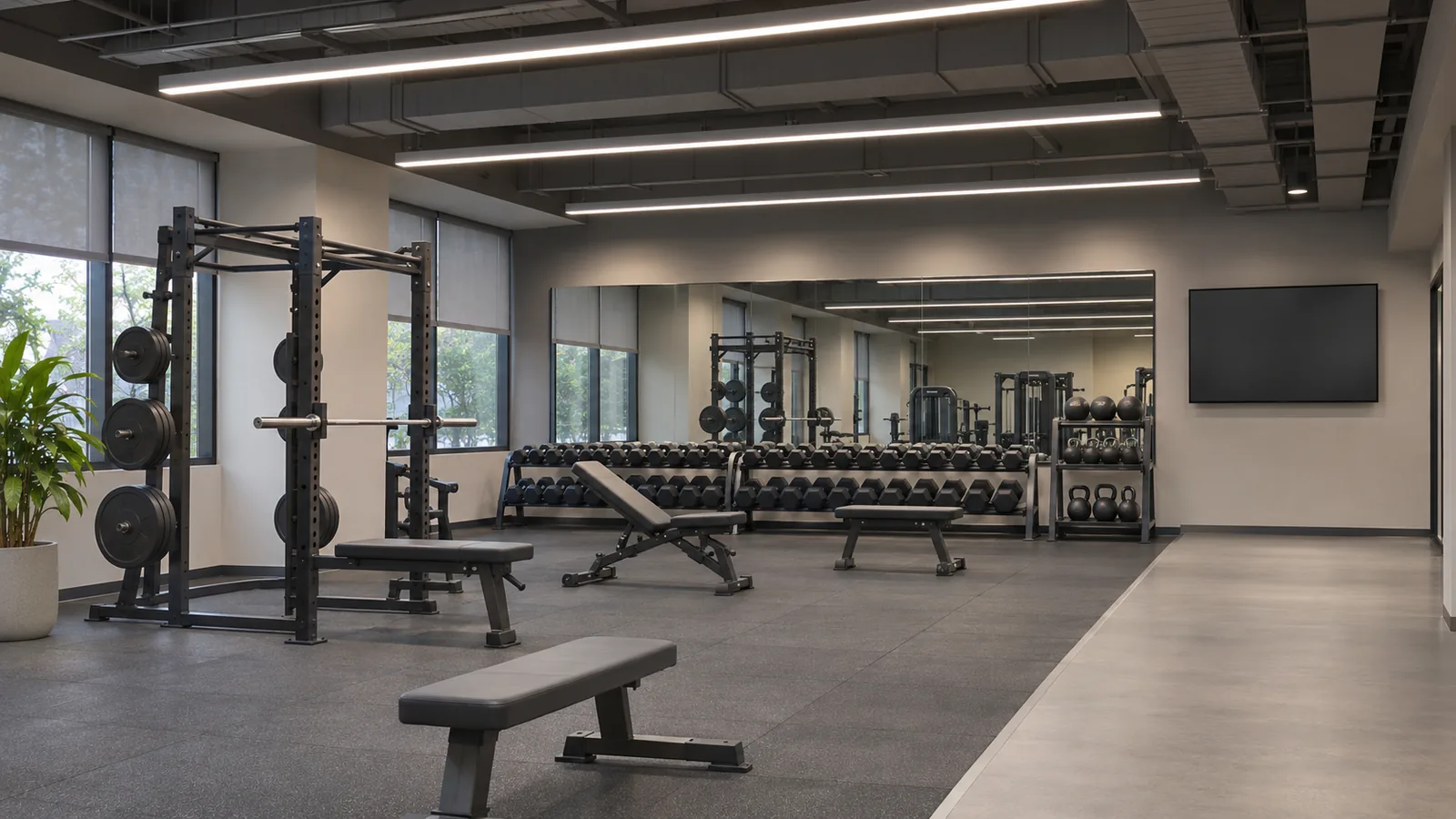
If the studio uses scenes, name them for recognizable tasks: general use, class, screen instruction and cleaning. A control panel with clear labels is more useful than many obscure channels. Agree on the level and transition for each scene, including what remains on when the display-side row is reduced. Test the scene with the actual furniture, mirrors and equipment installed.
Do not assume every sensor is appropriate. A person may be stationary during a stretch or hidden behind equipment from the sensor’s view. If occupancy control is proposed, verify detection coverage and override behavior in the finished room. A facility may prefer a simple schedule plus manual scene choice where that matches its staffing and operating hours.
Evaluate temporal light artifacts before buying a dimmable system
Some LED systems can produce visible flicker or motion-related effects depending on their driver and control method. The US Department of Energy’s flicker basics explains temporal light modulation and why drivers affect the result. It is not correct to label all LED fittings as flickering, nor to assume a dimming claim guarantees a smooth visual experience.
A gym is a place where people and objects move. That makes it sensible to test candidate luminaires across the intended dimming range. Ask suppliers for relevant temporal-light data, then install a sample with the actual controller. Observe moving hands, equipment and reflections under the intended scenes. If the studio records classes, review footage from the intended camera as well. Banding in video can be a separate practical concern even when the room looks acceptable by eye.
Specify the tested combination of luminaire, driver and controller. If one component is substituted after approval, repeat the check. A paper protocol match does not prove the complete system behaves the same way at every output level.
Choose color appearance without making wellness promises
Studios often use color temperature and dimming to set a mood. That can be a useful design choice, but it should not turn into an unsupported claim that a particular CCT improves exercise performance or health. The buyer’s immediate questions are whether faces, equipment, floors and finishes appear coherent and whether different fixture families match acceptably when used together.
Compare samples in the actual room. Daylight, mirror reflections and wall color affect the perceived result. A source that looks neutral in a catalogue photograph may appear different beside a cool display or a warm wood floor. Ask for the proposed CCT and color-rendering data for the exact product; keep a record of the approved version so replacement batches are consistent.
Colored accent scenes may suit a brand concept, but they should be evaluated as optional scenes rather than the only usable lighting state. Staff still need a clear, practical setting for opening, equipment inspection and cleaning. The exercise floor must remain understandable to users when a mood scene is active.
Check fixture positions against equipment and maintenance access
Ceiling equipment changes over the life of a studio. Air-conditioning units, fans, speakers, sprinklers and cameras may compete with luminaire rows. Tall racks or suspended equipment can obstruct light. Ask for a coordinated reflected ceiling plan, not a lighting layout prepared without the other trades. Confirm that the selected mounting height and suspension do not interfere with the activity envelope below.
Plan service access before installation. Can a driver or diffuser be reached without moving heavy equipment? Is there a safe place for a ladder? If a light line crosses several zones, can one module be replaced without dismantling the entire run? These questions affect downtime and the appearance of the room after repairs.
Ask for photometric files, mounting drawings, driver information, cleaning instructions, control compatibility and spare-part references. The LCB product overview provides potential fixture families to discuss, while the project quote should identify the exact configuration under review. Do not infer a specific output, rating or compatibility from a general product category.
A practical sample and commissioning sequence
- Mark the views: place the mirror, display, instructor and representative users on a room drawing, with normal eye positions.
- Shortlist optics: request a calculation for the actual ceiling, walls and equipment layout, and compare the available distributions.
- Install a sample: use the proposed driver and control method, then check mirror reflections and screen legibility from several positions.
- Test every scene: observe the floor, movement, dimming behavior, daylight conditions and any class recording.
- Document handover: save final scene settings, aiming notes, fixture schedule, replacement references and the service method.
Our commercial LED commissioning checklist covers additional handover questions. A studio-specific acceptance test should include the views that users actually have while exercising. A photograph from the entrance is useful marketing material, but it cannot replace checking the mirror and screen from the mat rows.
What to ask in a supplier quote
Send a plan with ceiling height, mirror dimensions, window positions, screens, equipment and planned activities. State whether scenes or recording are required and describe the existing control infrastructure. Ask the supplier to show the proposed fixture positions and explain how the mirror and screen sightlines were checked. If the project is still conceptual, require a list of assumptions rather than accepting invented site dimensions or performance claims.
Compare bids on the installed result: fixture quantity, optical option, controls, access, sample approval and commissioning. A cheaper fitting may require a different spacing or create more maintenance work. A highly flexible control package may be unnecessary if staff will use only two simple scenes. Put those tradeoffs into the buying decision instead of comparing a single wattage or price per unit.
Frequently asked questions
What is the best LED lighting for a fitness studio?
No single fixture type is best for every studio. A suitable plan gives useful visibility for the actual activities, manages mirror and display reflections, and offers controls the staff can operate. Select candidates using the room geometry, photometric data and a sample installation.
Should gym lighting be dimmable?
Dimming can support different classes and operating periods, but only if the luminaire, driver and controller work well together. Define the scenes first, test the full dimming range, and retain a clear general-use setting.
How can we prevent LED lines from reflecting in mirrors?
Check the mirror from normal standing, seated and exercise positions. Adjust the luminaire position, orientation, distribution or output, then confirm the change in a mock-up. A floor illuminance number alone does not show the reflected image.
Do colored lights improve workout performance?
A colored scene can be part of a studio’s atmosphere, but this guide does not claim a universal performance or health benefit. Use it only after confirming visibility and user comfort for the intended activities, with a practical white-light scene available when needed.
What should be tested before ordering all fixtures?
Test a representative fixture and control combination in the real room. Inspect mirrors, screens, daylight, movement under dimmed scenes, camera footage if used, and maintenance access. Record the approved configuration for later deliveries.
Design for the views people actually experience
The right fitness studio lighting decision starts with the activities and sightlines. Map zones, inspect mirrors and screens, test dimming during movement, and approve a sample before repeating a layout. If you are planning a new facility or retrofit, share the room plan and use cases with LCB so fixture options can be reviewed against the real project.
