 跳到内容

Quick answer: A library LED lighting plan should treat reading tables, book stacks, computer desks and circulation as different visual tasks. Start with the actual shelving and furniture layout. Check how light reaches book spines from top to bottom, how paper and screens look from seated positions, and how daylight changes the room through the day. Use controls and maintenance access that fit the library’s operating pattern. Approve a representative mock-up before repeating one ceiling layout across the building.
Featured image: concept illustration only. It is not an LCB installation, a measured photometric design or proof of compliance with a library lighting standard.
A library is more than a large quiet room. Readers look down at print, browse vertical rows of book spines, use laptop screens, move between stacks and sometimes attend events in the same floor area. An attractive row of luminaires may light the tables well but leave lower shelves dull. A window-side desk can receive useful daylight in the morning and uncomfortable screen reflections in the afternoon. These differences make an application-led specification more reliable than choosing fixtures by wattage or appearance alone.
This guide is for library administrators, architects, lighting designers, electrical contractors and commercial LED buyers. It describes what to review in a supplier proposal and how to check an installed sample. It does not set universal illuminance values. The applicable project requirements and any local rules should be confirmed by qualified professionals.
Use the current library practice as a reference, not a shortcut
The Illuminating Engineering Society lists ANSI/IES RP-4-26, Recommended Practice: Lighting Library Spaces as the current edition. Its public description notes updated treatment of daylighting and controls and includes library-specific topics such as stack lighting. The detailed recommendations are in the paid standard; a website summary cannot replace reading the relevant sections when a project requires formal criteria.
For procurement, the useful lesson is to define library tasks and areas before comparing luminaire schedules. Provide the designer with the actual reading tables, shelf dimensions, circulation routes and computer positions. If the building includes a children’s area, archive, event space or staff-only stacks, ask for each to be treated explicitly. A generic “library average” does not tell you whether someone can find a title on the bottom shelf.
Agree on a review method early. The calculation should identify the surfaces being assessed and the assumptions for furnishings, finishes and maintenance. The site mock-up should then test representative books, desks and screens. A drawing can predict a layout, while a mock-up reveals reflections and obstructions that are easier to see in person.
Light book stacks as vertical surfaces
Book spines are usually upright. A floor-focused layout can produce a bright aisle with comparatively weak light on the shelves. Check the top, middle and lower rows from normal browsing positions. The most important question is whether people can scan the spines and shelf labels comfortably, not whether the aisle floor looks bright in a photograph.
Show the shelving height, aisle width and orientation on the reflected ceiling plan. A luminaire row centered over an aisle may produce a different pattern from one positioned closer to the shelf face. The optics, ceiling height and neighboring shelves also affect the result. Request photometric files for the exact proposed distribution and a calculation that includes the actual stack geometry rather than an empty rectangular room.
Pay attention to shadows made by overhanging signs, deep shelves and tall end panels. These details can leave one portion of the book face difficult to see even where the average light level is adequate. A sample aisle with real books is worth more than a product photograph of an isolated fitting. Our LCB product overview can help start a discussion about linear lighting platforms, but the final choice needs a project-specific optic and layout review.
Some designs combine ambient linear light with carefully placed shelf or accent light. That approach can work, but it adds installation and maintenance questions. Ask how fixtures are cleaned, whether shelving can move, and what happens to the wiring if a shelf layout changes. The simplest scheme that delivers the required visibility may be preferable to a visually elaborate one that is hard to maintain.
Make reading tables comfortable for paper and screens
At a reading table, people look down at books and notes but may also use laptops or tablets. These surfaces respond differently to light. A fitting directly above a desk can create a bright reflection on a glossy screen. A sharp pool of task light may make paper easy to read while leaving the surrounding room too dark. Evaluate the desk from the actual seated positions and with representative materials.
The US Occupational Safety and Health Administration advises arranging workstations to avoid reflected glare on displays from overhead lighting and windows. A library is not an office workstation in every respect, but the reflection check is relevant to shared computer tables. Use a laptop or monitor with the screen finish and tilt likely to be present, then review the proposed luminaire row and window position.
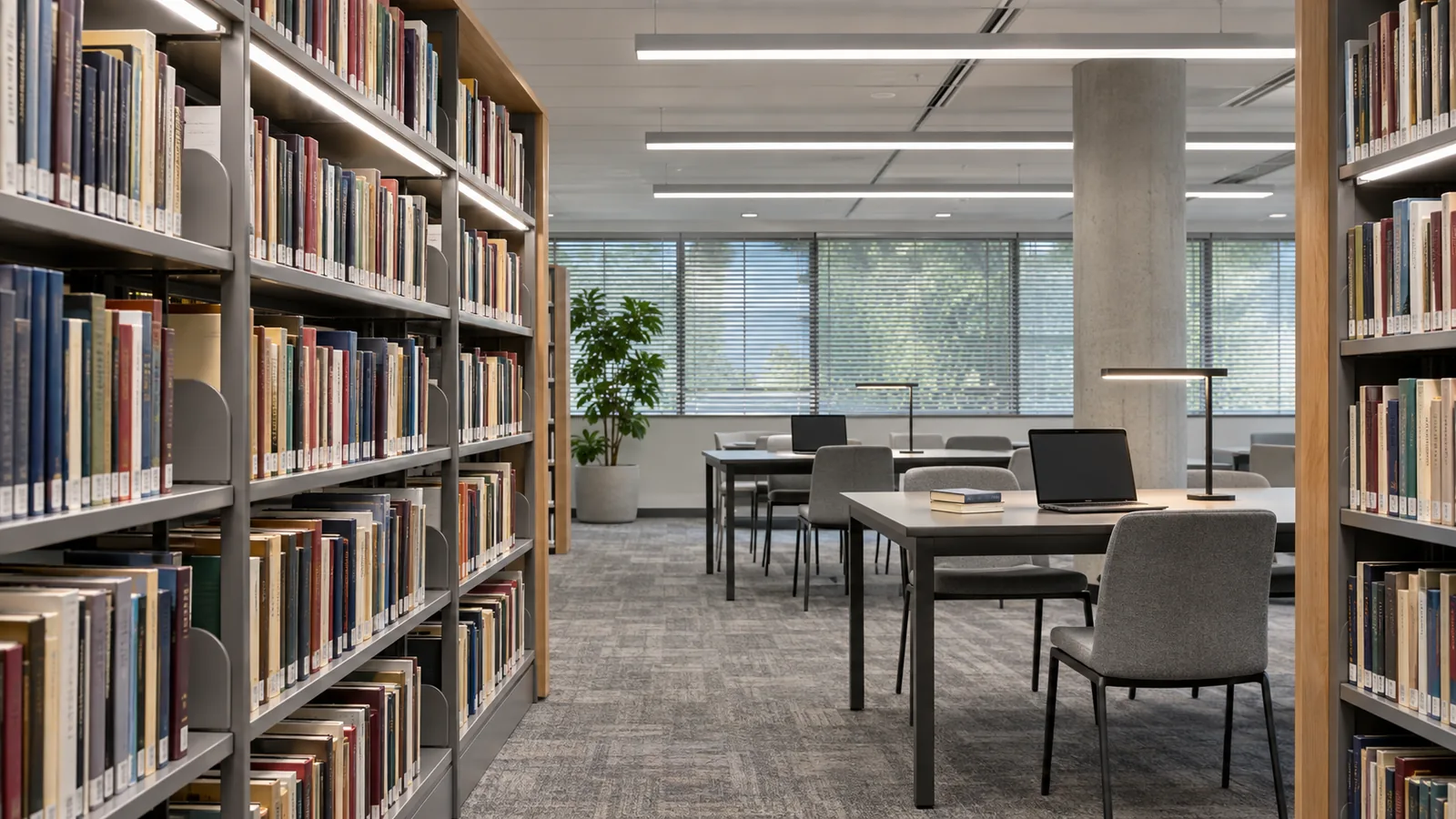
A desk lamp can add flexibility at a fixed reading place, but it should not be used to hide an inadequate general layout. If adjustable task lights are proposed, check power provision, cable management and whether the user can aim them without shining light into a neighbor’s eyes or screen. At long communal tables, consistent ambient light may be more practical than many separate lamps.
Plan daylight and electric light together
Daylight can make a reading area pleasant, but it changes with time and weather. A window can also create strong contrast or screen reflections. Identify which tables and shelves receive daylight and at what times. Review blinds or shades, especially where a low sun angle can reach a reader’s eyes or a computer display. A daylight sensor should respond to a meaningful representative area, not to a patch of sunlight that users cannot actually use.
Separate the window-side luminaires from deeper interior rows where the wiring and control plan permit. Then define what the electric light should do as daylight changes: dim gradually, switch, or remain at a selected scene. The choice depends on the library’s program and control system. Our daylight harvesting checklist explains the sensor-zone questions that also apply here.
Test the daytime and evening result. A layout that looks balanced on a sunny day may leave a dark zone after sunset if the electric lighting was undersized. Conversely, a bright full-output setting that works at night may feel excessive beside a sunlit window. Record settings after commissioning so future staff can understand and adjust the system.
Match controls to how the library is used
Public reading rooms, staff-only stacks, meeting rooms and closing-time cleaning may have different occupancy patterns. A single whole-building switch may be easy to install but wasteful or inconvenient to operate. Divide the plan into understandable zones and define who can override them. Keep circulation and any required safety lighting consistent with the local design requirements.
Occupancy control can make sense in spaces that are intermittently used, but it needs careful placement and timeout settings. A reader may sit quietly for a long period; a sensor should not turn off the light simply because it failed to detect movement. In deep stacks, tall shelves can block a sensor’s view. Test the complete area with the actual shelving in place.
A US Department of Energy New York Public Library project profile describes linear LED luminaires and integrated controls in staff-only book stacks. That is a useful example of controls matched to an occupancy pattern, not proof that the same scheme fits a public reading room. Design the controls for your library’s real hours and users.
Check the complete installed system
Specify the luminaire, optic, driver, mounting hardware and control interface as one combination. A catalogue image may not show the diffuser or distribution that the quote actually includes. Request the exact photometric file and drawing for the selected version. If a custom length or finish is proposed, confirm how it affects the delivered configuration and any supporting data.
Library ceilings often contain sprinklers, air diffusers, acoustic treatments and signage. Coordinate the reflected ceiling plan across trades so a light row is not shifted late without checking the resulting shelf and desk illumination. In a retrofit, verify ceiling structure and access before ordering long continuous runs. A revised row location can change both the visual result and the installation cost.
Maintenance is part of the installed system. Can a driver be reached safely above a tall stack? How is a diffuser cleaned or replaced? Are spare modules and compatible drivers identifiable years later? Record the final configuration and replacement procedure so that a future repair does not introduce a visibly different color or beam into one aisle.
What to send when requesting a supplier proposal
Provide a plan with table and shelving layouts, shelf heights, aisle widths, ceiling conditions, windows and computer locations. Identify public and staff areas, opening hours and any intended control zones. If the furniture may change, state which elements are fixed and which are likely to move. These details allow a supplier to explain assumptions rather than quietly designing for an empty room.
Ask for a proposed fixture schedule, layout, photometric calculation, product drawings, control compatibility, sample availability, maintenance access and warranty terms. Request a specific review of top and lower shelf visibility, reading-table surfaces and screen reflections. If the quote uses a direct-indirect fixture, our direct-indirect linear lighting specification guide gives additional product questions, though the library layout still needs its own validation.
Compare bids on the complete installed outcome, not only lumens per fixture. A lower-cost luminaire may require more units or a more complex mounting pattern. A sophisticated control system may be unnecessary if the library lacks staff to manage it. Conversely, well-chosen zoning can be valuable when public and staff areas have different hours. Ask each supplier to state what it has and has not included.
A practical acceptance walk-through
- Browse a sample stack: inspect top, middle and bottom spines and labels from normal aisle positions with real books on the shelves.
- Sit at the tables: read paper, use a laptop and look toward nearby luminaires and windows from representative seats.
- Check daylight change: test window-side and interior zones under the conditions available, then schedule a follow-up at another time of day if needed.
- Operate the controls: test occupancy, overrides, opening, closing and cleaning scenes with library staff present.
- Complete handover: retain the final layout, product codes, scene settings, service instructions and spare-part references.
Our commercial LED commissioning checklist covers broader handover issues. For a library, the most important extra step is to include the actual collection and desks in the test. Empty shelves, folded tables and a phone photograph can make a weak layout look more successful than it will feel in daily use.
Frequently asked questions
What is the best LED lighting for library book stacks?
There is no single universal fixture. Choose a distribution and layout that make book spines and shelf labels visible from top to lower rows while keeping the aisle comfortable. Use the actual shelf geometry, photometric data and a sample aisle to compare options.
Should reading tables have separate task lights?
Sometimes. Adjustable task lights can help at fixed desks, but they add power, cable and maintenance needs. First check that the general layout supports paper and screen work. Then use task lights where flexibility adds clear value.
How do we prevent reflections on library laptop screens?
Review seating, window direction, blinds, fixture position and distribution with representative screens in place. A bright source reflected in a display may be improved by moving a luminaire row, adjusting the desk layout or controlling daylight. Test the normal user view rather than relying on a floor measurement.
Can occupancy sensors be used in book stacks?
They can be considered where use is intermittent, but shelves can block detection and patrons may remain still. Confirm coverage, timeout, override and local safety requirements with the final stack layout installed.
Is one color temperature required for all library areas?
A coherent appearance is a useful goal, but the project may include different functions and finishes. Compare physical samples under daylight and electric light, and document the selected product versions. Do not choose a fixture from CCT alone.
Design for books, readers and screens together
Good library lighting is judged by the tasks it supports. Map the real furniture, check vertical stack faces, sit at the reading tables, manage daylight and give staff controls they can use. If you are planning a new library or refurbishment, share the plan and task requirements with LCB to discuss fixture options that can be verified against the actual space.
