 跳到内容
跳到内容 
A track adapter can slide into a rail and still be the wrong product for the system. Single-circuit and three-circuit track lighting differ in conductor arrangement, adapter geometry, switching possibilities and project use. The names are also used inconsistently across markets, so buyers should verify the exact manufacturer and profile rather than purchasing by a generic description.
This guide helps retailers, designers, contractors and importers understand the decision. It covers new projects, retrofits, adapter checks, circuit planning and sample approval. Electrical work and compatibility decisions must be confirmed by qualified local professionals using the actual rail and manufacturer documentation.
What a lighting track actually contains
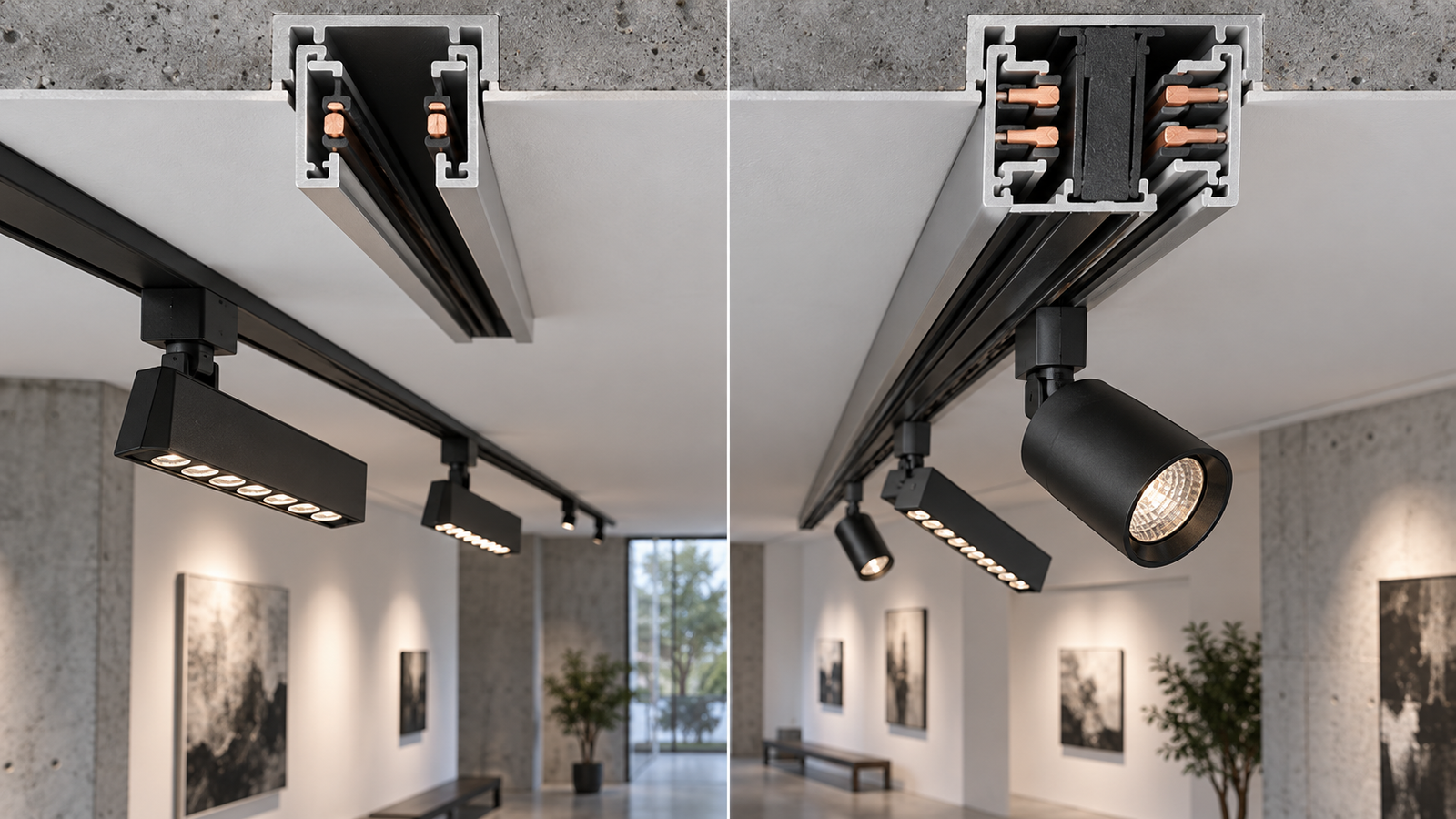
A track is more than an aluminium channel. It combines mechanical support, insulated conductors, protective earthing where required, feeds, connectors, suspension or surface fixings and a specific adapter interface. The complete system is designed around rated voltage, current, loading and permitted configurations.
Because these parts work together, a visually similar adapter should not be forced into an unknown rail. Contacts can align incorrectly, locking may be incomplete, earthing may be compromised, or the fixture may appear to work while remaining mechanically unsafe.
Single-circuit track in practical terms
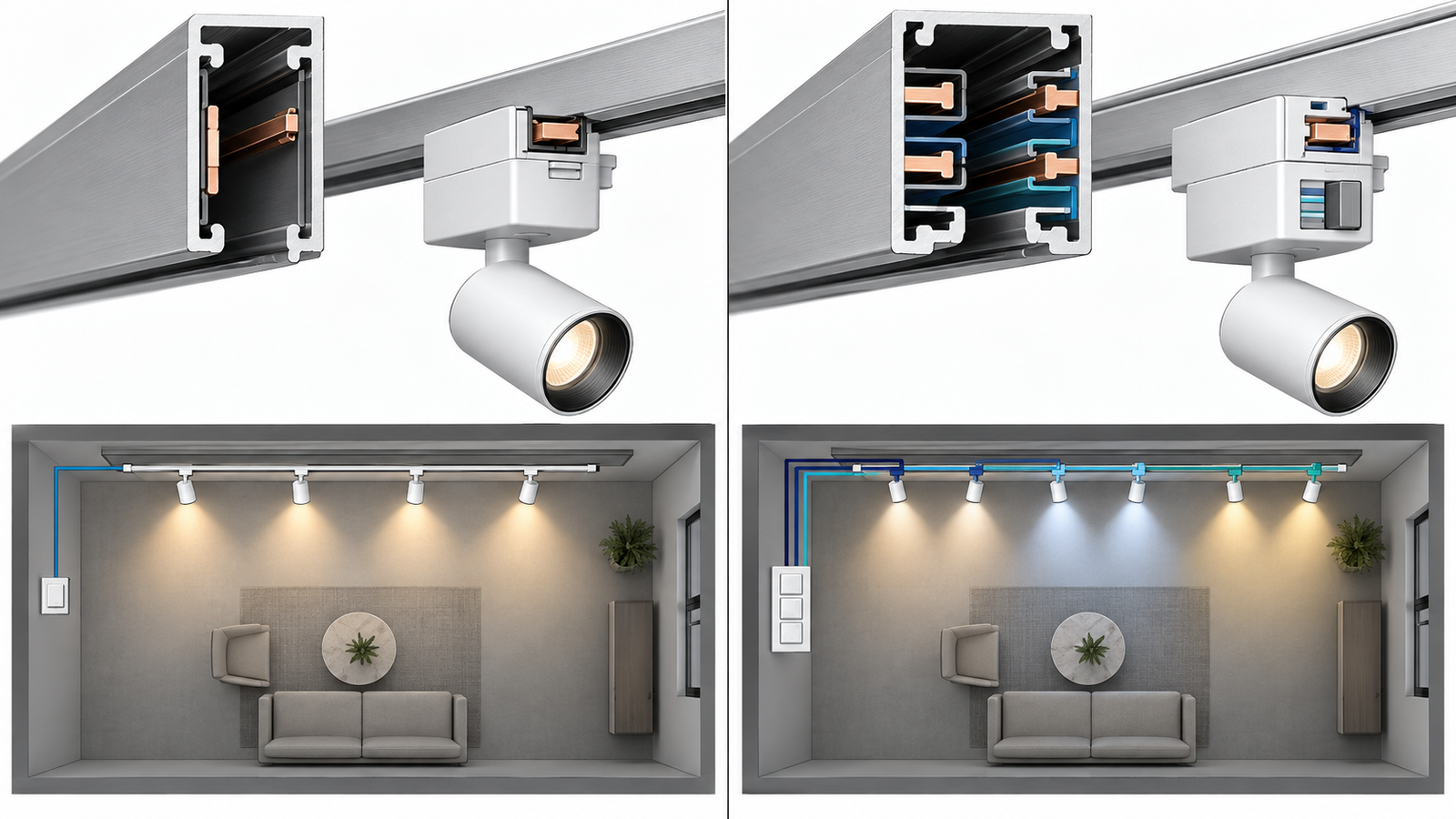
A single-circuit track supplies one switched lighting group along the rail. All luminaires connected to that circuit normally receive power together, although individual luminaires may include local controls or be part of a separate wireless or control system. The track can be compact and straightforward for small shops, residential-style applications and zones where all fittings follow the same schedule.
Its simplicity can reduce component and wiring complexity, but it provides less native flexibility for dividing fittings into separate switched groups. If a store later wants window displays, shelf lighting and general lighting controlled independently, it may need additional tracks, control equipment or rewiring.
Three-circuit track in practical terms
A three-circuit track typically provides three selectable live circuits that share other required conductors according to the system design. An adapter selector allows each luminaire to be assigned to one of the circuits. This lets luminaires on the same physical rail operate in separate switched groups.
For example, one circuit can serve perimeter displays, a second can serve central merchandising and a third can serve promotional features. The designer gains zoning flexibility without installing three parallel rails. However, this is still mains circuit selection; it should not be confused with addressable digital dimming.
Why naming creates procurement risk
Terms such as one-phase, single-phase, single-circuit, three-phase, three-circuit, four-wire and multi-circuit are used differently by sellers. A “three-phase track” listing may refer to a common European commercial format, but the words do not guarantee one mechanical profile or universal adapter.
Use the rail manufacturer, model and drawing as the primary identifier. For a retrofit, provide a dimensioned end-profile photograph and physical sample. For a new installation, select rail, feeds, connectors and adapters as one coordinated system and retain the system documentation.
Compatibility has four separate layers
1. Mechanical fit
The adapter must enter in the correct orientation, lock fully, remain retained under the luminaire load and release using the intended method. Profile width alone is insufficient; locating ridges, slots and locking geometry matter.
2. Electrical contact
Live, neutral and protective contacts must align with the designed conductors, with required clearances and insulation. In multi-circuit systems, the selector must engage the intended circuit without bridging contacts.
3. Load and support
The rail, ceiling fixings and connectors must support the luminaire quantity, mass and leverage. A long linear fixture can impose different moments from a compact spotlight. Obtain weights and load limits from the responsible manufacturers and project engineer.
4. Control compatibility
Selectable mains circuits do not automatically provide DALI, 0–10V or other dimming signals. If controls are required, map their conductors and interfaces separately. A physical adapter fit does not prove control compatibility.
When single-circuit track is the better choice
- The space is small and all luminaires follow one schedule
- The layout is unlikely to require separate switched groups
- Controls are handled through a compatible separate system
- A compact rail is important and loading is suitable
- The project values a simple installation and maintenance approach
Do not choose it only because the rail is cheaper. Include feeds, controls, extra rail runs, wiring and future changes in the cost comparison.
When three-circuit track adds value
- Retail zones need independent switching on one physical rail
- Window, perimeter and central displays have different schedules
- Merchandising changes may require fixtures to be reassigned
- The project wants operational flexibility without relocating rails
- The commercial team can manage circuit labels and commissioning
Three circuits are useful only when the electrical design and operating plan actually use them. Installing multi-circuit track while connecting every fitting to one group adds cost without real benefit.
New-build selection workflow
- Define lighting zones and operating schedules.
- Decide whether switching, dimming or addressable control is required.
- Select a complete track family with compatible feeds, connectors and adapters.
- Calculate electrical load and inrush for every circuit.
- Check mechanical loading, suspension spacing and ceiling structure.
- Coordinate rail positions with shelves, signs, services and sprinklers.
- Install a representative mock-up with intended luminaires.
- Label circuits and document the final configuration.
Keep the track system schedule in the project handover. Future buyers should not need to identify the rail from photographs years later.
Retrofit identification workflow
Start at the electrical distribution information and original drawings. Record the rail manufacturer and model from labels on the rail, live end, connectors or existing adapters. Photograph the open end profile with a scale, the conductor arrangement, selector and locking method. Note every store or zone because chains often contain multiple generations.
Have a qualified electrician confirm voltage, frequency, earthing, number of circuits, switching and condition. Inspect for overheating, damaged insulation, loose joints, corrosion, sagging or inadequate fixings. If the rail is obsolete or unsafe, adapter matching is no longer the main question—replacement should be evaluated.
How to approve a new adapter
Ask the luminaire supplier to state the adapter manufacturer and part number. Send the track model or physical rail sample. The production-intent luminaire should be fitted by a competent person who checks orientation, insertion, selector operation, locking, retention, contact and removal. Do not grind, bend or modify the adapter to make it enter.
Energise only in a controlled and protected setup. Verify each intended circuit, movement of the fixture and stable operation. Record photographs and the approved adapter code for the purchase order.
Planning circuits for a retail store
Group luminaires by operational purpose, not merely by their nearest rail. A practical schedule might separate window displays that run longer, feature lighting used during events and general shelf lighting. Consider cleaning, stocking, emergency arrangements and daylight zones.
Calculate connected load and protective devices using real driver input and inrush information. A circuit with many small LED drivers can present a different switching challenge from the same wattage of older lamps. Let the electrical designer set device quantities.
Using a dual-panel linear fixture
An adjustable dual-panel track light can direct one panel toward each side of an aisle or divide output between a shelf and promotional feature. This mechanical flexibility can make a multi-circuit rail position more useful. However, both panels may share one driver and therefore one circuit assignment.
State whether separate electrical control of the panels is required. Do not assume independent tilt means independent switching. The LL1615 adjustable LED linear track light should be evaluated with the exact adapter and rail chosen for the project.
Common mistakes
Buying by wire count
Conductor number is useful evidence but not a compatibility guarantee. Profile, contacts, keying and manufacturer family also matter.
Calling circuit selection “three-channel dimming”
Three switched mains groups and three dimming channels are not the same. Document controls separately.
Testing an empty adapter
The full luminaire’s weight and movement affect retention. Approve the production-intent assembly.
Ignoring connectors
Straight, corner, T and flexible connectors have orientation and circuit continuity requirements. Review the complete layout, not only straight rail.
Mixing track brands silently
If a project combines systems, label each zone and keep distinct spare parts. Do not let installers choose adapters by appearance.
RFQ checklist
- Country and project type
- New installation or retrofit
- Rail brand, model and drawing
- End-profile and adapter photographs
- Voltage, frequency, earthing and circuit arrangement
- Controls and dimming method
- Luminaire quantity, wattage, weight and adapter code
- Track layout, connectors and suspension
- Required circuit grouping and labels
- Sample-fit and site pilot requirement
- Applicable compliance documents
- Spare adapter and track-part plan
Our RFQ and sample-approval guide can help turn these items into a controlled order.
Final recommendation
Choose the number of circuits from the operating plan, then prove the exact rail and adapter as a system. A three-circuit rail can provide valuable retail flexibility, while a single-circuit rail can be the cleanest solution for a simple zone. Neither is universally better.
If you send us the rail model, profile photos, circuit plan and luminaire requirements, we can help identify the questions that need a sample test. We would rather recommend a controlled fit check than promise compatibility from the phrase “standard track.”

