 跳到内容

Quick answer: A supermarket track-lighting plan should treat shelves, floor, fresh-food counters, end caps and promotional displays as separate visual tasks. Build the general layer first, add vertical merchandise light, then use adjustable fixtures where layouts or priorities change. A dual-panel linear track light can serve two shelf faces or combine shelf and circulation light from one rail position, but the final quantity and aiming must be verified with photometric data.
Supermarkets are difficult to light because the space looks repetitive while the lighting tasks are not. A main aisle, a narrow grocery aisle, a fresh-food counter and a seasonal display may sit under the same ceiling but need different distributions, colour qualities and levels of emphasis. If the design uses one fixture type and one aiming position everywhere, the result is usually either visually flat or unnecessarily bright.
We created this guide to help supermarket operators, consultants, contractors and procurement teams organise the decisions in the right order. It focuses on useful outcomes: readable packaging, comfortable circulation, flexible promotions, predictable installation and lower rework risk.
1. Divide the Store Into Lighting Tasks
Begin with a zone schedule rather than a luminaire schedule. Walk through the customer journey and identify what people must see in each area.
| Zone | Main visual task | Typical design concern |
|---|---|---|
| Entrance and decompression zone | Orientation and first impression | Daylight transition, reflections and visual hierarchy |
| Long grocery aisles | Read labels across vertical shelves | Upper/lower shelf uniformity and glare |
| End caps and promotions | Attract attention | Contrast without excessive brightness |
| Fresh food | Render colours and texture naturally | Spectrum, heat, hygiene and product appearance |
| Checkout | Support tasks and communication | Faces, screens, scanning surfaces and comfort |
| Back-of-house connection | Safe movement and adaptation | Consistency, controls and maintenance |
For each zone, record horizontal and vertical target planes. The floor is one plane; shelf faces, signs and people’s faces are others. This avoids a design that passes a floor measurement but fails the shopping task.
2. Collect Geometry Before Choosing Wattage
We need the physical relationship between track and target before we can judge a fixture. Ask the design team for:
- finished mounting height and suspension depth;
- track centre lines and distance to shelf faces;
- aisle width, shelf height and shelf depth;
- end-cap and promotional-display dimensions;
- ceiling colour and major surface reflectance;
- existing rail brand, conductors and circuit arrangement;
- operating voltage and required control protocol;
- hours of use, cleaning method and maintenance access.
If you are retrofitting an open store, survey several representative aisles. Do not assume every row uses the same dimension. Refrigerated cases, structural columns and service zones can change the geometry enough to require a different optic or aiming position.
3. Build Three Lighting Layers
General and circulation light
This layer supports safe navigation, trolley movement and overall brightness. It should feel consistent without washing out every contrast. Continuous linear lighting or broad-distribution track luminaires may provide the base, depending on the ceiling and store format.
Vertical merchandise light
Packaging is read on vertical and inclined surfaces. Add calculation grids on shelf faces at upper, middle and lower levels. Check whether shelf lips or the merchandise itself creates shadows. A panel tilted toward the shelf can move useful light from the floor to the product.
Accent and promotional light
End caps, new products and campaign displays benefit from contrast. Use separately aimed track spotlights or an adjustable panel only where the target needs it. If every bay receives the same accent, nothing remains visually important.
Controls should follow these layers. Even a simple multi-circuit track can help operations reduce or emphasise selected zones. Addressable control may be appropriate for larger rollouts, but the value comes from an operating plan, not from the protocol name.
4. Why Dual-Panel Adjustment Can Be Useful
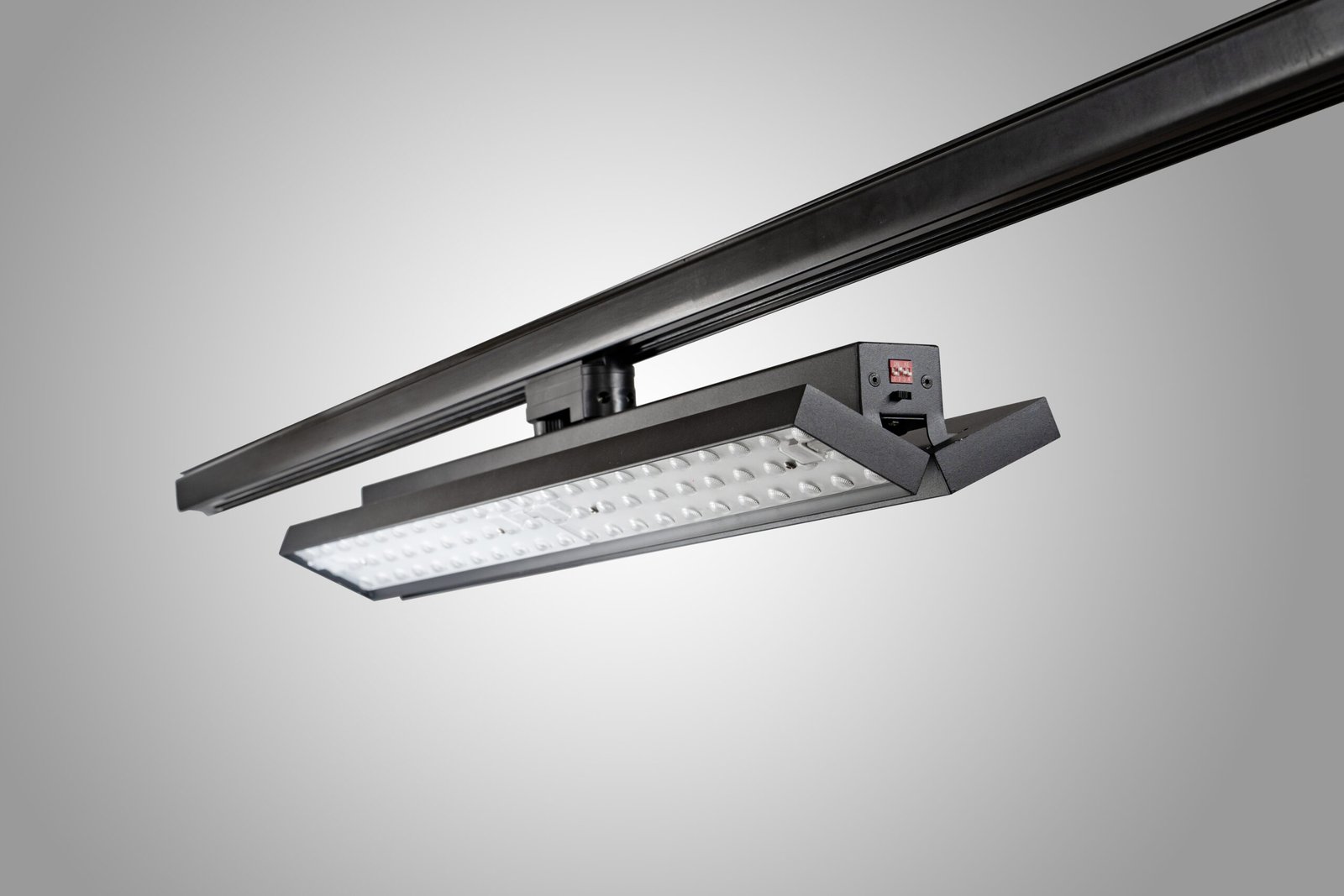
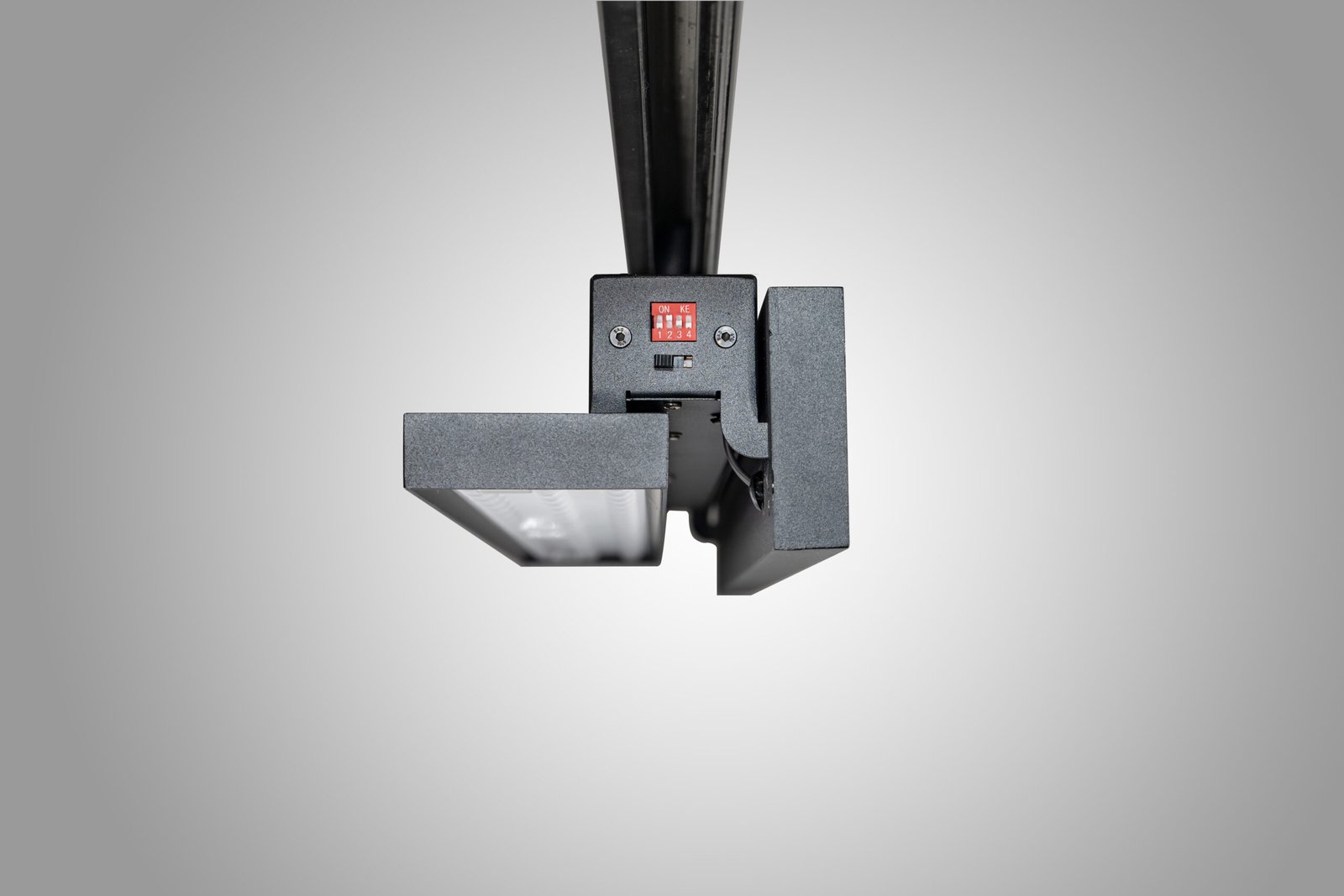
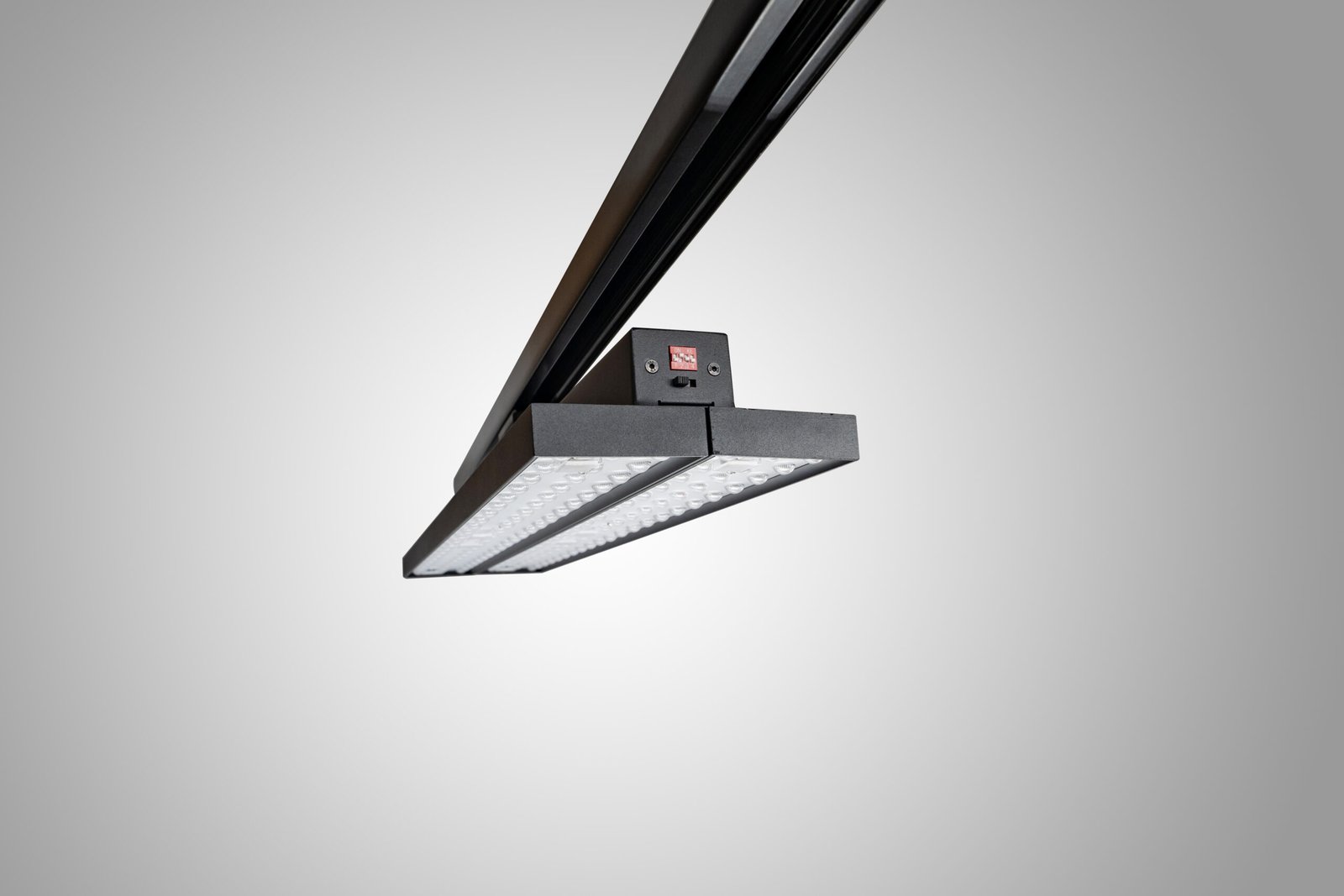
In a two-sided aisle, a conventional downward luminaire can leave both shelf faces weaker than the floor. Tilting it toward one side helps that shelf but harms symmetry. A dual-panel linear track light provides two independent aiming planes from one adapter. One panel can serve the left shelves while the second serves the right, or one can support a shelf while the other contributes to the aisle or an end-cap zone.
Our LL1615 adjustable dual-panel model can rotate up to 350° around the track connection, and each panel tilts independently up to ±90°. It is offered in 27 W, 40 W, 50 W and 60 W versions with 60° or 90° beam options. These features create useful design choices, but they should be treated as inputs to the calculation—not as proof that the fixture suits every supermarket.
See the current specifications on our adjustable dual-panel LED track linear light page, and request the IES/LDT file for the exact version under review.
5. Select the Beam From the Target
A 60° beam is a useful starting point when the target is more defined or the throw is longer. A 90° beam may suit a broad close surface or low mounting condition. Because shelf lighting is usually oblique, the projected footprint is elongated and cannot be judged from a simple circular beam diagram.
Compare options in software using the actual panel tilt. Review:
- average, minimum and maximum vertical illuminance;
- uniformity from the top to the bottom shelf;
- overlap between adjacent fixtures;
- light lost above the shelf or into the aisle;
- direct view of the optics from each walking direction;
- reflections on glossy packaging, doors and screens.
If the 60° option creates bright scallops, try spacing or aiming changes before increasing fixture quantity. If the 90° option produces too much spill, a narrower distribution or a different track position may improve both comfort and efficiency.
6. Choose Colour Quality for the Merchandise
Colour rendering should follow the product category. General packaged goods may have different needs from meat, produce, bakery goods, fashion or cosmetics. A single CRI number is a starting point, not the complete colour story. Ask for the available CCT, CRI and any relevant spectral information, and view real merchandise under an approved sample.
Our dual-panel family offers CRI options above 80 or 90 according to the selected configuration. If brand colours or fresh products are critical, specify the required version in the order code and approve it visually. Also confirm colour consistency across the rollout and replacement batches; mixed white appearance can make a long aisle look poorly maintained even when illuminance is adequate.
7. Control Glare From the Shopper’s Viewpoint
Supermarket shoppers look up and across shelves while moving. That makes direct view of a tilted panel an important risk. Inspect the design from both ends of every representative aisle, from checkout queues and from low or high viewing positions where staff work.
Practical glare controls include:
- adjusting track setback and panel tilt;
- using the narrower verified beam to reduce spill;
- selecting optics with good shielding and controlled high-angle light;
- avoiding excessive output that cannot be dimmed or switched;
- coordinating track orientation with the customer approach direction;
- checking reflections in refrigerated doors and glossy packaging.
Do not solve a dark shelf by pointing a bright source directly across the aisle. Correct the geometry, distribution and spacing first.
8. Plan Track Compatibility and Loading
“Fits standard track” is not enough for a tender. Confirm the rail manufacturer or provide a physical sample. Record conductor count, circuit selection, voltage, polarity, adapter dimensions and the allowable mechanical load of the complete rail and suspension system.
A dual-panel luminaire is larger than a compact spotlight. The contractor should check clearances, mounting orientation, spacing around sprinklers and signs, and whether the rail remains stable when panels are tilted. For an existing installation, inspect the rail condition and connection points rather than assuming the original system can accept any new fixture.
For European and Australian projects, ask for the documentation required by the destination and project specification. Certification scope should match the final driver, adapter and luminaire configuration.
9. Model a Representative Bay, Then Test It
A supermarket may contain hundreds of similar bays, so a small error repeats at scale. Use a representative section in DIALux or other suitable software, then construct a physical mock-up with real shelves and sample products.
Desktop calculation checklist
- correct room and shelf geometry;
- verified surface reflectance;
- exact IES/LDT files;
- realistic maintenance factor;
- vertical and horizontal grids;
- end-of-row conditions;
- emergency and control requirements kept separate.
Mock-up checklist
- measure at multiple shelf heights;
- walk in both directions and check glare;
- compare 60° and 90° if uncertain;
- test at full output and intended operating level;
- check packaging colours, labels and reflections;
- time installation and aiming;
- record the approved panel angles.
The mock-up should include the people who operate the store. A lighting designer may approve the visual result while maintenance staff identify access or adjustment problems that would be expensive across a chain.
10. Make the RFQ Easy to Answer Correctly
A useful supermarket lighting RFQ includes drawings, quantities by zone, voltage, track details, CCT, CRI, beam, power, controls, finish, certification, photometric files, sample requirement and delivery programme. If the store will be rolled out in phases, include forecast quantities and required batch-consistency expectations.
Ask the supplier to identify assumptions and exclusions. For example:
- Is the quoted lumen value for the complete luminaire?
- Does the photometric file match the ordered lens and CRI?
- Are driver and track adapter included?
- Is dimming standard or optional?
- Which reports are available before shipment?
- How will samples be compared with mass production?
- What information is needed for a project calculation?
Our lighting RFQ and sample approval guide can help you prepare a clearer package.
11. Commission and Document Every Repeating Layout
Commissioning is not simply switching the lights on. Aim the panels, measure the target planes, confirm controls and document the result. Create an aisle-type schedule so installers can repeat approved positions across the store.
Include fixture ID, optic, power, track circuit, panel direction, nominal tilt and the target served. Photograph a reference bay. Keep the approved sample and photometric revision with the handover documents. These records make future merchandise changes and replacement orders faster.
12. Review Energy and Maintenance as a System
Connected load matters, but operating hours and control behaviour determine annual energy use. Compare designs at the verified light level. A lower fixture count is not automatically more efficient if each luminaire is oversized or poorly aimed. Likewise, a higher count can create better uniformity at lower power, but may increase installation and maintenance work.
Evaluate:
- total connected load by zone;
- expected operating schedule;
- daylight or time-based control opportunities;
- driver replacement access;
- availability of lenses, adapters and replacement modules;
- cleaning frequency for exposed optics;
- consistency of future production batches.
Frequently Asked Questions
Can one dual-panel track light illuminate both supermarket shelves?
It can in suitable geometry. Each panel must reach its target with acceptable vertical illuminance, uniformity and glare. Verify a calculation and mock-up before a large rollout.
Should both panels use the same angle?
Not necessarily. The mechanical tilt can differ. If you require different optical lenses on the two panels, confirm that configuration and obtain matching photometric data from the supplier.
Is the highest wattage safest?
No. Excess output can increase glare and energy use. Choose the lowest verified configuration that meets maintained targets and operating requirements.
Can the fixture replace general linear lighting?
Sometimes, especially where the panels are aligned for broad coverage, but the project still needs an ambient-light calculation. A hybrid scheme may be more appropriate.
What should we send for a proposal?
Send the plan, aisle section, shelf dimensions, track details, target illumination, voltage, control method, CCT/CRI, destination, certification needs and project schedule.
Final Recommendation
Plan supermarket lighting from the merchandise outward. Separate shelf, floor and promotional tasks; verify each with the correct calculation plane; and reserve adjustment for zones that genuinely benefit from it. A dual-panel track light can reduce ceiling clutter and give two targets independent direction, but its value comes from a documented design and commissioning process.
If you share a representative aisle plan and section, we can help you compare panel aim, 60° and 90° options, power packages and track compatibility before sample approval.
