 跳到内容

The optical cover on a linear luminaire is not a minor cosmetic detail. It influences how the light is distributed, how the fixture appears from below, how bright individual LEDs look and how much useful light reaches the task. Two fixtures with the same aluminum profile and electrical power can feel entirely different when one uses a prismatic lens and the other an opal diffuser.
This comparison helps commercial buyers ask better questions when selecting office, retail or industrial linear lighting. “Prismatic” and “opal” are broad families, not single performance standards. Actual behavior depends on the material, microstructure, LED layout, cavity depth and complete luminaire design. Use current photometric files and samples for the exact proposed configuration.
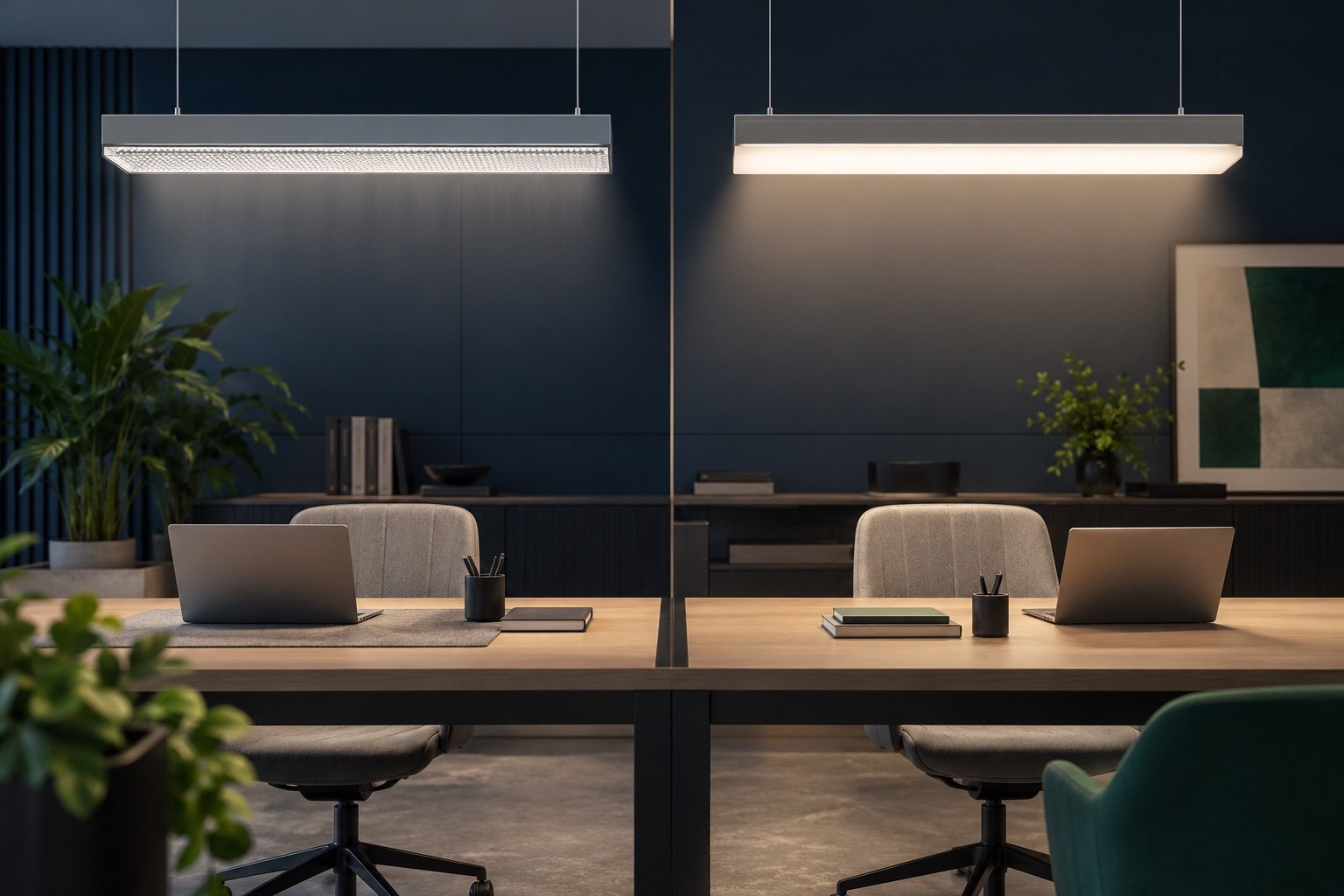
What an opal diffuser typically does
An opal diffuser scatters light to create a more uniform luminous surface. It can make individual LED points less visible and give a clean, continuous appearance in a corridor, office or suspended line. This quality can be valuable when the fixture itself is in the field of view. However, the amount of scattering affects optical transmission and distribution. A heavily diffusing cover may require a different LED or power configuration to deliver the desired task light.
Inspect the diffuser in the actual profile. A shallow cavity or wide LED spacing may still reveal hot spots. Also look at joints between modules: a continuous-looking center can be undermined by dark connector gaps or bright end effects. A sample of one short module may not show the appearance of a long installed run.
What a prismatic lens can offer
A prismatic or microprismatic optic uses shaped surfaces to redirect light. Depending on its design, it may help manage high-angle brightness and direct more light toward a useful area. Some buyers choose it for visual comfort in workspaces or for an industrial platform that needs controlled output. But “microprismatic” printed on a datasheet does not guarantee low glare in every room. The luminaire’s geometry, mounting height, orientation and surrounding surfaces remain important.
View the optic from multiple angles. A textured lens may appear more technical or sparkling than an opal surface. That visual character may fit one project and conflict with another. Ask for the tested photometric distribution for the chosen lens, not a generic file for the housing.
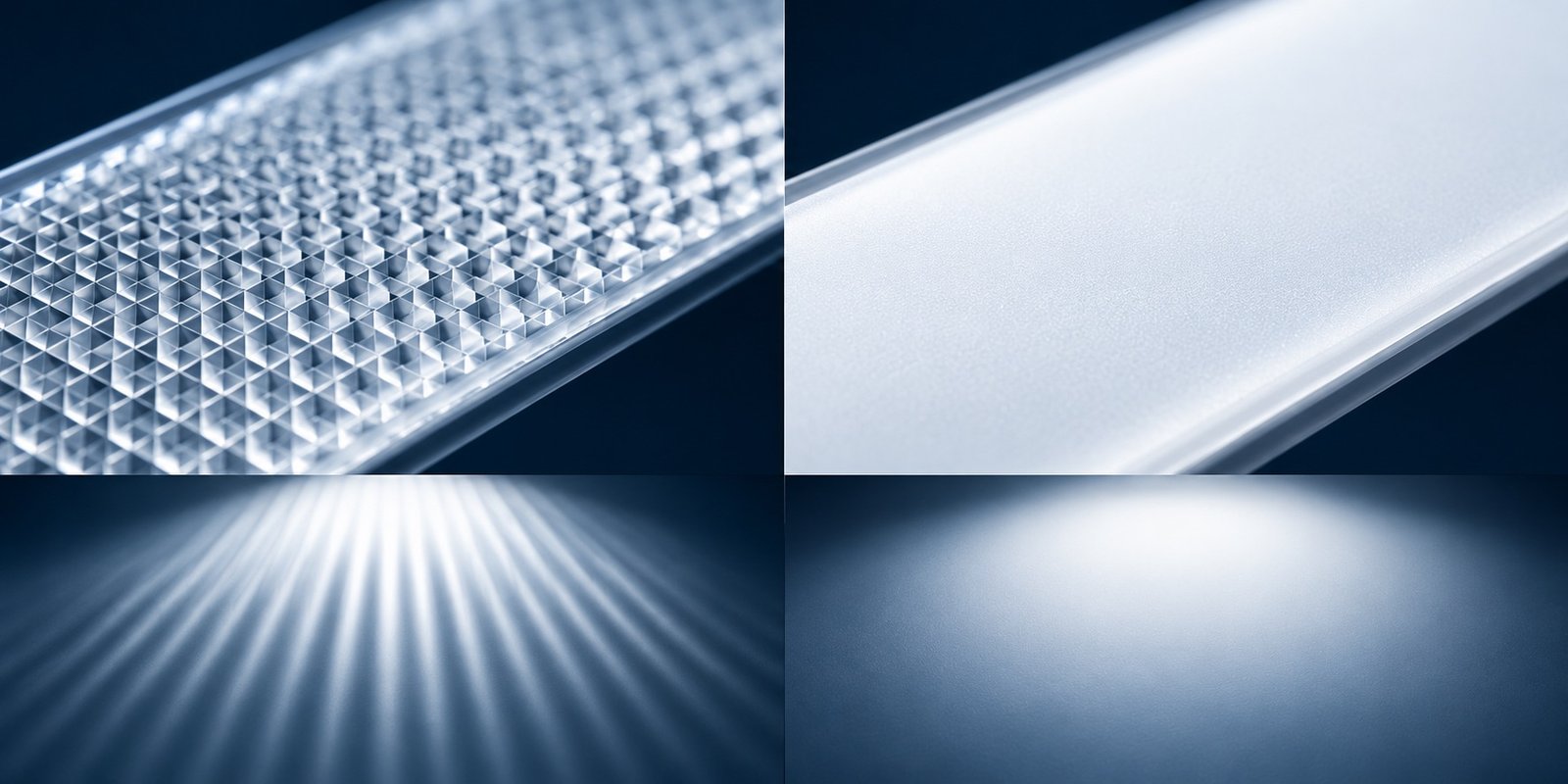
Compare on the same basis
When comparing two options, keep the luminaire length, LED board, drive setting, CCT and installation geometry as similar as possible. Otherwise, a difference in lux or apparent brightness may come from the electronics rather than the cover. Compare the complete fixture’s measured output, distribution and electrical power. Evaluate both horizontal and vertical task surfaces where relevant.
Do not rely on a single efficacy number. A slightly lower total lumen value can still produce more useful light on the intended plane if the distribution is better suited to the room. Conversely, an efficient optic with harsh brightness in normal viewing directions may be a poor choice for a low ceiling. The decision is application-led.
Glare requires context
People often ask which cover is “anti-glare.” Neither term answers that by itself. An opal diffuser can create a broad, luminous surface that is comfortable in one layout but visually prominent at another viewing angle. A prismatic lens can control certain directions but still show bright patterns if the geometry is unsuitable. Request project-specific assessment rather than a universal claim.
For offices, look at desks, screens and normal lines of sight. For retail, inspect the view from aisles and the effect on merchandise. For warehouses, consider mounting height, rack geometry and worker tasks. A mock-up should include the real ceiling and surface finishes, because reflections can dominate the perceived result.
Appearance, dirt and maintenance
Optical surfaces must survive handling and cleaning. Ask how the cover is removed, what cleaning method is permitted and whether a replacement lens is available. A microprismatic surface may collect visible dust in one environment; an opal cover may show scratches or yellowing depending on material and exposure. The actual material specification and maintenance instructions matter more than the label alone.
For linkable systems, inspect how each optic meets the next at joints. Are there shadow lines, visible fasteners or mismatched tint between batches? Ask the supplier whether replacement covers can be ordered by lot or specification. If the system will be installed in a dirty industrial area, cleaning access may outweigh a small difference in initial optical performance.
Use a decision matrix rather than a slogan
- Visual priority: Is the fixture intended to disappear as a smooth luminous line or to direct light precisely?
- Task priority: Which surfaces need light, and what distribution supports them?
- Viewing priority: From where will occupants see the optic?
- Integration: How does the cover look at joints and end caps?
- Maintenance: Can the cover be cleaned and replaced without damage?
- Evidence: Is the IES/LDT file for the exact optic and drive setting?
Lowcarbon’s linear lighting platforms include linkable and prismatic-lens options. Send your ceiling height, run length, application and visual priorities through the project inquiry form so the relevant optic can be shortlisted. The homepage gives the wider product and OEM/ODM context.
Set up a fair side-by-side sample
Install both options at the proposed mounting height and spacing, with the same CCT and comparable electrical input. Observe them from the entrances and seating or work positions that matter. Place a neutral surface and the actual materials underneath: a desk with a monitor, a retail shelf, or a workbench. If possible, measure illuminance on the target plane and photograph both options with fixed exposure. Ask the supplier to identify the tested optic code on each sample.
Compare the appearance when the lights are off as well as on. An opal cover may create a calm white band in an exposed architectural line; a prismatic cover may reveal texture. When the system is recessed, the visible trim width and ceiling interface may dominate. Check end caps and joints from normal viewing distances, not just a close-up at the review table.
Questions for a desk-based calculation
Ask the designer to compare the two options using the same room geometry, surface reflectance, mounting height and maintenance assumptions. Review horizontal and vertical illuminance as needed, not only one average figure. If visual comfort is a priority, agree the relevant assessment method and viewpoints. A manufacturer’s isolated “low-glare” claim is not a project calculation.
Check whether the photometric data represents the final optical cover and output setting. If a supplier changes from opal to microprismatic late in procurement, the calculation may need to be rerun. Avoid approving the appearance of one sample while ordering a model code that points to the other optic.
Other variables that can dominate the result
LED pitch and cavity depth influence whether individual sources are visible through either cover. A deeper profile may blend light more effectively than a shallower one with the same diffuser material. Drive current affects source brightness. Surface finish inside the housing can alter distribution. These factors explain why judging a loose sheet of diffuser material is insufficient; the entire luminaire must be tested.
Mounting orientation matters too. A linear fixture perpendicular to the main sightline may create a different visual impression from one parallel to it. In a low office, occupants may view the fixture for long periods; in a high warehouse, they may see it mainly from below. The preferred cover should follow the actual viewing environment.
Cost and replacement planning
Compare total installed cost, not just the cover price. A change in optic may require a different LED board or driver setting to meet the target plane. It may also affect cleaning frequency or spare inventory. Ask whether replacement covers can be supplied later in matching dimensions and appearance. For a long continuous run, one mismatched replacement section can be more noticeable than a small performance difference in the original choice.
A concise decision record
Document the chosen optic code, fixture length, drive setting, CCT, measured file revision, sample ID and the reason for selection. Note any rejected option and why. This record prevents a value-engineering change from being described merely as “same linear light with another diffuser.” It also helps the owner order visually compatible replacements in the future.
Examples by application
In an open-plan office with many screens, a designer may prioritize controlling high-angle brightness and reflections while still achieving sufficient task light. A well-designed prismatic optic could be a candidate, but the result must be checked in the actual geometry. In a hospitality corridor where the luminaire is intentionally visible as a calm line, a smooth opal appearance may be more important. Neither example is a universal prescription; ceiling height and viewing direction can reverse the preference.
In a supermarket or industrial service area, ease of cleaning and useful vertical or horizontal light may dominate. A textured optic that collects dirt or a diffuser that is hard to remove could increase maintenance burden. If impact or moisture is possible, ask about the complete fixture’s protection and material suitability rather than attributing those properties to the cover name. In a retail display, compare how products and signs look under the full lighting scheme, not the linear luminaire alone.
What a supplier comparison table should show
Request two rows for the exact options under consideration, with model code, optic code, rated power, measured lumens, photometric file revision, dimensions, mounting method and replacement-cover part number. Add a column for the designer’s assessment of target illuminance and glare, plus a column for the owner’s visual preference from the mock-up. This makes the trade-off explicit and prevents a salesperson’s generic “better diffuser” claim from deciding the project.
Frequently asked questions
Is an opal diffuser always more comfortable?
No. Comfort depends on luminance, viewing angle, fixture size and room layout. Compare samples in the actual application.
Is a prismatic lens always more efficient?
No. Performance varies by design. Compare measured complete-luminaire data for the proposed options.
Can I use the same photometric file for both covers?
Not unless the supplier confirms that the file represents the exact chosen optical configuration. A cover change can alter distribution.
Which is better for a continuous run?
Choose based on the intended visual line, task distribution, joints and maintenance needs. Test several connected modules before approval.
What sample should I ask for?
Request the final profile, LED board, optic, driver and mounting arrangement, ideally with a joint and end cap included.
