 跳到内容
跳到内容 
The linear light diffuser affects much more than the appearance of the luminous line. Its material and optical structure influence transmission, glare, LED visibility, impact resistance, heat behavior, color shift and long-term service. At LCB Light, we first separate two questions that are often mixed together: PC and PMMA describe material families, while “microprismatic” describes an optical surface pattern that may be produced in different materials.
This guide helps buyers define the performance they need instead of choosing a diffuser from a single catalogue word.
What an opal diffuser does
An opal cover scatters light so individual LEDs and board patterns are less visible. More diffusion usually improves visual uniformity but can reduce transmitted output. The result depends on thickness, additives, profile depth, LED pitch and the distance between the LED board and diffuser. Two covers both called “opal PC” can therefore look and perform differently.
For a continuous line, inspect joints and end regions as well as the center of one module. Our guide to continuous light without dark spots explains why diffuser choice must be coordinated with LED pitch and mechanical connections.
Why buyers choose polycarbonate
Polycarbonate is commonly selected where impact resistance and toughness matter. It can suit public areas, transport-related projects, schools or installations exposed to handling. Its heat resistance can also be useful around compact, higher-output profiles. However, optical transmission, UV stability, flame performance and yellowing resistance depend on the specific grade and additives.
Ask for the resin grade or relevant material declaration when the project has a defined impact, fire or UV requirement. “PC” alone is not a complete performance specification.
Why buyers choose PMMA
PMMA is valued for optical clarity and stable appearance in many indoor lighting applications. It can achieve high transmission and a crisp surface, making it attractive for architectural profiles. Compared with typical PC, it is generally more brittle and should be protected from impacts and assembly stress.
The best choice depends on the real environment and profile design. A material with excellent laboratory transmission may still show LED dots if the optical geometry, opacity and mixing distance are not coordinated.
What microprismatic optics change
A microprismatic surface redirects light through a repeated small-scale pattern. It can help control high-angle intensity and support lower-glare designs while maintaining more directional efficiency than a heavily diffused opal cover. The exact prism geometry, substrate, orientation and secondary optical layers determine the distribution.
Microprismatic does not automatically mean UGR<19. The final glare result depends on luminance, luminous area, output, room and layout. Review the IES/LDT file and a project calculation, then inspect a sample at the intended viewing angle.
Compare the options against the application
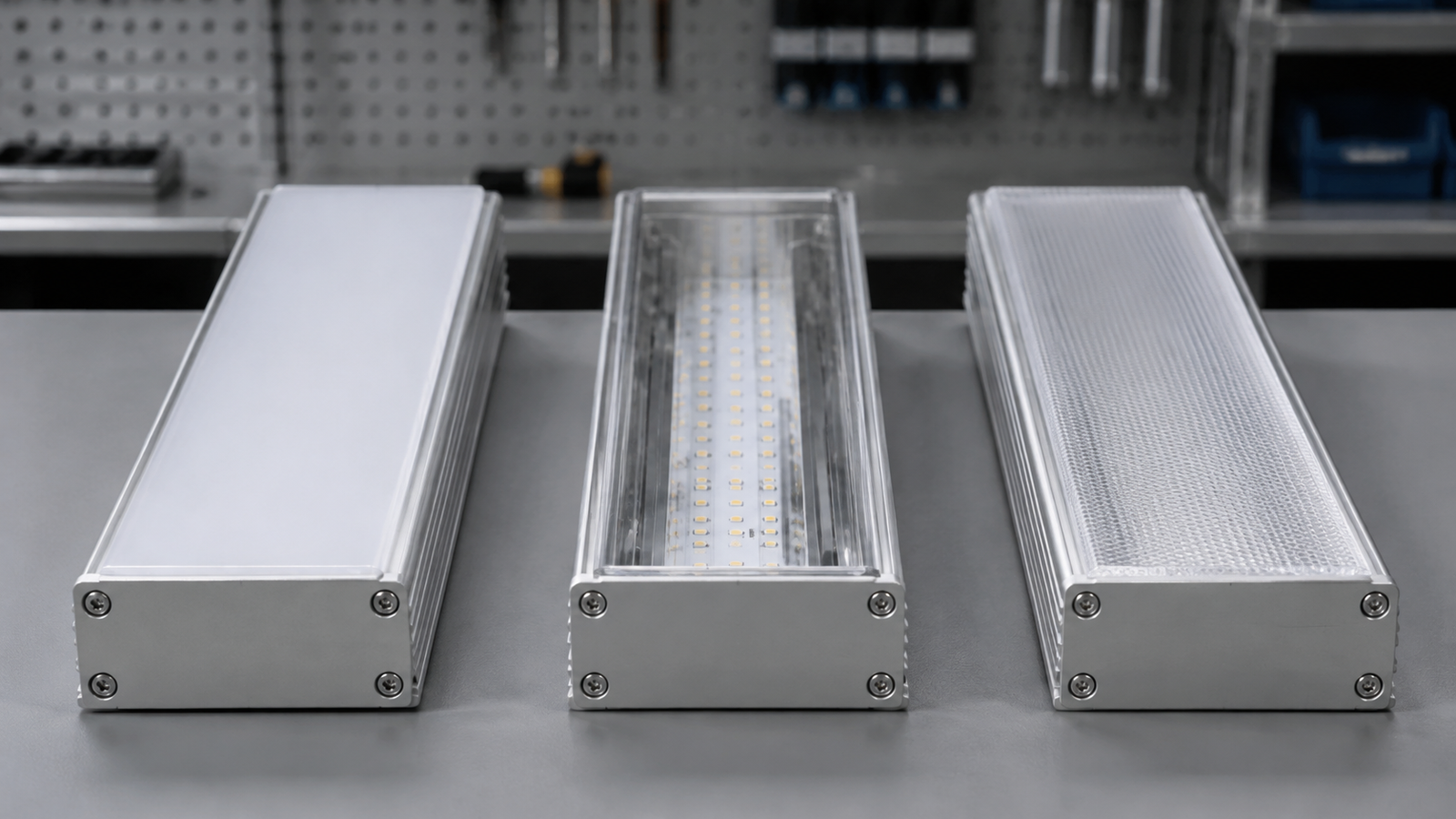
| Question | PC option | PMMA option | Microprismatic option |
|---|---|---|---|
| Primary reason to consider | Toughness and impact performance | Optical appearance and clarity | Controlled distribution and glare strategy |
| Main point to verify | Grade, UV and flame performance | Brittleness, mounting stress and environment | Material, orientation and photometric result |
| Sample check | Fit, scratches, yellowing evidence | Uniformity, cracking and surface | Brightness by angle and pattern visibility |
This table is a shortlisting aid, not a universal ranking. Specific grades can behave differently.
How heat and LED pitch affect the result
A diffuser does not operate alone. High LED current, insufficient aluminum mass or restricted airflow can raise internal temperature. The cover may warp, discolor or become difficult to remove if the material and profile are not designed together. Ask for temperature testing from the intended output and ambient condition.
LED pitch and optical distance control spotting. A shallow profile with widely spaced LEDs may need stronger diffusion, which can reduce efficiency. A deeper mixing chamber may produce a smooth line with a clearer material. This is a system trade-off, not only a material choice.
Sample approval and quality control
Approve color, opacity, fit, surface texture, luminous uniformity and removal method. Compare samples after warm-up and at full and dimmed output. For long runs, examine seams from normal viewing distances. Define whether small extrusion lines, color variation or joint visibility are acceptable.
During production, check material identification, dimensions, clip retention and optical consistency by batch. If the diffuser supplier or resin changes, the buyer should be notified because transmission and appearance can change even when the nominal material name remains the same.
Illustrative selection scenarios
For a low-level school corridor, impact resistance and secure retention may lead the team toward a suitable PC grade, subject to fire, UV and optical checks. For a protected decorative pendant in a hotel lobby, a PMMA solution may be shortlisted for its surface and optical appearance. For a screen-heavy office, a microprismatic optical system may be considered to manage high-angle intensity. These are starting hypotheses, not automatic material rules.
In each case, request complete-luminaire data. The corridor sample should be checked for impact and removal, the pendant for continuous visual uniformity, and the office optic in a glare calculation. A material can be technically strong yet wrong for the visual or regulatory context.
Cleaning, handling and service life
Cleaning chemicals, abrasive cloths and repeated removal can scratch, craze or stress optical covers. Ask for cleaning instructions and train maintenance teams. Protective film should remain until the appropriate installation stage, but it must be removed before handover. Long diffusers also need packaging that prevents bending and surface marks.
For replacement stock, store parts flat or as the manufacturer recommends, protected from heat and sunlight. Label the material and batch. A replacement that looks similar when unlit may transmit or diffuse differently once installed beside the original run.
Questions that make supplier answers comparable
- What is the actual substrate and grade?
- What transmission is measured in the complete luminaire?
- Which impact, flame, UV or temperature evidence applies?
- How does the optic change IES/LDT distribution and efficacy?
- What maximum continuous operating temperature was evaluated?
- Can the diffuser be removed and replaced without damage?
- How are material or supplier changes controlled?
These questions move the conversation from “PC is stronger” or “PMMA is clearer” to evidence that relates to the proposed product.
Approve appearance under realistic conditions
Mount the sample at the intended height and view it from normal paths, not only on a desk. Compare full output and dimmed levels, because lower current can make LED spacing more visible. Inspect the end cap, joint and feed region. If a microprismatic pattern is visible, decide whether that texture supports the design language. Record the approved sample with photographs and the exact diffuser code.
Write performance, not brand shorthand
A robust specification can state the required luminous uniformity, transmission or efficacy outcome, impact or fire classification, UV/environmental condition, glare result, fit and service method. The supplier can then identify the suitable PC, PMMA or patterned optical construction and provide evidence. This is safer than prescribing a material name while leaving the actual risk uncontrolled.
When appearance is critical, attach an approved physical sample and define whether substitutions require reapproval. Optical covers are visible components; a change can alter brightness, color and joint appearance across an entire ceiling. Treat the diffuser code with the same revision discipline as the driver and LED board.
Turn the technical finding into a purchasing decision
A useful specification states the application, exact luminaire configuration, operating conditions, required evidence and acceptance method. At LCB Light, we encourage buyers to separate mandatory performance from preferences and to approve one production-intent sample. That makes quotations comparable and gives production inspectors a clear reference.
Keep the approved product code, drawing, driver, optic, test file and finish in one project package. If any of those items changes, review the effect before shipment. This simple change-control step protects the result more effectively than adding more marketing adjectives to the purchase order.
Our material-selection approach
At LCB Light, we ask the buyer which failure would be most costly: visible LED dots, excessive glare, impact damage, yellowing, low output or difficult maintenance. We then compare diffuser samples and photometric data from the intended profile. This keeps the decision connected to the project rather than to a simplified PC-versus-PMMA debate.
For an RFQ, specify the optical appearance, impact or fire requirement, environment, glare target and expected service conditions. Allow the manufacturer to propose a tested material and then approve it as part of the production-intent sample.
Frequently asked questions
Is PMMA always brighter than PC?
Not necessarily. Specific formulation, opacity, thickness, surface structure and geometry determine delivered transmission. Compare measured complete-luminaire data.
Is microprismatic a material?
No. It describes an optical pattern. The patterned sheet or cover can use a chosen substrate, so ask what material is actually supplied.
Which diffuser is best for offices?
The answer depends on glare target, output, appearance, impact risk and layout. A calculated optic and full-size sample are more useful than a generic material ranking.
Discuss Your LED Linear Lighting Project
Share your layout, mounting height, target light level, optic, control and destination-market requirements. The LCB Light team can help you prepare a project-specific configuration and sample plan.

