 跳到内容

A commercial LED luminaire may look identical to the approved sample while containing a different driver, LED board, optic or power setting. For importers and lighting brands, that is why OEM/ODM traceability matters. The purpose is not to create paperwork for its own sake; it is to connect the design that was approved to the components installed, the tests performed and the cartons shipped. If a field issue appears, a usable record helps identify the affected batch without guessing or recalling the entire product family.
This guide explains what a practical traceability plan can look like from PCB mounting to final shipment. It is a buyer checklist, not a claim that every factory already operates exactly this system. The appropriate detail depends on product risk, market requirements, order size and the supplier’s process. Agree the required records before production and inspect a sample record, not just a statement that “full traceability” is available.
Define the approved configuration
Start with a controlled specification for the exact luminaire. Include model and revision, mechanical drawing, LED board, driver, optic, housing, finish, CCT, wattage or selectable settings, control interface, labels and packaging. Reference the approved physical sample and the test documents relevant to the target market. Assign one revision code that all parties use. A vague product name such as “commercial downlight 30 W” is not enough to distinguish meaningful differences.
For an ODM design, record who owns the drawing and who can authorize a change. For an OEM product made to a brand’s specification, define which substitutions require written approval. A supplier may have legitimate reasons to change a component—availability, improvement or compliance—but the buyer needs to know what changed and whether the photometric, electrical or installation behavior is affected. The change-control rule should be written before a shortage forces a hurried decision.
Create a short configuration matrix if the range has several versions. One housing may be sold with multiple CCTs, beams, drivers or finishes. Give each build a unique identifier or a clear option code. The factory work order, carton label and buyer’s purchase order should refer to the same code. Otherwise a batch can be electrically correct yet wrong for the intended site because an optic or finish was mixed up.
Link component lots to production orders
At PCB mounting, record the LED board design and revision, relevant material or component lots, assembly date and work order. The exact data fields should suit the process; the goal is to know which finished luminaires received a particular board or critical component. A line photograph is useful for showing the production setting, but it cannot replace a lot ledger or barcode record. Ask the factory to show an anonymized example of how a component batch maps to finished goods.
The driver is another critical identifier. Record manufacturer, model, revision and lot where practical. A substitution can change electrical behavior, dimming compatibility or thermal characteristics even if the connector fits. Optics and reflectors can change distribution; gaskets or cable glands can affect suitability for a specified environment. The traceability plan should prioritize parts whose change would matter to safety, performance or the buyer’s approved appearance.
A record is only useful if it survives normal factory operations. Labels can fall off, handwritten codes can be misread and data can be entered late. Ask how parts are checked at issue to production, how exceptions are recorded and how the finished fixture receives an identifier. The buyer need not dictate one software system, but should be able to follow a sample unit backward from its carton to its key components.
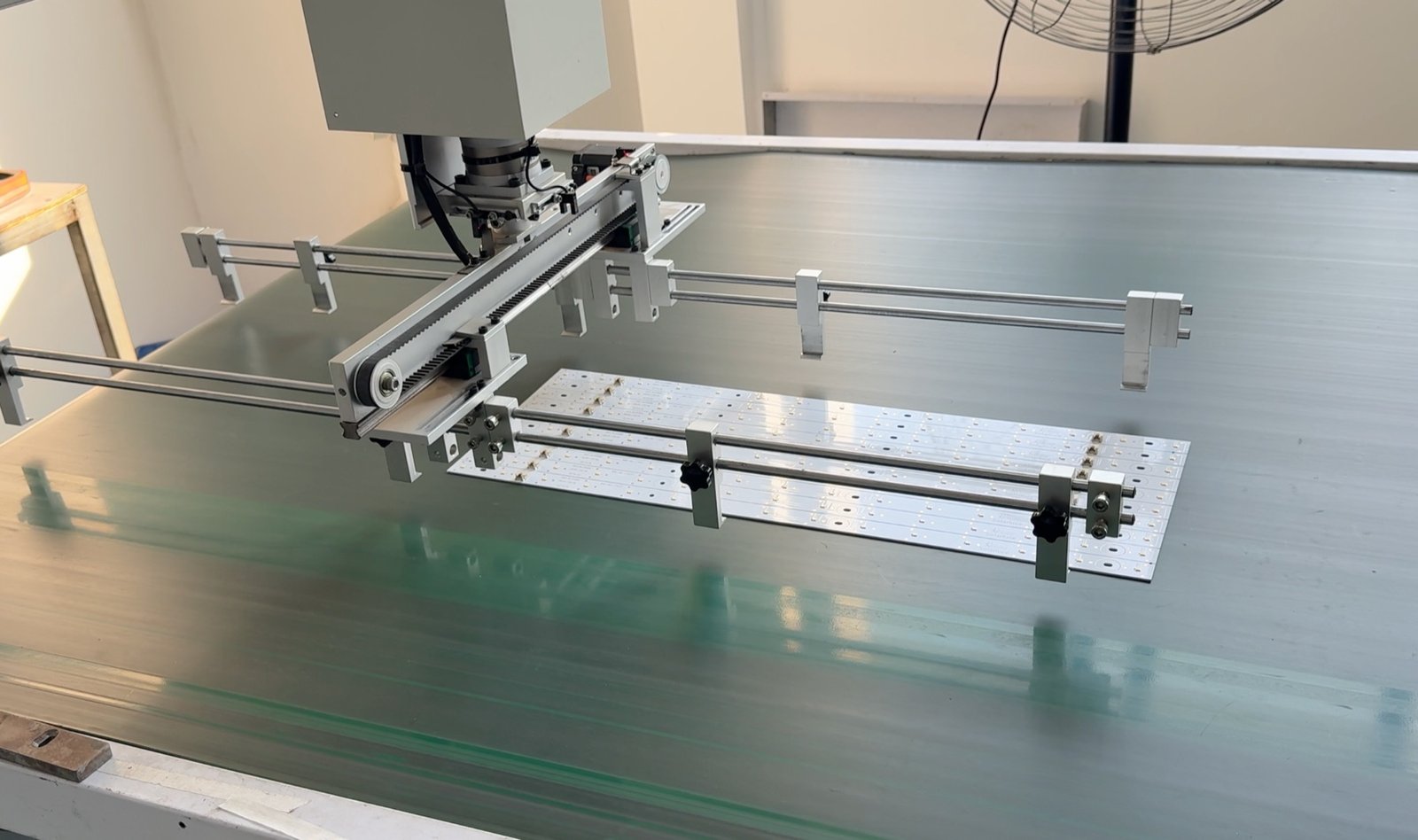
A production photo provides context for where a board lot enters the process. It does not establish which exact batch went into a buyer’s shipment; a recorded link is needed.
Record assembly and in-process checks
The assembly traveler or digital equivalent can capture work order, operator or station, key component identifiers and inspection points. For a multi-head downlight, confirm head count, optical accessories, driver and wiring. For a linear light, confirm profile length, joint type, diffuser, feed end and control option. For a track product, confirm the correct adapter. The checks should reflect the product configuration, not one generic form for every luminaire.
In-process checks catch errors before the product is closed and packed. A visual inspection might verify connector seating, cable routing, fasteners, sealing components and labels. A functional test can check that the fixture powers on and that specified settings respond. Other safety or performance tests may be required by the product and market; those should follow appropriate methods and be linked to the same order. A “pass” mark without a test definition or unit reference is hard to audit.
A buyer can request a first-article inspection at the start of a production run. Compare the first assembled units with the approved sample and drawing. Check visible finish, mechanical fit, driver label, beam and CCT setting. If the product is adjustable or selectable, test the intended positions or switch states. Hold the run if the first article does not match. This is generally more efficient than discovering a wrong optic after hundreds of units are packed.
Connect tests to the lot and the unit
Different tests answer different questions. A production aging screen may reveal early electrical or assembly problems. A photometric report supports a defined optical configuration. A safety certificate applies only to its tested scope. The traceability system should connect each report to the applicable model and revision, and the batch record should show which routine checks were performed. It should not imply that every unit received a laboratory test simply because one type-tested sample did.
Where individual serial numbers are used, the factory may record test results per unit. Where lot identification is more practical, the buyer should still be able to determine the affected production window and quantities. Agree the level of granularity needed. A serial number is not useful if the supplier cannot retrieve the underlying component and test history; a well-maintained lot record can be more informative than a decorative QR code.
When a unit fails, document the failure, cause, disposition and retest. If repair changes a critical part, update its record. If several units share a defect, identify the suspect lot and hold it for review. The LED luminaire aging-test guide explains why the test conditions and results should be batch linked rather than represented by a generic factory photograph.
Treat change control as part of traceability
A component change should create a new record, and sometimes a new product revision. Decide which changes require a new sample, photometric review, thermal assessment, control test or market approval. A driver swap may affect dimming and electrical behavior. An LED board change may alter color appearance. An optical material change may alter the beam. A packaging change may not alter the light but could affect shipping damage. The buyer and factory should agree a proportionate review for each category.
Keep superseded drawings accessible but mark them clearly. The factory should know which revision is active for the order, and the buyer should know what was shipped under each revision. If two revisions overlap during a transition, prevent accidental mixing within one carton or site. A clear cutover date and lot boundary can help. The best traceability record does not merely say what exists today; it explains what changed and when.
For private-label products, label artwork and manuals are also controlled components. The wrong regulatory mark, model name or operating instruction can create trouble even when the luminaire works. Approve the packaging proof and include it in the build record. Verify that carton and unit labels match the purchase order and the technical file.

The assembly image shows the stage where component identities and workmanship checks should converge. A real order should have its own work-order and inspection records.
Make packaging the final link
A traceable product can become untraceable when it enters an unmarked carton. Decide what goes on the unit, inner box and master carton: model, option code, batch or serial reference, quantity, destination and any required handling marks. The exact label content depends on the market and product. The shipping list should map cartons to the production lot or unit range. If goods are split across pallets or shipments, retain that map.
Before dispatch, inspect a sample of packed cartons. Check the product variant, accessories, manuals, spare components, label, carton strength and count. A product may pass assembly tests and still arrive incomplete because a bracket or driver was omitted. Record any rework or repacking and update the carton map. For international orders, the buyer should be able to connect the commercial invoice and packing list to the physical goods.
If a later claim concerns one installation, the buyer should be able to provide a photo of the fixture or carton label. The supplier should then identify the production batch, approved configuration and related test or component records. This is the practical test of traceability. If the process requires weeks of guesswork, it is not functioning well enough for repeat commercial supply.
Request a sample trace-back before placing a large order
Ask the supplier to choose one representative finished unit or carton and demonstrate the record chain backward: carton to work order, work order to configuration, configuration to critical component lots, and batch to inspection and test results. Then trace forward from one component lot to the affected finished goods. Both directions matter. A system that can only find a document by model name may not isolate a field issue.
The demonstration can use redacted or anonymized data if the factory has confidentiality concerns. The buyer needs to verify the method, not receive unrelated customer information. Record gaps and agree improvements before bulk production. A practical trace-back drill is more revealing than asking whether the supplier has an ERP system, because software names do not guarantee disciplined data entry.
For first orders, keep the requirement proportionate. A small custom batch may use controlled spreadsheets and physical labels; a high-volume repeat programme may use barcodes and automated station records. Either can work if the identifiers are consistent and retrieval is reliable. The scope should be defined in the quality agreement, including retention period and response time for a complaint.
Build a buyer-facing handover pack
At shipment, request a compact dossier: approved model/revision and sample reference, purchase order, build and batch identifiers, any agreed component change notices, final inspection summary, relevant test reports, packaging list and contact for issue resolution. Store it where procurement, engineering and after-sales teams can find it. A document that remains only in one person’s email inbox is not an effective traceability system.
Lowcarbon’s product center introduces the commercial lighting families and OEM/ODM context. The exact record package should be negotiated for the selected product and market. Do not assume that a website description is a substitute for a signed specification or quality agreement.
Common mistakes to avoid
- Using a generic product name where several optics, drivers or settings exist.
- Recording component lots without linking them to finished goods.
- Printing a serial number that cannot retrieve any production history.
- Accepting a “QC passed” stamp without defined test scope or batch reference.
- Changing drivers or LED boards without revision and buyer notification.
- Mixing old and new revisions in one shipment without clear labels.
- Failing to map finished units to cartons and pallets.
- Keeping records that only one employee can locate after a complaint.
Frequently asked questions
Does every luminaire need an individual serial number?
Not always. The required granularity depends on product risk and the quality agreement. Lot traceability can be sufficient for some orders if it reliably identifies affected quantities and records.
Which components deserve the most attention?
Prioritize parts whose change affects electrical safety, optical performance, controls, environmental suitability or approved appearance—often the LED board, driver, optics, sealing parts and relevant connectors.
Is a QR code proof of traceability?
No. It is an identification method. The underlying database or record must accurately connect the code to the build, components, tests and shipment.
What happens when a component is substituted?
The change should be documented and reviewed against the approved specification. Depending on its impact, a new sample or test may be needed before the substituted build is accepted.
How can a buyer check a factory’s claim?
Ask for a trace-back demonstration from one finished carton to its approved configuration, critical component lots and inspection records, then trace a chosen component lot forward to the affected goods.
Final recommendation
Treat OEM/ODM traceability as an operating chain, not a label on a carton. Define the approved build, record critical lots and changes, link tests to batches, and carry identifiers through packing and shipment. A clear trace-back demonstration before a large order is the fastest way to see whether the system will help when a real question arises.
