 跳到内容
跳到内容 
Choosing the right lighting for a new office or retail project is tough. You’re trying to pick between linear lights and downlights. You want a clean, modern look, but you also need to hit the right light levels and stay on budget. It’s confusing.
It’s not about which is “better,” but which is right for the job. As a general rule, LED linear lights are best for general illumination and task areas (like desks or aisles). LED downlights are best for accent lighting and circulation paths (like hallways).
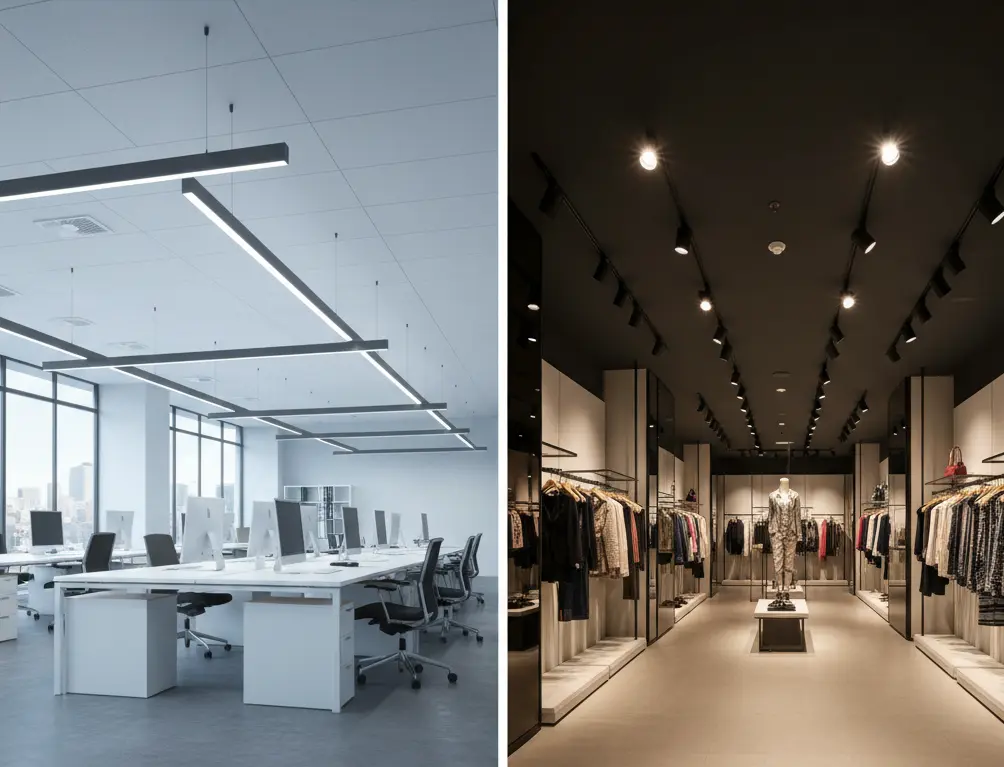
I’ve been manufacturing LED linear lights and downlights for over 20 years. My friend Mike, who runs a big lighting distribution company in Germany, calls me with this question almost every week. He’ll say, “Joe, my client has a 500-square-meter office. Should I quote them 300 downlights or 60 linear lights?”
My answer is always the same: It depends on the space and the purpose. You would never use a hammer to turn a screw. It’s the same with lighting. Linear lights and downlights are two different tools for two different jobs. The best projects, the ones that make clients really happy, almost always use both. Let’s break down the specific job of each light.
What is the Main Job of an LED Linear Light?
Do you need to light a large, open-plan office? Or a long, straight supermarket aisle? Using hundreds of little downlights will make the ceiling look like Swiss cheese. It’s an old-fashioned look, and it’s a nightmare for your installers.
The main job of an LED linear light is to provide a wide, even, and continuous line of light. This makes it the perfect tool for general (ambient) illumination. It’s also the best choice for task lighting over any long, rectangular area, like a row of desks, a workbench, or retail shelving.

Let’s dive deeper into this. The keyword for linear lighting is “broad.” It throws a wide, soft light. When we talk about “general illumination,” we mean the base layer of light for the whole room. You want this to be even and comfortable. This is exactly why we designed our new linkable LED linear light, which you can see in the picture.
The Office Lighting Problem (UGR)
In a modern office, especially in Europe, the most important factor is glare. You can’t have bright lights reflecting off computer screens. This is where UGR (Unified Glare Rating) comes in. For office work, the standard is UGR < 19. A standard downlight, which is a bright point of light, is terrible for this. It’s a “point source” and creates a lot of glare.
A high-quality LED linear light, on the other hand, is designed for low glare. Look at the product photo I shared. That isn’t a simple frosted cover. That’s a microprismatic lens. This special diffuser takes the thousands of small light points from the LEDs and spreads them out. It shapes the light. It directs the light down onto the desk, not sideways into your eyes. This is how we achieve a very “Niski UGR” (as my Polish client says), or Low UGR.
The Retail Aisle Problem (Vertical Light)
In a retail store, the job is different. You don’t care about the light on the floor. You care about the light on the products. The products are on vertical shelves. A downlight shoots light straight down. This makes a bright circle on the floor and leaves the shelves dark.
Now, look at this next photo. This is our new linkable linear light in a real-world supermarket project.

This is the perfect example of vertical illumination. The lights are running in a continuous, seamless line. They are washing the entire aisle with even light. Notice how the products on the top shelf are just as visible as the products on the bottom shelf. This is impossible to do with downlights. This even light makes products look more attractive and helps customers find what they need.
Customization is Key
This is where we, as a factory, really help our partners. Mike’s client in Germany needed linear lights for an office with an open ceiling. We manufactured 60 suspended (pendant) linear lights for him.
- Seamless Linking: The supermarket project used our “linkable” feature. The installers could connect 8-meter or 10-meter sections together seamlessly. It looks like one single, continuous blade of light. This is very clean and modern.
- Lengths: We offer standard flexible lengths. For this new model, we have 84cm and 168cm versions (about 2.8ft and 5.5ft). This lets you mix and match to create the exact length you need for a row.
- Light Direction: We can make them “direct-indirect.” This means 70% of the light shines down (for the task) and 30% shines up. The light bouncing off the ceiling makes the whole space feel bigger and more open.
- Control: They are all DALI dimmable, so the client could control them with their smart building system.
You can’t get this level of customization from an off-the-shelf supplier. This is the power of working directly with a factory that has a dedicated linear production line.
When is an LED Downlight the Smart Choice?
You’ve used linear lights for the main office floor. It looks great. But the reception desk looks dim. The hallway to the restrooms is dark. And the company’s expensive logo on the wall is invisible. The project feels unfinished.
An LED downlight is the smart choice for accent lighting, wall washing, and circulation spaces. You use it to highlight specific features (like a logo, a product display, or artwork). You also use it to provide efficient ambient light in smaller, defined areas like hallways, lobbies, and meeting rooms.

The keyword for downlights is “focus.” Where the linear light is a wide “wash” of light, the downlight is a “spot.” This is your artist’s tool.
Accent and Drama
This is the most important job for a downlight. How do you make a product look special in a retail store? You hit it with a downlight that has a narrow beam angle. At our factory, we produce downlights with interchangeable reflectors. This is a huge benefit for contractors. You can install the main light, and then click in the reflector your client wants.
- Narrow Beam (15° or 24°): This creates a sharp, high-contrast circle of light. Perfect for a single mannequin, a jewelry counter, or a piece of art.
- Medium Beam (38°): A good all-purpose beam. Great for highlighting a product table or a reception desk.
- Wide Beam (60°): This is for general lighting in smaller rooms, like a restroom or storage area.
Wall Washing
A special type of downlight is a “wall-washer.” It has an optic that is shaped like a scoop. It throws the light sideways and grazes the wall. This is a high-end technique. It makes a narrow hallway feel wider. It shows off a beautiful textured wall (like brick or stone). In Mike’s office project, we used wall-washers in the main lobby to light up the company’s award wall.
The Quality Problem
This is where I have to warn my partners. Mike has this pain point. He once bought a batch of 500 downlights from a cheap trading company. The sample was fine. But the main order was a disaster. The “4000K white” was different on almost every light. Some were greenish, some were pinkish. This is called “bad binning” or a high MacAdam ellipse.
As a factory with over 20 years of experience, this is something we never compromise on. We have 5 production lines, and our downlight line has strict quality control.
- Chips: We use high-quality LED chips from top brands.
- Color Consistency: We guarantee a 3-Step MacAdam ellipse. This means all 500 downlights in your order will have the exact same shade of white. Your eye cannot see the difference.
- CRI: For retail, you need high Color Rendering Index (CRI). This makes colors look real. A cheap CRI 70 light makes red meat look brown. We produce all our downlights with CRI 90 or CRI 95 as a standard for our European and Australian clients.
A downlight is a simple product, but it is very easy to get wrong.
How Do You Combine Linear Lights and Downlights for a Perfect Project?
Your client wants a space that is both functional and beautiful. If you use only linear lights, the space can feel flat and boring, like a library or a warehouse. If you use only downlights, the space can feel like a casino or a “Swiss cheese” ceiling—full of glare.
You combine them by designing in “layers.” Use linear lights for your base “ambient” (general) layer and your “task” layer. Then, use downlights for your “accent” layer. This professional approach creates visual interest, guides visitors, and provides the perfect light for every activity.

I always advise my B2B partners, like Mike, to stop thinking about “lights” and start thinking about “layers.” A great project has three layers of light.
Layer 1: The Ambient Layer
This is the “general fill” light that lets you walk around safely. This is the perfect job for indirect linear lighting. For Mike’s office project, we used suspended linear lights that shine 30% of their light up onto the white ceiling. This “up-light” bounces back down as soft, shadow-free, ambient light. It makes the entire 500-square-meter room feel open and airy.
Layer 2: The Task Layer
This is the light you need to do a job.
- In the Office: This was the job for our new low-UGR, high-efficacy linear light. The down-light portion is focused by the microprismatic lens. It pushes 500 lux directly onto the desk surfaces, so people can read and type without eye strain.
- In a Supermarket: This is the project photo I showed you earlier. That entire aisle is lit with our seamlessly connected linear lights. This is 100% task lighting, and the task is “selling products.”
Layer 3: The Accent Layer
This is the “drama” or “focus” layer. This is where downlights do their best work. In Mike’s project, we used downlights in several key areas:
- Lobby: We used five 15W downlights with a 24° beam to create bright, dramatic spots on the company logo behind the reception desk.
- Hallways: We used simple 10W downlights (60° beam) spaced 2 meters apart. This is a very clean, efficient way to light a circulation path.
- Meeting Room: The client wanted a high-end feel. We used a recessed linear light around the perimeter of the room (as an ambient layer). But we used four downlights to accent the whiteboard and the art on the walls.
The result? The client was thrilled. The space feels dynamic, professional, and expensive. Mike looked like a brilliant lighting designer. And for us, as the factory, it was a great partnership. We were his single supplier for the entire project. He got his custom linear lights and his high-CRI downlights from one place. This meant all the 4000K CCTs matched perfectly. The DALI dimming systems worked together. This is the reliability that project contractors need.
What are the Key Technical Differences: Cost, Installation, and Efficiency?
You have to make a budget for your client. The downlight seems cheaper per piece, but is it cheaper for the whole project? What about installation time? Your electrician’s time is very expensive.
Per fixture, downlights are almost always cheaper. But for a large, open room, linear lights are often cheaper overall. You need far fewer fixtures and fewer expensive installation points. For installation, surface-mounted or suspended linear is fastest, while recessed downlights are the most time-consuming.

This is the part of the conversation Mike (the procurement officer) cares about most. Let’s talk real numbers, using our new linear light as an example.
The Power of High Efficacy
I just got the final test report for our new linear series. It hits “160lm/W,” which means 160 lumens per watt. This is a massive energy saver for your clients.
- A standard good-quality downlight might be 100lm/W.
- A cheap downlight might be 80lm/W.
Let’s do some simple math for a supermarket.
- Standard Downlights (100lm/W): To get the light level you need, your project might require 5,000 watts of power.
- Our Linear Light (160lm/W): To get the exact same amount of light, you only need about 3,125 watts.
That is a 37.5% reduction in energy use. When you are lighting a 2,000-square-meter supermarket that is open 18 hours a day, this is a saving of thousands of Euros per year for your client. This is a huge selling point.
Wattage Selectable = On-Site Flexibility
It is “Power 168cm: 22,8W, 28,5W, 34,2W, 39,9W.” This means the 168cm version of our light has a built-in switch. Your installer can select the power on-site.
Why is this a big deal for Mike? Because he doesn’t have to stock four different lights. He stocks one light.
- If the aisle has a low ceiling, the installer can set it to 22.8W.
- If the aisle has a high ceiling, they can set it to 39.9W.
- The client can fine-tune the brightness after installation.
This is maximum flexibility for the installer and minimum inventory cost for the distributor.
Installation Speed
This is the hidden cost.
- Downlights: Every single fixture is a separate installation. Mark, drill, wire, clip in. To light a 100-meter-squared office, you might need to cut 35 holes. This is slow and expensive labor.
- Linkable Linear: This is the “linkable” part. You provide one power feed at the start of the row. Then you can connect 10, 20, 30 meters of light using the seamless connectors. Instead of 35 wiring points, you have 4 or 5. This saves an enormous amount of labor. Your electrician’s time is often more expensive than the hardware.
So, when you compare the total project cost (hardware + labor + energy savings), our new high-efficacy linear light is the clear winner for any large, open space.
Conclusion
So, linear lights and downlights aren’t enemies; they are partners. Linear lights are your “workhorse” for broad areas and tasks, while downlights are your “artists” for adding focus, drama, and accent.
Ready to Design the Perfect Space?
I know this is a lot to think about. As a factory with 5 production lines for both linear lights and downlights, we help contractors in Europe, the UK, and the Middle East with this “mix-and-match” strategy every day. We make sure all your products match and work together perfectly.
- Contact me on WhatsApp: Let’s have a quick 1-on-1 chat about your project.
- Download our Catalog: See our full range of customizable linear, track, and downlight products.
- Book a Factory Video Tour: Let me show you how we maintain quality and consistency across all our product lines.

