
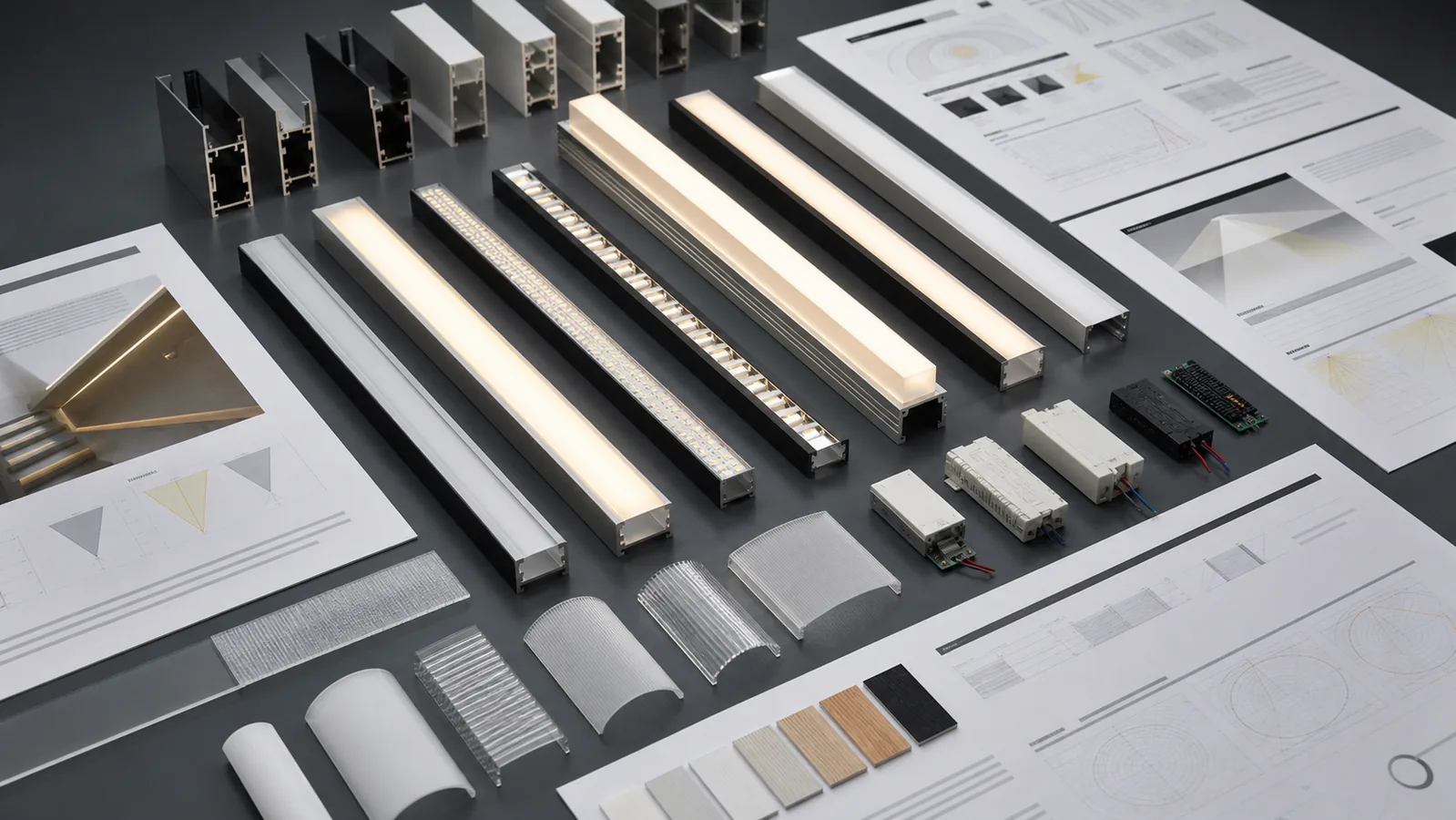
We often see buyers compare two catalogue pages that appear similar but describe different configurations. At LCB Light, we recommend tracing every performance value back to the complete product code. This guide shows how we read a linear-lighting catalogue when preparing a quotation or checking whether a specification can be manufactured consistently.
An LED linear lighting catalogue may show dozens of lengths, wattages, optics and mounting options. The challenge is confirming which values belong to the exact product code you plan to order. Use the catalogue to shortlist products, then verify the final configuration with a technical datasheet and photometric file.
Decode the ordering code
Many linear luminaires use a code for series, length, output, CCT, CRI, optic, driver, mounting and finish. Ask for a worked example. A single changed character can mean a different driver or diffuser, affecting efficiency, glare and lead time.
Compare lumens, wattage and efficacy
Confirm whether listed lumens are for the LED source or the complete luminaire. System efficacy should use delivered lumens divided by total input power. Check whether values vary by CCT, CRI or optic. For a deeper explanation, read our LED linear light lumens and wattage guide.
Understand optics and glare information
Beam angle alone does not describe distribution. Review intensity diagrams and IES/LDT files, especially for asymmetric, batwing, aisle or low-glare optics. If UGR is shown, identify the room dimensions, mounting height and reflectances used in the calculation. Product optics contribute to glare, but the completed room determines the result.
Check color and driver details
- CCT options and tolerance
- CRI and any required color-rendering metrics
- Driver brand and model
- Dimming protocol and minimum dim level
- Flicker or modulation data where relevant
- Emergency and sensor compatibility
Do not assume a dimmable version uses the same dimensions or performance as an on/off version. Control gear may change the housing, feed arrangement or maximum run.
Review mechanical information
Compare the actual body length, luminous length, profile width and height, weight, cutout size and suspension spacing. For continuous runs, catalogue module lengths may not equal the final installed length. Confirm connectors, end caps, corner modules and power feeds.
Verify environment and documentation
Check ambient-temperature range, IP and impact rating, insulation and mounting restrictions. Request dimensional drawings, installation instructions, photometric files and compliance documents that match the selected product code. Certification needs depend on the destination market and project.
Create a specification comparison matrix
Place each shortlisted model in a spreadsheet with identical rows for output, power, efficacy, dimensions, optic, CCT, CRI, driver, control, environmental rating, accessories, documents, warranty and lead time. Mark every value that is estimated or still unverified. This prevents a polished catalogue from hiding gaps in the technical package.
Keep the final product code and revision with the project file. If the LED linear lighting catalogue is later updated, the approved configuration can still be traced without relying on screenshots or an obsolete marketing page.
Finally, compare listed accessories with the installation drawing. Missing feeds, suspension sets, corners or end caps can delay a project even when the main luminaires arrive on time. Confirm quantities for every room and spare requirement before release.
How we verify a catalogue value before quoting
At LCB Light, we check the relationship between the model code and the performance table. We confirm whether lumens are delivered lumens, which diffuser or optic was measured, and whether the driver power is included. We also check whether the value is typical or guaranteed and whether it changes with CCT or CRI. This prevents an attractive headline figure from being applied to the wrong configuration.
Read the footnotes as carefully as the table
Catalogue footnotes often contain the information that changes a purchasing decision: output tolerances, maximum run length, special-order status, driver limitations or ambient restrictions. If a value is shown only for one length, do not scale it automatically. Longer profiles can use different LED-board arrangements or drivers, and optical losses may not be identical.
Our recommended three-document rule
Before approving a linear fixture, we recommend collecting three product-specific documents: a technical datasheet, a dimensional drawing and an IES or LDT file. For a controlled project, add installation instructions and relevant compliance records. The ordering code should match across these files. If it does not, ask the supplier to identify which document governs the order.
Commercial questions a catalogue cannot answer
- Is the selected configuration a standard item or made to order?
- What is the MOQ for special finish, driver or length?
- Which accessories are included and which are separate?
- What production lead time applies to this exact code?
- Can components remain consistent for repeat orders?
We address these questions during quotation because technical suitability alone does not make a project supplyable. A product may perform well but create schedule risk if its key option requires a long custom lead time.
How to send us a catalogue-based inquiry
Mark the preferred model, length, output, optic, CCT, CRI, control, mounting and finish. Add quantities and the destination market. If you are unsure about one field, include the application and target result rather than guessing. At LCB Light, we can use that information to confirm a standard configuration or propose alternatives that are easier to manufacture and maintain.
A clear request also produces a more meaningful price comparison. Instead of receiving several quotations for vaguely similar fixtures, you can compare complete configurations with traceable differences.
Convert the shortlist into one final code
Before purchase, ask the supplier to write the complete product code beside a plain-language description of every option. At LCB Light, we use this step to align sales, engineering and production. It gives the buyer one reference for the order, drawing, sample and inspection. When the configuration is traceable, future repeat orders and replacement discussions are less likely to depend on memory or an outdated catalogue page.
An example of two “similar” catalogue models
Model A and Model B may share the same length and nominal wattage, yet Model A uses an opal diffuser with broad distribution while Model B uses a louver with lower visible brightness. Their delivered lumens, glare behavior and suitable spacing can be different. If one model includes a DALI driver and the other is on/off, cost and dimensions may also change. We recommend describing these differences in words beside the data instead of comparing numbers alone.
At LCB Light, we would ask which result the project values: maximum efficiency, visual comfort, vertical light, precise control or a particular appearance. The answer determines which catalogue column deserves the most attention.
Marketing page, datasheet and quotation serve different purposes
A marketing page introduces the product family. A technical datasheet defines a configuration. A quotation states what is being supplied. Buyers create risk when information from these levels is combined without confirmation. For example, a family page may show every available finish and control, but a particular length may not support all combinations as a standard order.
We recommend requesting a project-specific submittal after shortlisting. It should identify the offered product code, performance, dimensions, accessories and exceptions. This does not replace the catalogue; it converts catalogue information into an orderable proposal.
Build an approval trail for future orders
Save the approved catalogue revision, datasheet, drawing, photometric file, sample reference and quotation. If a repeat order is needed, start from this package and ask whether any component or document has changed. At LCB Light, we favor clear revision identification because product families can evolve over time.
This approval trail has commercial value. It reduces the time needed for repeat quotations, helps new team members understand the original decision and makes replacement discussions more accurate. A catalogue is most useful when it leads to a controlled specification, not when it remains the only record of what the buyer intended to purchase.
Our final catalogue rule
If a value cannot be connected to the final product code, do not use it as the basis of approval. At LCB Light, we welcome questions that connect catalogue claims to drawings, photometric files and the quotation. This discipline protects both sides: the buyer understands what will arrive, and the manufacturer has a controlled configuration to build and inspect. A short clarification before ordering can prevent a much larger disagreement after delivery.
Frequently asked questions
Can two products with the same wattage be considered equal?
No. Output, distribution, glare, driver quality, thermal design, dimensions and controls may differ significantly.
What files should accompany a catalogue?
A robust submittal usually includes product-specific datasheets, drawings, IES/LDT files, installation instructions and relevant test or compliance documents.
