
The terms LED linear light, LED strip light, and LED tube light are sometimes used interchangeably, but they describe different product categories. Choosing the wrong type can create problems with heat, glare, wiring, maintenance, certification, or installation quality.
This guide compares the three options from a commercial project perspective.
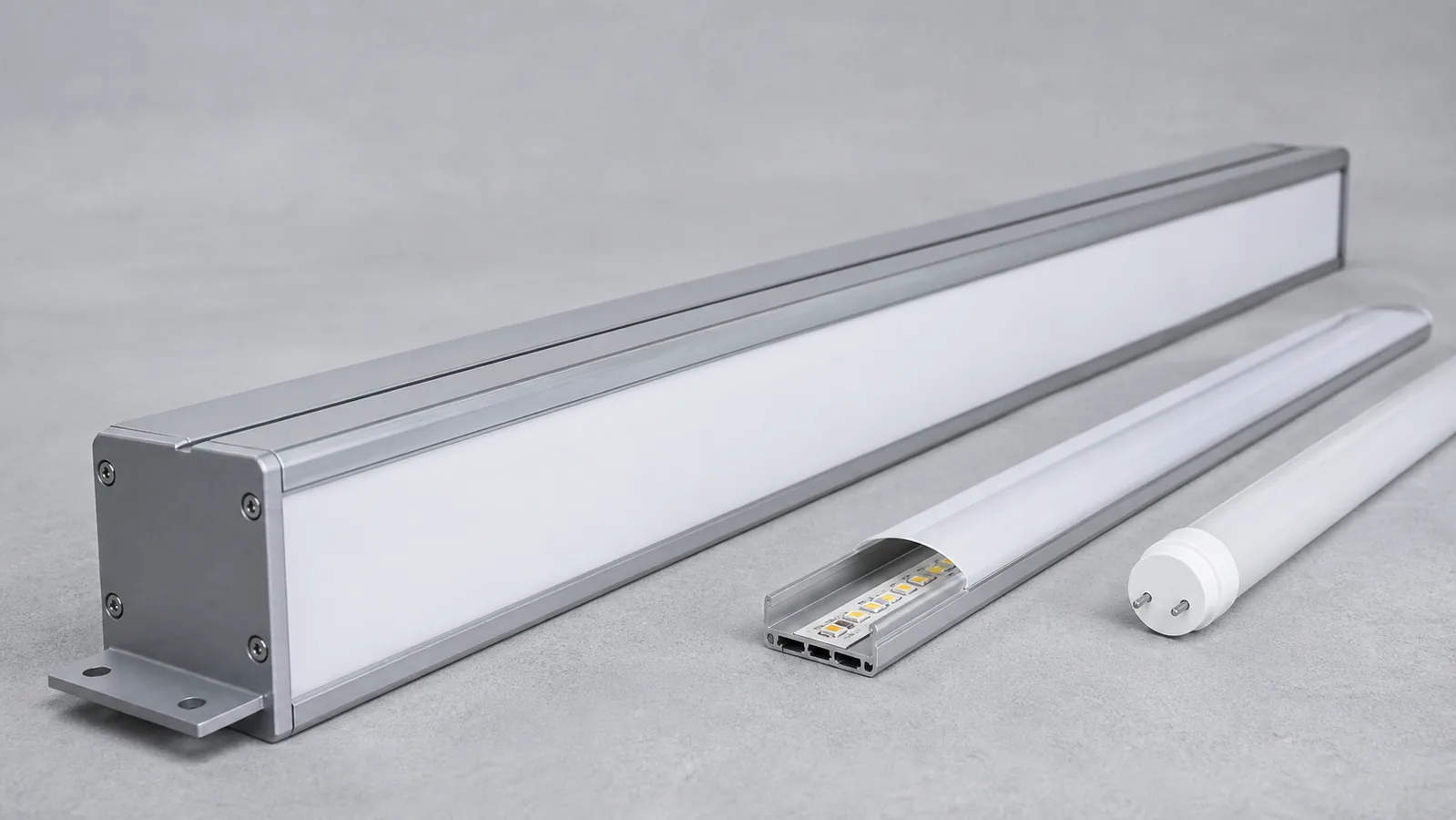
Complete LED Linear Light Fixtures
A complete linear fixture normally includes a rigid housing, LED module, driver, optic, wiring, end caps, and mounting hardware. It is designed as a luminaire with defined output, photometry, thermal performance, and electrical ratings.
Typical uses include offices, retail stores, schools, showrooms, warehouses, corridors, and continuous architectural lines. Products may be suspended, recessed, surface mounted, track mounted, or configured as trunking.
Flexible LED Strip Lights
LED strip is a flexible circuit with LEDs and resistors or current-control components. It usually needs an aluminum profile for heat management and appearance, a diffuser, a separate power supply, connectors, and project-specific wiring.
Strip light is valuable for coves, shelves, joinery, backlighting, signage, and concealed details. It is not automatically a substitute for a complete commercial fixture.
LED Tube Lights
LED tubes are designed primarily as replacements or alternatives for fluorescent tubes. They use a tubular form and standardized lengths, with power supplied through lamp holders or a retrofit wiring arrangement.
Tube products are common in utility areas, workshops, basic commercial spaces, and retrofit projects. Compatibility and wiring method must be confirmed because ballast-compatible, ballast-bypass, and externally driven products differ.
Performance Comparison
| Factor | Linear fixture | LED strip | LED tube |
|---|---|---|---|
| Product form | Complete engineered luminaire | Flexible component system | Replacement lamp |
| Optical control | Diffuser, lens, louver, reflector | Profile and diffuser dependent | Generally broad |
| Mounting | Purpose-designed hardware | Adhesive/profile/clips | Lamp holders or retrofit kit |
| Continuous appearance | Available in modular systems | Good in a well-designed profile | Visible lamp breaks |
| Best use | Primary commercial lighting | Details and concealed accents | Fluorescent replacement |
Thermal and Lifetime Considerations
A complete fixture should provide a defined thermal path. LED strip performance depends strongly on profile selection, mounting surface, density, enclosure, and ambient temperature. Tube lifetime depends on driver design, heat, switching, and the condition of existing holders and wiring.
Compare lifetime claims using stated test conditions, not only the largest hour figure on a datasheet.
Safety and Certification
A luminaire certification normally applies to a complete construction. Combining uncertified strip, profiles, power supplies, and connectors on site may shift compliance responsibility to the installer or system integrator.
Tube retrofits must follow the correct wiring method and labeling requirements. Existing ballasts and holders should be evaluated by a qualified professional.
Which One Should You Choose?
Choose a complete LED linear fixture for primary illumination, controlled distributions, professional mounting, and consistent project documentation. Use LED strip for compact concealed details and custom joinery. Use LED tubes when the project objective is a suitable fluorescent-lamp retrofit.
For complete fixture selection, read our LED linear light fixture guide.
Frequently Asked Questions
Is an LED strip a linear light?
It creates a line of light, but it is usually a component rather than a complete commercial luminaire.
Can LED strip replace an office linear fixture?
Usually not directly. Office lighting requires suitable output, glare control, thermal design, driver performance, mounting, and compliance.
Are LED tubes good for continuous lines?
Tubes usually show breaks at lamp holders and fixture joints. Purpose-designed continuous linear systems create a cleaner uninterrupted appearance.
Which option is easiest to customize?
LED strip is flexible for small details, while modular linear fixtures are better for professional continuous runs, corners, and coordinated commercial systems.
