 跳到内容
跳到内容 
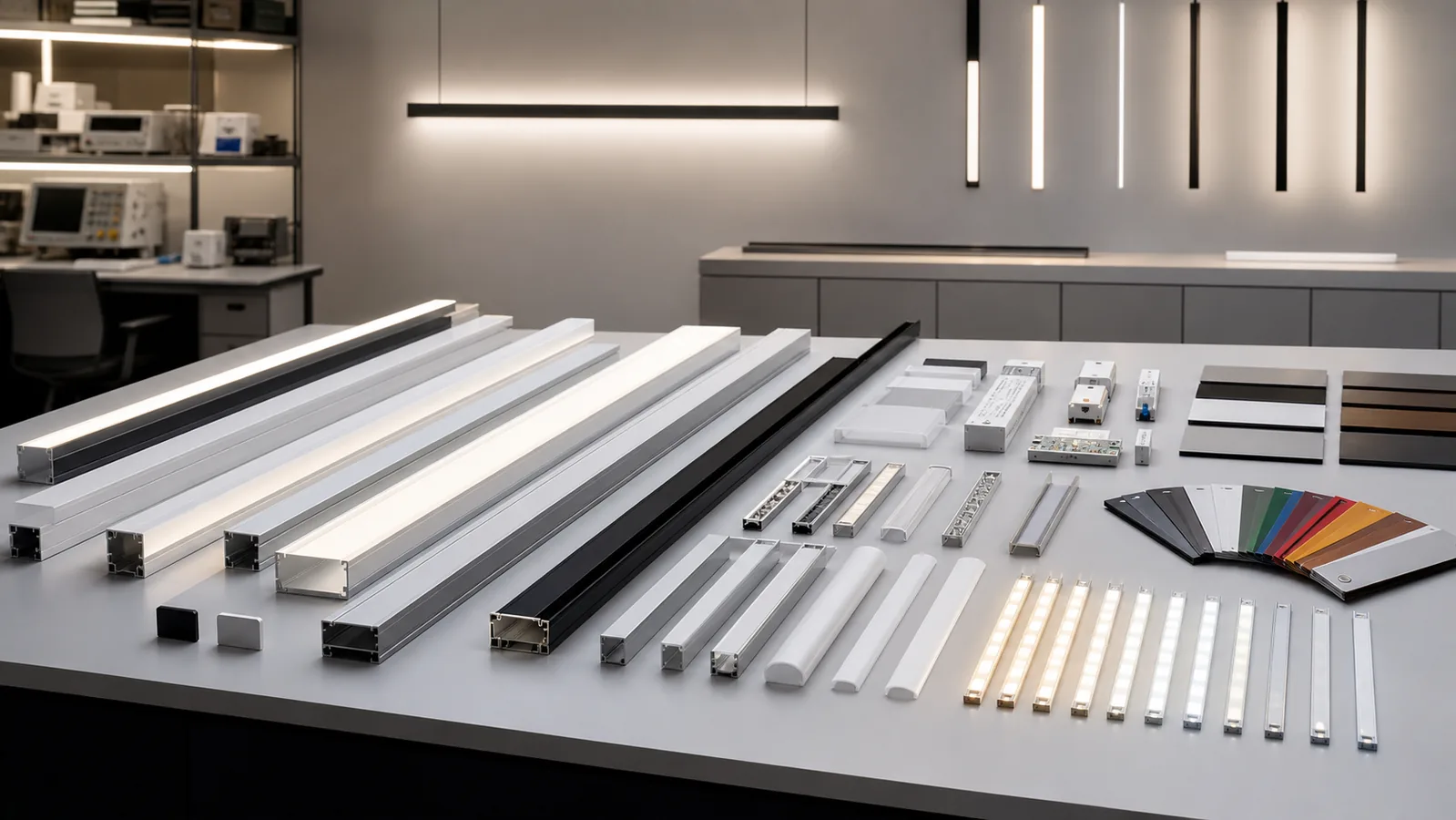
Custom linear lighting is one of the areas where early communication creates the greatest value. At LCB Light, we use the buyer’s application, drawing and performance target to separate necessary customization from changes that add cost without improving the result. This guide explains how we would organize that development process with an OEM or project customer.
Custom LED linear lighting can adapt a standard product platform to specific architectural, photometric or branding requirements. Customization may be as simple as a special finish, or it may involve new lengths, optics, wiring and mechanical parts. A controlled specification process keeps the project buildable and repeatable.
Define what “custom” means
List the required changes and the reason for each one. Separate cosmetic options from changes that affect safety, thermal performance or photometrics. New wattages, drivers, profile dimensions and wiring schemes usually require more engineering validation than a finish change.
Lengths, shapes and connections
Custom lengths can align light lines with rooms, displays or furniture. Confirm overall body length, luminous length, end-cap allowance and tolerance. L-, T- and X-shapes need controlled drawings and clear identification of luminous or blank connectors. Long continuous runs may require several factory modules and power feeds.
Wattage and lumen packages
Choose output from the lighting calculation rather than from a target wattage alone. Higher drive current can raise lumens but may affect efficacy, temperature and lifetime. Ask for performance data from the production-intent configuration, including the selected diffuser or optic.
Optics and light quality
Options may include opal diffusers, microprismatic lenses, louvers, reflectors, asymmetric distributions and wall-wash optics. Specify CCT, CRI, color tolerance and any application-specific color requirements. Review physical samples because finish, diffuser appearance and perceived color cannot be fully judged from a PDF.
Drivers, controls and emergency options
Define supply voltage, dimming protocol, minimum dim level, flicker requirements, sensor integration and emergency strategy. The driver must fit mechanically and thermally inside the intended luminaire. A control change late in development can alter dimensions or lead time.
Finishes, branding and packaging
- Standard or custom powder-coat color and gloss
- Anodized or metallic appearance where supported
- Labels, model codes and private-label branding
- Connector, cable and suspension colors
- Project or retail packaging, manuals and barcodes
Approve finish samples under representative lighting. Define acceptable color and texture tolerances, especially for products installed in a continuous line.
Use a staged approval process
- Approve the written specification and drawings.
- Review an appearance or mechanical prototype if needed.
- Test a production-intent working sample.
- Freeze the bill of materials and revision number.
- Validate a pilot batch before volume production.
Discuss tooling, sample cost, MOQ, lead time and ownership of drawings at the beginning. If you are comparing potential partners, use our project inquiry page to share the application and target specification.
Build a clear customization brief
A useful brief combines a dimensioned drawing, target photometrics, reference finish, driver and control requirements, destination market, estimated quantity and schedule. Identify which dimensions interface with ceilings, furniture or other equipment and therefore cannot change. Suppliers can then concentrate engineering effort on the true constraints.
Custom work should also include a change-control method. If a component becomes unavailable, the proposed alternative should be reviewed for electrical, thermal, optical, mechanical and compliance impact before production continues.
How we decide whether customization is justified
We ask what problem the change must solve. A special length may be essential for architectural alignment, while a new profile width may only reproduce an appearance that a standard platform can already achieve. At LCB Light, we compare the value of the change with tooling, testing, MOQ and schedule impact. This helps the buyer invest in features that improve performance, installation or market differentiation.
Our recommended development sequence
We begin with a written design brief and dimensioned drawing. After feasibility review, we agree which elements can use existing components and which require new work. A mechanical or appearance sample may come first, followed by a powered production-intent sample with the correct LEDs, driver, optic and finish. Each stage has an approval record and revision code.
For a product family, we test the combinations with the greatest risk: the longest length, highest output, most demanding optic or most complex control gear. This provides more useful evidence than approving only the simplest version.
How custom options affect commercial terms
- New extrusion or molded parts may require tooling and ownership terms.
- Special LEDs, drivers or colors can create component MOQs.
- Custom finishes need an approved reference and tolerance.
- Private-label packaging adds artwork, barcode and carton requirements.
- Market-specific documents may affect construction and lead time.
We prefer to make these effects visible in the quotation. A lower unit price can be misleading if tooling, testing, accessories or packaging are not included.
Protect repeat orders with change control
At LCB Light, we recommend freezing the approved drawing, bill of materials, performance targets and golden sample. If a component must change, we review its optical, thermal, electrical, mechanical and compliance impact before approval. This protects color consistency, dimming behavior and fit across repeat orders.
What to send for a useful OEM discussion
Share your application, target market, annual or project quantity, dimensional constraints, lumen goal, optic, CCT/CRI, controls, finish, branding and schedule. Reference photos are helpful, but measurable requirements are more reliable. With a structured brief, we can identify whether a standard LCB Light platform, a modified configuration or a new custom development is the most practical route.
Start with the business reason for customization
Tell us whether the product must fit a project detail, enter a new market segment, carry a private label or improve an existing design. At LCB Light, that context helps us recommend where customization creates differentiation and where a standard platform lowers risk. A successful OEM product is not simply unique; it must also be manufacturable, inspectable, competitively priced and repeatable after the first order.
Prioritize features with a value-versus-risk matrix
List every requested custom feature and score its customer value, engineering risk, MOQ impact and schedule effect. A unique finish may have high brand value with manageable risk. A completely new driver enclosure may affect thermal behavior, tooling and compliance. At LCB Light, we use this kind of discussion to help buyers keep the differentiating features while simplifying changes that do not support the business case.
The matrix also helps internal teams agree. Design, purchasing and sales may value different outcomes, and unresolved priorities can produce repeated sample revisions.
Understand non-recurring and recurring costs
Tooling, engineering samples, special tests and artwork are non-recurring or development costs. LEDs, drivers, profiles, assembly and packaging contribute to recurring unit cost. We recommend separating them in the commercial review. Spreading a tooling charge across one small order can make the unit price appear high, while ignoring it entirely hides the investment required to launch the product.
Forecast volume and expected product life influence the right decision. A dedicated tool may be reasonable for a long-running family, while a modified standard platform can be safer for a project or market test.
Launch, feedback and controlled scaling
After the pilot order, review assembly, inspection, packaging, shipping and customer feedback before increasing volume. At LCB Light, we want to know whether installers understood the connectors, whether labels were clear and whether the actual light effect matched expectations. Small corrections at this point can protect the larger launch.
Scaling should not remove the controls used during development. Keep the approved bill of materials, golden sample and inspection plan active. If demand grows quickly, discuss capacity and component planning before placing an urgent volume order. A custom product becomes commercially valuable when it can be produced repeatedly—not only when the first sample looks impressive.
Our final custom-development principle
Customization should create measurable value for the buyer or end user. We recommend protecting the features that support performance, installation or market differentiation and simplifying the rest. At LCB Light, we can help examine those trade-offs before tooling or production commitments are made.
A controlled brief, realistic sample plan and frozen production standard turn a creative concept into a supplyable product. That is the commercial objective: not only to make one attractive prototype, but to deliver the same approved result across the quantities and timelines your market requires.
For repeat orders, keep the approved sample code, drawing revision, bill of materials, finish reference and packaging artwork together. Ask the supplier to issue written change notification before substituting a driver, LED, optic or mechanical part. This simple discipline protects light quality and installation compatibility while giving both sides a clear baseline for warranty discussions and future cost engineering.
Frequently asked questions
Does every custom option require new certification?
Not necessarily, but changes to electrical, thermal or mechanical construction may affect existing approvals. Confirm with the manufacturer and the requirements of the destination market.
How can custom projects avoid production drift?
Use signed drawings, an approved golden sample, a frozen bill of materials, traceable revisions and pre-shipment inspection criteria.
Discuss Your LED Linear Lighting Project
Share your application, dimensions, target output, optics, controls and installation requirements. The LCB Light team can help evaluate a suitable linear-lighting configuration for your project.

