 跳到内容

A factory aging test places LED luminaires under operation before shipment so obvious assembly or component problems have a chance to appear while the batch is still at the factory. Buyers often ask whether products are “100% aging tested,” but that question is incomplete. A useful answer names the product revision, test conditions, duration, acceptance criteria, records and action taken when a unit fails. A photograph of illuminated fixtures shows an activity, not the quality of its control system.
This article explains what commercial LED buyers should ask a supplier to document for production aging tests. It also separates a factory screening step from long-term lifetime evidence. The two are related but not interchangeable. A short operational check cannot prove years of service, and an LED package life projection does not cover every driver, connector or optical part in a complete luminaire.
What a production aging test is for
In a production context, aging or burn-in generally means operating assembled products under defined conditions before release. It can help reveal early failures, intermittent connections, unexpected driver behavior or problems introduced during assembly. The test is most useful when it is consistent, recorded and followed by diagnosis. Simply turning fixtures on for an unknown period, then packing them without a result record, provides limited assurance to a buyer.
Ask the factory to describe the routine for the exact product family. Is every fixture tested or only a sample? At what stage is the test performed—before or after final assembly? What input voltage, power setting, ambient conditions and operating duration are used? Are selectable wattage and CCT versions checked in more than one state? If the product has dimming, is control behavior tested separately? These questions reveal what the word “aging” means in the supplier’s process.
The test should have a clear disposition path. A failed unit should be identified, segregated and assessed. The record should show whether the cause was a component, assembly, wiring, driver or handling issue and whether the rest of the batch needs review. A supplier that can explain its response to failures is giving more useful evidence than one that promises “zero defects” without showing a method.
Separate screening from lifetime prediction
Aging test duration at the end of a production line is normally much shorter than the intended service life of the product. Passing it can support process control, but it cannot establish a credible lifetime claim by itself. Long-term behavior may involve gradual lumen decline, color shift, driver failure, sealing problems or other mechanisms that will not necessarily appear during a short batch screen. Product construction and application environment matter.
The Illuminating Engineering Society’s position on LED product lifetime prediction explicitly cautions against treating LED component projections as the lifetime of an entire luminaire. It notes that drive circuitry and secondary optical components introduce other failure mechanisms. Ask suppliers to identify which claim is supported by which test rather than combining a factory aging photo, LED package data and a blanket lifetime slogan into one unsupported conclusion.
A buyer should distinguish three types of evidence: routine production screening for each order; design or type testing of representative products; and component-level data such as LED source maintenance. The records answer different questions. A robust purchasing file may include all three, but no one document replaces the others. If a supplier cites a particular standard, ask for the actual report, tested model and revision, not just a logo in a brochure.
What should appear in a batch record
A practical aging record identifies the production order or batch, exact fixture model and revision, quantity entering the test, test station or rack, input conditions, start and end time, acceptance criteria, number passed and failed, and operator or inspector. It should be possible to connect the record to the cartons being shipped. The buyer does not necessarily need every raw line for every fixture, but the supplier should be able to retrieve the underlying evidence if a problem occurs.
For selectable products, state which switches or driver settings were tested. A fixture with multiple wattage or CCT settings can pass one state yet show a problem in another. The factory may use a defined sampling plan for some settings and full inspection for others; what matters is that the plan is explicit and appropriate for the product and order. Do not claim that every possible setting was verified if the record only shows one.
Record the environment and power source sufficiently to interpret the result. A test rack in an open production area is not the same as an enclosed high-temperature chamber. Both can have roles, but the buyer should not confuse them. If the supplier uses cycling or elevated conditions, ask for the method and rationale. Avoid accepting impressive-looking stress conditions that may not represent normal use and may not have a clear pass/fail interpretation.
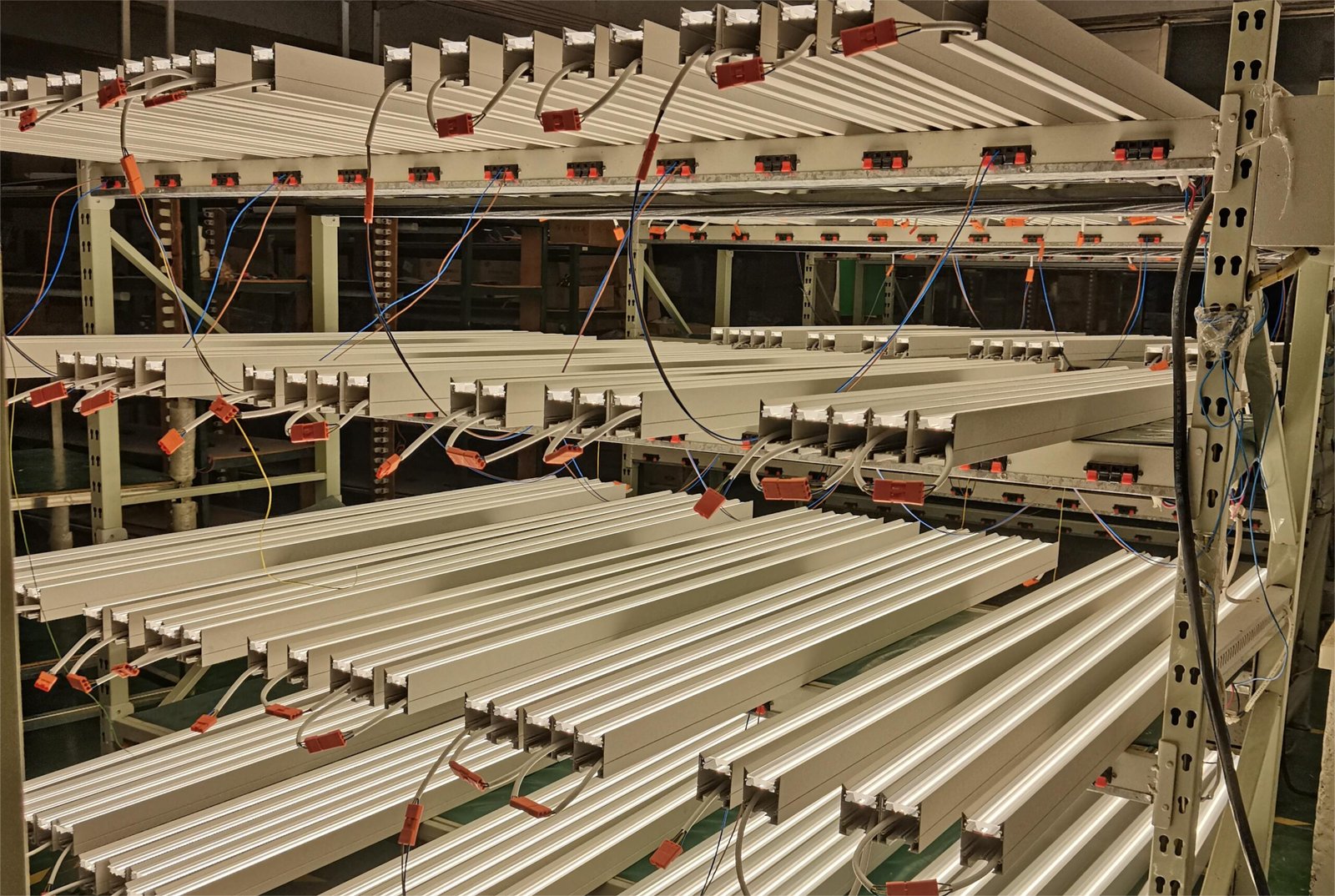
The photograph illustrates a production activity. It does not prove a specific duration, temperature, sample size or pass rate; those belong in the traceable batch record.
Ask how failures are investigated
A test is only as valuable as the response it triggers. If one unit goes dark, does the factory check the driver, connector, LED board, control setting or power feed? Does it record the root cause and correct the affected process? If several units fail for the same reason, is the batch held? What triggers a re-test after repair? Ask for a sample anonymized record showing the path from detection to disposition. This is more informative than an unverified “QC passed” stamp.
For intermittent behavior, the issue may appear only under a specific operating state. A fixture can switch on at full power but flicker at a low dimming level with the intended controller. A selectable product can have an incorrectly positioned switch. A tri-proof fitting can pass an electrical check while a seal or cable gland still requires separate inspection. Production aging should be part of a wider final inspection plan, not a catch-all name for every quality check.
When a design or component is changed, decide whether the established aging method still makes sense. A new driver or LED board may introduce a different risk. The supplier should identify revisions and show how the production screen and type tests were reviewed. A buyer managing repeat orders should ask for change notification and maintain an approved sample or baseline record for comparison.
Link aging with electrical and photometric checks
Aging says little about whether the fixture meets its optical specification unless measurements are included. A batch may light reliably but have the wrong CCT, beam, output or power setting. Ask how the factory checks these characteristics and whether those results are tied to the same order. A sample photometric report can be useful for a design specification, while a production check may verify selected parameters against an approved sample. The methods serve different levels of assurance.
Similarly, safety-related inspections have their own procedures and qualified requirements. A visible rack of lit fixtures does not demonstrate insulation, grounding, ingress protection or regulatory compliance. The purchaser should obtain the relevant reports for the target market and exact configuration where required. Ask the supplier to distinguish a formal third-party certificate from an internal line check. Unsupported blanket claims can create trouble at customs, approval or installation.
The integrating-sphere buyer guide explains a related measurement issue: a sphere report can support certain source or luminaire metrics under stated conditions, but it does not tell the whole story about the installed room. Likewise, aging is one piece of the production evidence, not a complete warranty of site performance.
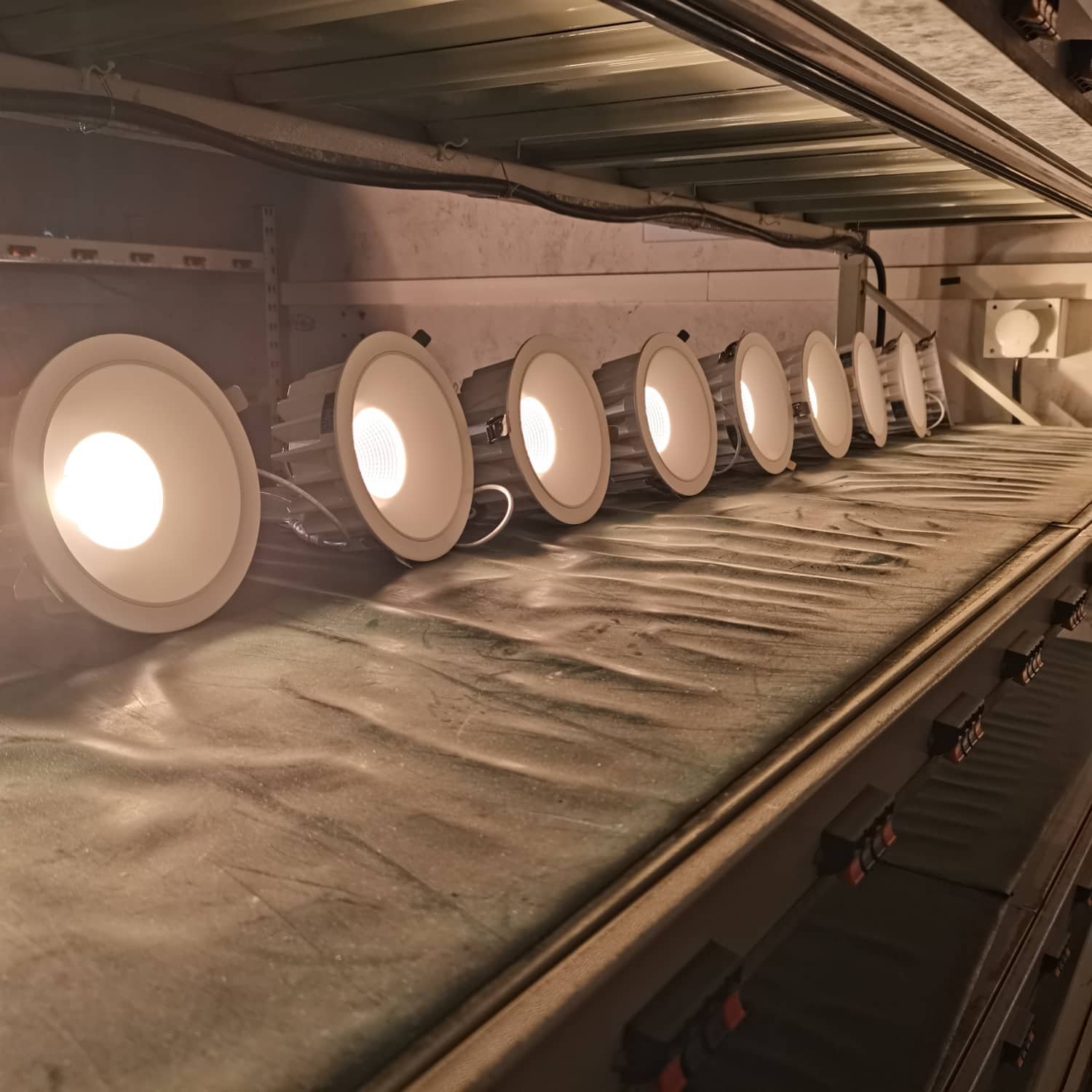
Different luminaire types can use different fixtures and inspection steps. Confirm the method used for the exact family being ordered.
Specify the evidence in the purchase process
Put the aging requirement in the quotation or quality agreement before production. State which product variants are in scope, what report the supplier will deliver and when. If the buyer needs photographs, ask that they show the specific batch or order identification, not a generic factory rack from a brochure. If the order is large, agree whether an independent inspection will witness any steps and how failed units will be handled.
A concise acceptance package could include the approved sample reference, production order number, batch quantity, operating test method, pass/fail summary, issue log, any rework record, final inspection sign-off and packaging traceability. Ask for these files in a format the buyer can store and retrieve later. Quality evidence has limited value if it cannot be connected to cartons, serials or a shipment.
A supplier should also be honest about what it cannot prove. If a product is new, there may be limited field history. That does not automatically disqualify it, but it means the buyer should rely on design validation, component evidence, pilot installation and a clear warranty process rather than inflated lifetime claims. The product center is a starting point for selecting a family; request model-specific records for the actual purchase.
Watch for misleading signals
A row of lit fixtures is visually reassuring, but it may represent only a display or a test in progress. An “aging passed” sticker without a batch ID and method is hard to audit. A long claimed lifetime based solely on source data omits driver and assembly risks. A high pass rate reported without the number tested or treatment of repaired units is difficult to interpret. Buyers should ask clear follow-up questions, not automatically reject every supplier that lacks a glossy report.
The objective is a proportionate, repeatable control. A well-run factory can explain what the test screens, what it does not screen and how the records connect to shipments. That transparency helps the buyer compare suppliers and respond faster if a field issue appears. It is more useful than a promise that no unit will ever fail.
Common mistakes to avoid
- Treating a factory aging photograph as proof of a specific test duration or pass rate.
- Confusing a short batch screen with a whole-luminaire lifetime claim.
- Omitting the product revision and tested setting from the record.
- Counting reworked units as first-pass without explanation.
- Failing to link the test record to shipment cartons or lots.
- Assuming lit operation verifies safety, optical output and ingress protection.
- Accepting a component lifetime projection as the lifetime of the finished fixture.
- Forgetting to update the test plan after a driver or board change.
Frequently asked questions
Does a passed aging test prove an LED luminaire’s lifetime?
No. It can screen for certain early problems under defined conditions, but long-term reliability involves components and failure mechanisms beyond a short production test.
Should every fixture be aged?
The appropriate scope depends on product risk and the agreed quality plan. Ask whether the supplier tests all units or samples, and require a clear record of the method and quantity.
What if a unit fails during the test?
The factory should identify and segregate it, investigate the cause, decide whether other units are affected, document rework or rejection, and apply a defined retest or batch-hold rule.
Is an LM-80 or TM-21 figure enough to prove whole-luminaire life?
No. Those methods concern LED source characteristics or projections. The complete luminaire also depends on drivers, optics, housing and other factors, as the IES cautions.
What is the most useful document for a buyer?
A batch-linked record stating the exact model and revision, test method and conditions, quantity, results, failures, corrective actions and shipment reference is much more useful than a generic “QC passed” statement.
Final recommendation
Ask a supplier to show aging as a defined production control with traceable records and a clear response to failures. Keep it separate from design validation and lifetime claims. That distinction protects both the buyer and the manufacturer by making every statement about quality mean something specific.
