 跳到内容
跳到内容 
“50,000 hours” looks precise, but it can describe very different things. It may refer to projected LED package lumen maintenance, a complete luminaire test, a driver design target, a warranty period or simply a catalogue claim. None of those meanings is interchangeable. A commercial buyer needs to know what performance level, population and evidence sit behind the number.
This guide explains L70, L80, B10, LM-80 and TM-21 from a procurement perspective. It also shows why driver reliability, temperature, colour shift, controls and maintenance access belong in the same lifetime discussion.

First separate lumen maintenance from failure
LEDs often fade gradually rather than burning out suddenly. Lumen maintenance describes how much light remains compared with initial output. A product can still operate electrically while no longer providing enough light for the project. Conversely, a driver, connector or solder joint can fail while the LED packages could theoretically retain high output.
A useful service-life plan therefore considers parametric failure, such as insufficient output or unacceptable colour shift, and catastrophic failure, such as no light or unstable operation.
What L70 means
L70 is the time at which luminous flux is expected to remain at 70% of its initial value under the stated method and conditions. It is not automatically the time when every complete luminaire fails. The letter L identifies lumen maintenance and the number identifies the retained percentage.
For an application that can tolerate gradual reduction and has generous initial margins, L70 may be a familiar reference. For a carefully designed retail or office system, waiting until output falls to 70% may leave the space below its required maintained illuminance.
What L80 and L90 mean
L80 and L90 use the same principle but set higher retained-output thresholds. L80 indicates 80% remaining, and L90 indicates 90% remaining. A quoted time to L80 will normally be shorter than time to L70 for the same depreciation curve.
Choose the threshold from the maintenance strategy and lighting calculation, not from which number looks premium. If the design maintenance factor assumes only modest depreciation, L80 or L90 information may be more relevant than L70.
What B values add
A B value describes the proportion of a population expected not to meet the specified lumen-maintenance level at the stated time, depending on the reporting framework. L80B10, for example, connects an L threshold with a population statistic. B50 represents a median concept, while B10 is more demanding because it limits the fraction below the threshold.
Ask the supplier to define exactly how B is calculated and whether it is measured, projected or assumed. A lifetime string without its method and confidence basis is difficult to compare.
What LM-80 measures
ANSI/IES LM-80 is an approved method for measuring maintenance of light-output characteristics of solid-state light sources such as LED packages, arrays or modules under controlled conditions. It records output and colour behaviour over time at specified temperatures and operating currents.
LM-80 data is component evidence. It does not by itself test every failure mode of the complete luminaire. The driver, PCB, optics, seals, wiring, connectors and thermal interface are not automatically covered by an LED package report.
What TM-21 projects
ANSI/IES TM-21 provides a method for projecting long-term lumen maintenance from LM-80 data. Projection limits are related to the duration and sample size of the underlying test. A very long claim based on a short data set should trigger questions about the permitted projection and reported notation.
The U.S. Department of Energy has repeatedly cautioned that LM-80 data with TM-21 addresses LED-source lumen depreciation, not the complete lifetime of every luminaire component. Ask for the actual LM-80 report, operating current, temperature and TM-21 calculation rather than accepting a copied summary.
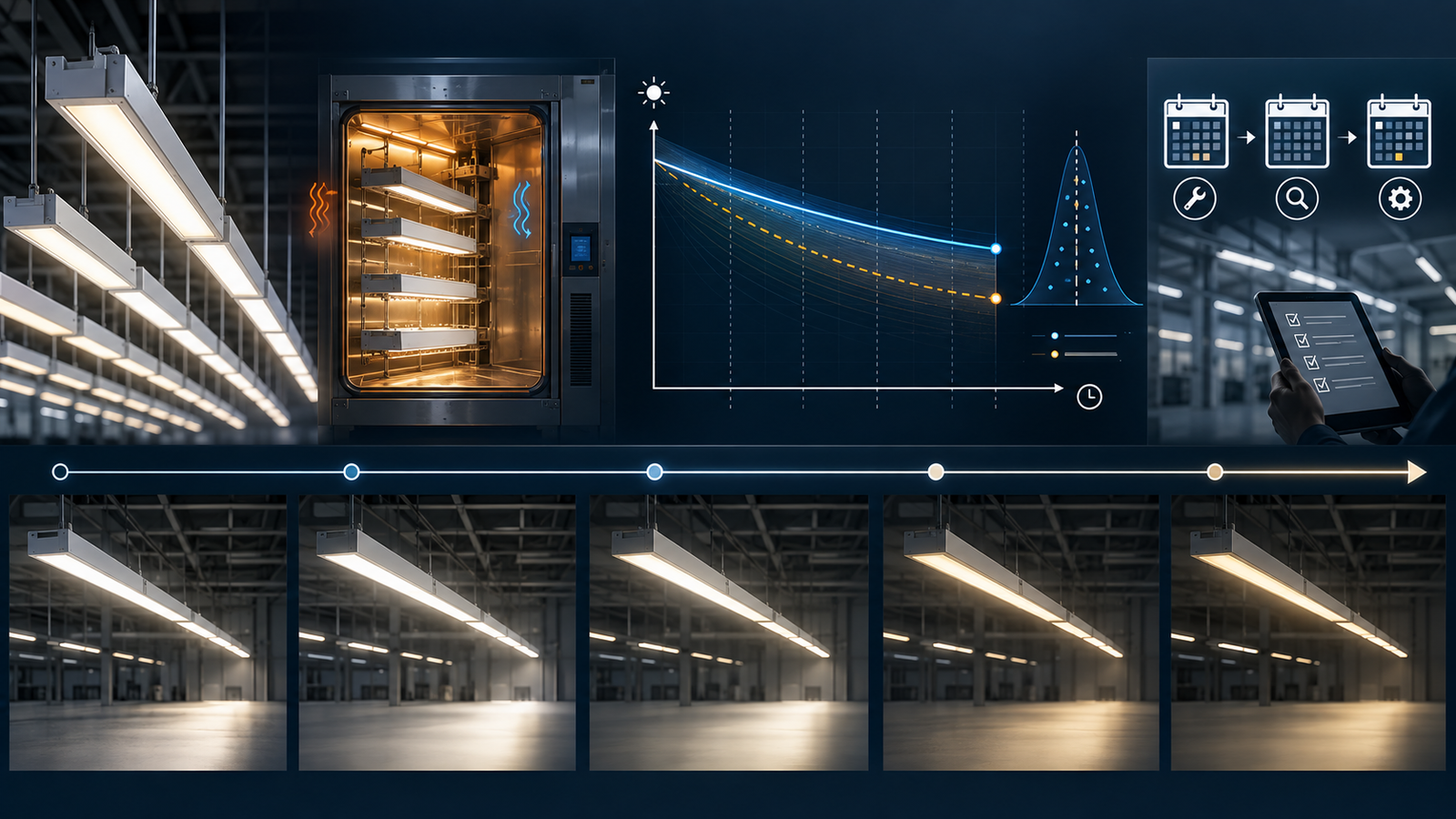
LED package temperature must represent the luminaire
Lumen maintenance is strongly influenced by junction and case temperature and drive current. A luminaire with poor heat transfer can expose LEDs to a more demanding condition than the component data selected for a projection. The manufacturer should measure the appropriate temperature point in the final product under representative ambient and orientation.
Compare that in-situ temperature with the LM-80 conditions and TM-21 input. For selectable-wattage products, test the worst relevant setting. For adjustable fixtures, confirm that intended orientation does not trap heat against the ceiling or other surfaces.
Ambient temperature changes service conditions
Catalogues often quote performance at a standard laboratory ambient, while real sites may be warmer. Retail ceilings can contain heat, poorly ventilated cavities or nearby equipment. Warehouses and industrial spaces can experience seasonal extremes. A driver or LED operated near its temperature limit may age faster.
State the expected ambient range and installation condition in the RFQ. Ask for rated ambient, thermal test setup and any output or lifetime derating. Do not enclose a product that is intended for open mounting.
The driver can be the life-limiting component
Electrolytic capacitors, switching components and other driver parts have temperature and electrical stresses. A premium LED package does not prevent a low-quality driver from failing early. Request the exact driver model, rated life conditions, case-temperature limits, surge information, control compatibility and warranty support.
If the driver is replaceable, document the replacement method and approved alternatives. If it is not replaceable without damaging the luminaire, include that fact in the total-cost and sustainability decision.
Controls and switching affect stress
Frequent switching, standby operation, dimming, high inrush, emergency modes and communication electronics can influence complete-system behaviour. A driver may spend most of its life at a dimmed level, but experience thermal or electrical stress at another condition.
Test representative control states and recovery after interruptions. For networked products, software support and component availability can determine useful system life even when the LEDs still emit light.
Colour shift can end useful life before lumen loss
A retail luminaire may retain adequate lumens while its chromaticity moves enough to create visible mismatch. Colour shift is especially noticeable on white walls, continuous lines and adjacent product displays. LM-80 data can include chromaticity maintenance, but the project needs an acceptance criterion.
Specify initial colour consistency and a maintenance expectation where colour is critical. Compare both panels of a dual-panel fixture and keep reference measurements for repeat orders.
Optics and dirt affect maintained output
Dust, grease, yellowing, lens damage and surface contamination reduce useful light independently of LED depreciation. A product installed above a supermarket bakery or industrial process may require a different cleaning schedule from a clean office.
Include luminaire dirt depreciation in the lighting maintenance factor. Review optical material data, sealing, cleaning instructions and chemical compatibility. A 50,000-hour LED claim cannot compensate for an optic that becomes dirty and inaccessible.
Warranty is not the same as rated life
A five-year warranty and a 50,000-hour lumen-maintenance projection answer different questions. Warranty terms define commercial remedies and exclusions; lifetime data describes expected performance under conditions. Check operating hours, switching, ambient limits, labour coverage, shipping, failure threshold and proof required.
Calculate how many hours the project will accumulate during the warranty. A store operating 16 hours per day reaches hours much faster than a residential installation. Align spare parts and service expectations with the operating schedule.
Convert hours into a project timeline
Divide the claimed hours by annual operating hours to estimate calendar time, while recognising that conditions and failure modes still matter. At 4,000 hours per year, 50,000 hours corresponds to 12.5 years of operation. At 6,000 hours per year, it is about 8.3 years.
Do not round that estimate into a guaranteed replacement date. Use it to plan inspections, output checks, cleaning, driver spares and financial comparisons.
Questions to ask about a 50,000-hour claim
- Is the claim L70, L80, L90 or another endpoint?
- What B value or population statement is included?
- Does it refer to the LED package, module or complete luminaire?
- Which LM-80 report and LED code support it?
- Which TM-21 calculation and projection limit were used?
- What LED current and in-situ temperature apply?
- What ambient and orientation were tested?
- What driver lifetime evidence is available?
- How are catastrophic failures and colour shift addressed?
- Are optics, seals and controls included in reliability review?
- What warranty conditions and remedy apply?
- How are component changes controlled in production?
How to approve a sample
A short sample test cannot prove 50,000 hours, but it can validate the configuration that supports the claim. Confirm LED and driver identity, measure input and relevant temperature points, check thermal contact, operate at maximum intended setting, test controls and inspect mechanical assembly. Link the sample to the reports and projection.
For a multi-wattage dual-panel track light, document the power setting and panel orientation. Higher settings may be the thermal worst case, while another control state may challenge the driver. Let the engineering review identify the appropriate conditions.
Production and receiving controls
Require component traceability for LEDs and drivers, verification of thermal-interface materials, fastening torque where relevant, electrical tests, operating checks and an ageing or burn-in process defined by the quality plan. A short factory burn-in screens early assembly defects; it is not a substitute for long-term reliability data.
At receiving inspection, verify model, driver, labels, function and batch records. Randomly compare power and colour with the approved reference. Investigate substitutions before installation.
Use lifetime data in the maintenance plan
Set inspection intervals for output, colour, dirt, controls and mechanical condition. Keep approved spare drivers or luminaires in a controlled environment and review compatibility before use. If the project expects a ten-year visual match, plan how repeat batches will be managed.
Our RFQ and sample-approval guide helps connect lifetime evidence to the exact purchased configuration.
Final recommendation
Treat “50,000 hours” as the start of a technical conversation. Ask what L threshold, B value, component, temperature, current, test duration and projection method it represents. Then examine drivers, colour, optics, controls and maintenance as parts of the complete luminaire.
If you send us the operating hours, ambient, required maintained light level and warranty expectations, we can organise the available LED, driver and thermal information for the selected product. We prefer a transparent evidence chain to a lifetime number that cannot be traced.

