 跳到内容
跳到内容 
Choosing a dimming method after the luminaires have been ordered is a common and expensive mistake. The driver may not match the control system, the track may not carry the required control conductors, the minimum dimming level may be disappointing, or a supposedly simple retrofit may require new wiring. “Dimmable” is therefore not a complete specification.
This guide compares DALI, 0–10V and TRIAC or phase-cut dimming from the viewpoint of a commercial lighting buyer. We focus on the questions that affect track and linear lighting projects: wiring, addressing, commissioning, compatibility, low-end performance, future changes and supplier documentation. Always have the electrical and control design completed by qualified project professionals.

Start by writing the control story
Before naming a protocol, describe how the space should work. Will all luminaires dim together? Do merchandising teams need separate zones? Are scenes required for trading hours, cleaning and events? Should a building management system monitor faults or energy? Will staff rearrange track fixtures? Is the project a new installation or a retrofit with limited wiring?
A clear sequence of operation turns technology into a business requirement. For example: “During trading hours, perimeter displays operate at full output while aisle lighting runs at 70%; after closing, all general lighting falls to 30%; store staff can recall three approved scenes but cannot change individual limits.” That description lets the designer compare control methods fairly.
What DALI provides
DALI is the Digital Addressable Lighting Interface, an internationally standardised protocol for communication between lighting-control devices. Its key idea is digital, addressable and bidirectional communication. A DALI system can control individual devices or groups, recall scenes and, depending on equipment and system design, obtain status or diagnostic information.
The DALI Alliance explains that DALI-2 certification uses more rigorous testing and aims to improve interoperability. Buyers should check the Alliance product database for certified devices rather than assuming that any driver described as “DALI compatible” has the same verification. System design still matters: a certified driver does not commission itself.
DALI strengths
- Individual addressing and flexible regrouping without changing mains circuits
- Scene control and precise digital commands
- Bidirectional communication and potential status data
- Useful integration options for larger commercial projects
- Strong fit for spaces where zones or layouts may change
DALI considerations
- Requires compatible control gear, application controllers and bus design
- Needs commissioning, addressing and documentation
- Track infrastructure must support the intended mains and control arrangement
- Interoperability should be verified through certified products and system testing
- Future maintenance teams need access to the configuration and competent support
What 0–10V provides
In a typical 0–10V arrangement, a separate low-voltage control signal tells compatible drivers what output level to produce. It is widely understood and can be practical for zone-based commercial lighting. The exact behaviour, wiring class, polarity, sourcing or sinking convention and off-state must be confirmed for the selected equipment and local rules.
Unlike a digitally addressed network, a basic 0–10V zone usually controls all connected drivers together. Changing groups may require wiring changes or additional interfaces. Performance depends on the controller, driver and cable installation as a system.
0–10V strengths
- Relatively straightforward concept for zone dimming
- Broad availability of compatible commercial drivers and controls
- Can deliver smooth dimming when controller and driver are well matched
- Suitable where fixed zones are acceptable
0–10V considerations
- Requires control conductors in addition to mains wiring
- Polarity and wiring practice must be correct
- Voltage drop, interference and mixed device characteristics can affect results
- Individual addressing is not inherent in a simple analogue zone
- Minimum level and switch-off behaviour vary by driver
What TRIAC or phase-cut dimming provides
Phase-cut dimming modifies the AC waveform supplied to the driver. It is attractive in some retrofits because it can use the mains conductors without a separate control pair. However, the dimmer, driver, load and installation must be compatible. Terms such as leading-edge, trailing-edge, forward-phase and reverse-phase matter.
LED loads behave differently from traditional incandescent loads. Minimum and maximum connected load, number of drivers, inrush current and driver input design can influence flicker, dropout, audible noise and dimming range. A wall dimmer that works with one sample may not work with twenty luminaires on a circuit.
Phase-cut strengths
- Can be useful where existing two-wire mains control must be retained
- Familiar user interface for small or simple zones
- No dedicated digital bus is required in the basic arrangement
Phase-cut considerations
- Driver and dimmer compatibility is critical
- Low-end stability and minimum level can vary
- Multiple drivers may behave differently from one sample
- Typically offers less zoning flexibility than an addressable digital system
- Waveform interaction can create flicker, noise or incomplete switch-off
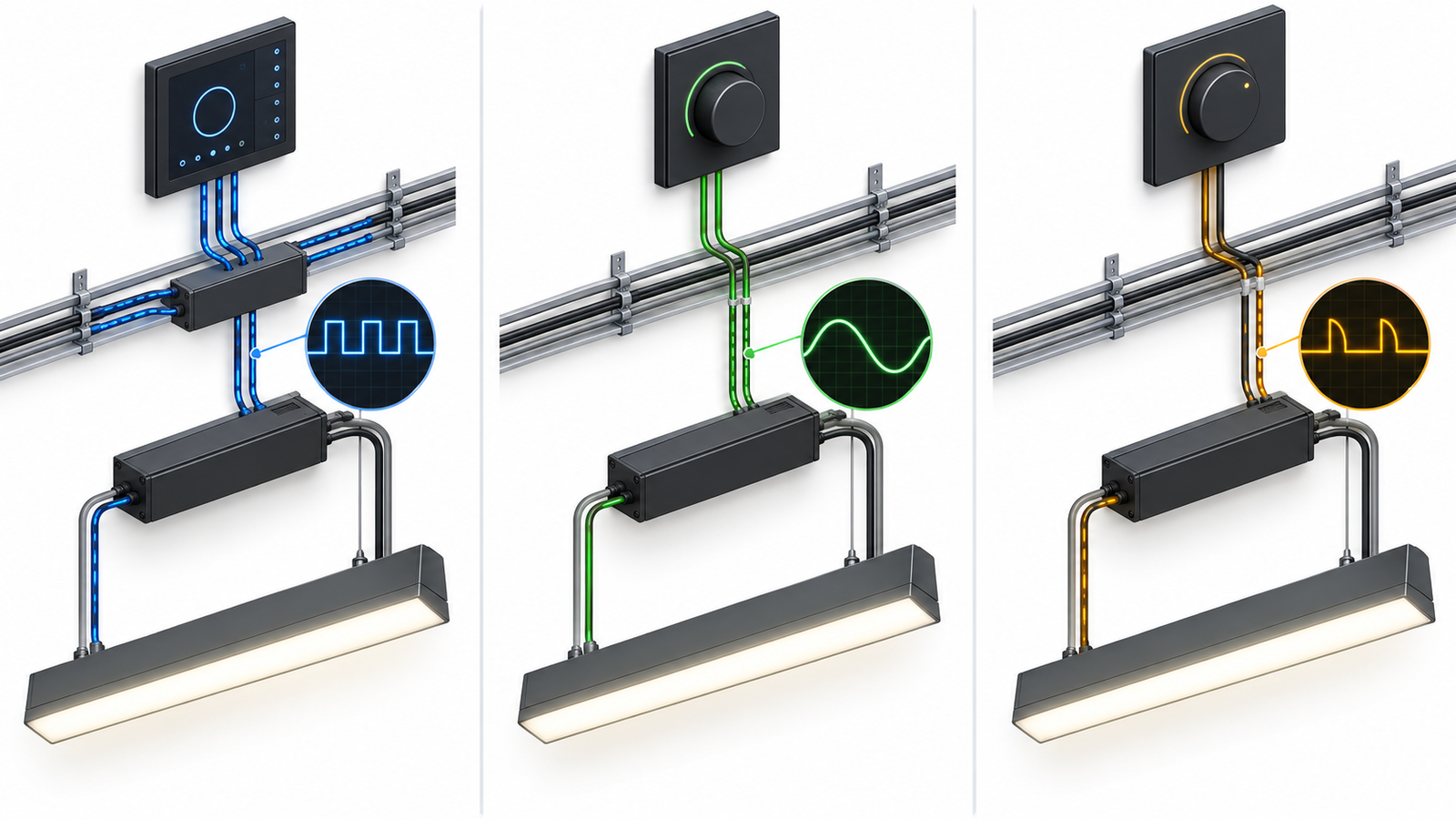
Comparison table for project decisions
| Decision factor | DALI | 0–10V | TRIAC / phase-cut |
|---|---|---|---|
| Control principle | Digital addressed bus | Analogue control signal | Modified AC mains waveform |
| Typical grouping | Software-addressed devices and groups | Hardwired zones | Mains circuit or dimmer zone |
| Feedback | Possible through bidirectional communication | Not inherent in basic control | Not inherent |
| Extra control wiring | DALI bus required | Control pair generally required | Often uses mains path |
| Commissioning | Addressing and programming | Zone and level setup | Dimmer/load compatibility setup |
| Best fit | Flexible, managed commercial systems | Stable fixed zones | Simple or constrained retrofits |
This table describes common project patterns, not every implementation. Gateways, wireless interfaces, relay functions and proprietary systems can alter the architecture. The controls designer should document the actual topology.
Track lighting creates an additional compatibility question
A track provides a mechanical and electrical infrastructure. Standard power track may offer one or several selectable mains circuits but no control bus. Some control-track systems include additional conductors or communications. A luminaire adapter that fits mechanically does not prove that DALI or 0–10V signals reach the driver.
For a retrofit, record the track brand, model, conductors, circuit arrangement, feeds and existing controls. Ask the supplier to identify the exact adapter and wiring configuration. Test a production-intent sample on the actual rail. Do not modify an adapter or use the track earth conductor for control.
How control affects an adjustable dual-panel fixture
A dual-panel track light provides two optical directions from one track position. Confirm whether both panels share one driver and one control address or have separate control channels. The answer changes what the system can do. Independent mechanical aiming does not automatically mean independent electrical dimming.
If both panels dim together, commissioning should balance their physical angles before setting output. If separate channels are offered, verify wiring, addresses, controls and labelling. State the required behaviour in the RFQ and sample order rather than inferring it from photographs.
Ten questions to ask the driver supplier
- What exact control protocol and standard version are supported?
- Is the DALI device certified and listed in the official database?
- What is the guaranteed dimming range under the stated load?
- How does the driver switch off at the minimum command?
- What dimmer models or control interfaces have been tested?
- What are input current, inrush and maximum device quantity per circuit?
- What control wiring, polarity and cable limits apply?
- What flicker performance is declared across the dimming range?
- What happens after mains failure or communication loss?
- Which driver model will be locked for production?
Test more than one light level
Sample approval should check 100%, common operating levels, the specified minimum and switch-off. Observe smoothness, step size, delay, flicker, noise and consistency between units. Record electrical and temporal-light measurements where required. Test the intended number of drivers or a representative circuit, not only a single luminaire on a bench.
For phase-cut systems, test the exact dimmer and expected connected load. For 0–10V, test the controller, cable length and off behaviour. For DALI, confirm discovery, addressing, grouping, scenes, status and recovery after power interruption.
Commissioning records buyers should receive
- Control schematic and circuit schedule
- Driver and controller model list
- DALI addresses, groups and scenes, where applicable
- 0–10V zones and cable references
- Phase-cut dimmer compatibility and load schedule
- Minimum and maximum level settings
- Final fixture positions and aiming
- Backup of programming or configuration
- Fault-response and replacement procedure
- Training and handover record
Without these records, a simple driver replacement can become a troubleshooting exercise years later. Require an editable backup where the system permits it.
Common specification mistakes
Writing only “dimmable”
State the method, driver, minimum level, off behaviour, control interface and test requirement. Otherwise suppliers can quote different systems under the same word.
Assuming a three-circuit track provides three dimming channels
Selectable mains circuits and dimming control are separate concepts. Document the real conductor and control arrangement.
Choosing controls only by initial price
Include wiring, commissioning, interfaces, maintenance, future regrouping and troubleshooting. A lower-cost driver may create a higher installed cost.
Ignoring flicker at reduced output
A driver can appear stable at full output and perform poorly near minimum. Test the required operating range with suitable instruments.
How to choose
Choose DALI when addressability, flexible grouping, scenes, feedback and integration justify the commissioning infrastructure. Choose 0–10V when reliable fixed-zone analogue control fits the project and control wiring is available. Consider phase-cut where a simple retrofit must use existing mains wiring and the complete dimmer-driver-load combination can be proven.
The DALI Alliance provides official information and a certified product database. For product procurement, our RFQ and sample-approval guide helps lock the driver, adapter and control configuration.
Final recommendation
Do not buy a “dimmable luminaire.” Buy a documented control outcome. Define the user sequence, track infrastructure, zoning, minimum level, recovery behaviour and commissioning deliverables, then select the method that fulfils them.
If you send us your control schematic, track information and required dimming behaviour, we can configure a sample around the actual project. We will identify what the luminaire can provide and what must be supplied by the controls system, so the commercial quotation does not hide an installation gap.

