 跳到内容
跳到内容 
Importing a commercial LED luminaire into Australia is not completed by asking a factory for an “SAA certificate” and placing an RCM symbol on the label. The compliance route depends on the equipment, its risk classification, the responsible Australian or New Zealand supplier, applicable safety and communications rules, exact model configuration and evidence retained for inspection.
We wrote this guide for Australian importers, lighting brands, wholesalers and project contractors evaluating overseas LED track and linear lighting. It is a purchasing checklist, not legal advice. Classification and obligations should be confirmed with the relevant regulator or a competent local compliance professional before supply.
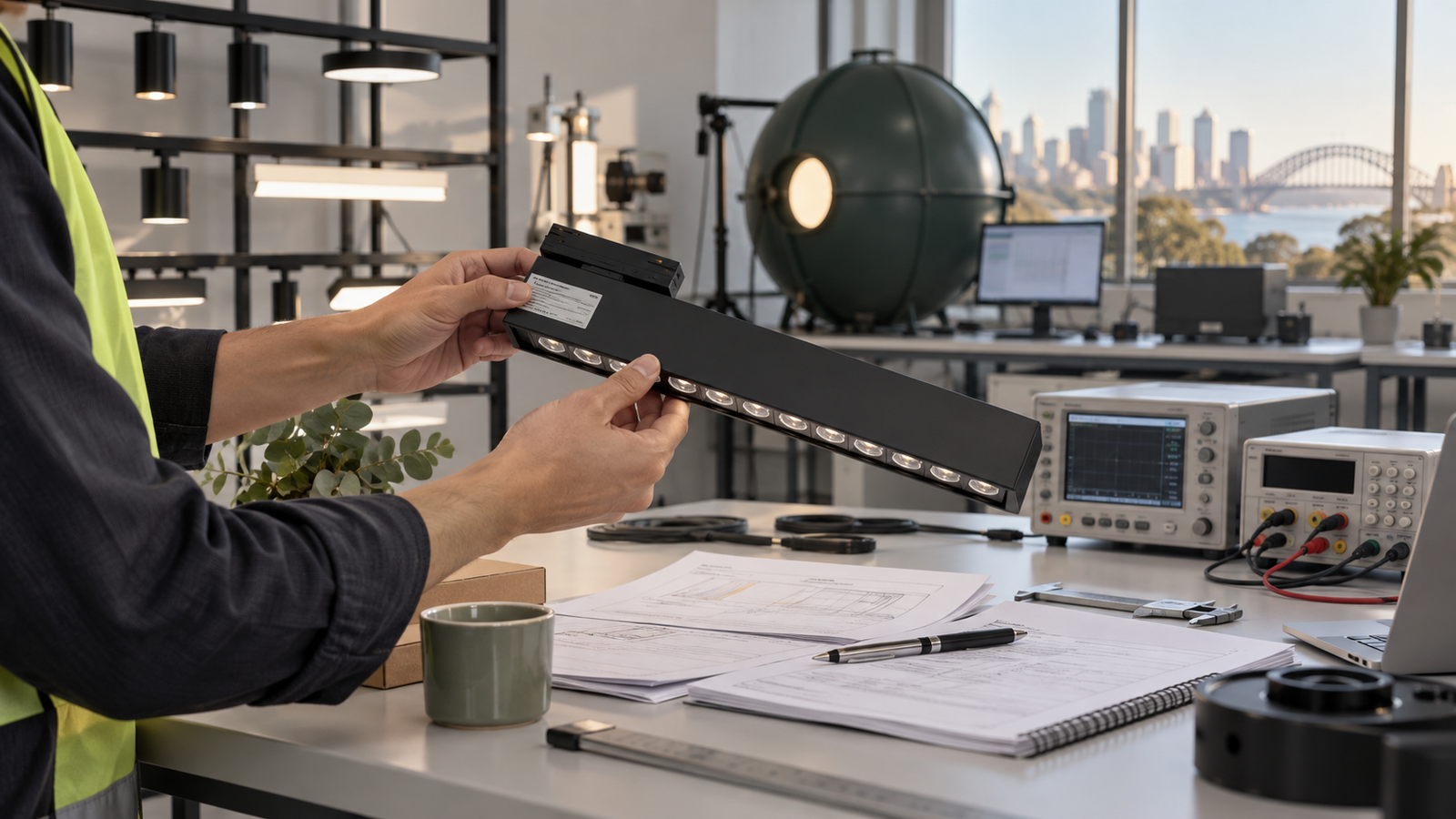
Start with the party who is legally responsible
The Electrical Equipment Safety System describes a Responsible Supplier as an Australian or New Zealand legal entity or person that manufactures or imports in-scope equipment. An overseas factory cannot simply register as the EESS Responsible Supplier without the required Australian or New Zealand legal presence. The local first supplier must understand and accept its obligations.
Before requesting documents, decide who will import and first supply the luminaire. Record its legal name, ABN or relevant New Zealand identifier, address and authorised officer. If a distributor says another company is responsible, confirm the commercial and registration chain rather than relying on a verbal assurance.
1. Define the exact equipment and intended use
Provide a full product description: model, wattage, voltage, frequency, LED module, driver, dimming or control, track adapter, optic, CCT, CRI, housing, mounting and intended environment. State whether it is a complete luminaire, a driver, a light source, a track component or a kit. The classification and evidence can change when the configuration changes.
For a configurable track product, create one model matrix. Show which components are common and which vary. If the sample uses a 40 W non-dimmable driver but the order includes a 60 W 0–10 V version, the compliance review must address both rather than assuming the sample represents the entire family.
2. Determine the EESS equipment classification
In participating jurisdictions, in-scope electrical equipment is classified by risk level. The EESS explains that Responsible Suppliers must register, while Level 2 and Level 3 equipment registration is mandatory and Level 1 equipment registration is voluntary, although evidence and supplier responsibilities still apply. Do not guess the level from a marketplace listing.
Use the current EESS equipment definitions and regulator guidance for the exact product. Ask a competent professional whether the complete luminaire, its driver or related components have specific classification and certification needs. Keep the written classification rationale in the compliance folder.
3. Understand what an RCM represents
The Regulatory Compliance Mark links equipment to a responsible supplier and the applicable regulatory arrangements. EESS states that registered Responsible Suppliers are authorised to apply the RCM when requirements are met. ACMA also uses the RCM for its regulatory arrangements. The mark is the visible endpoint of a process; it is not permission created by artwork.
Do not ask an overseas factory to apply an RCM until the responsible supplier has confirmed the evidence, registration, label rules and authorisation. Approve the final label with the local compliance owner. The EESS marking guidance and ACMA labelling guidance are useful official starting points.
4. Review electrical-safety evidence
Request a report or certificate appropriate to the product classification and applicable standard. Confirm the issuing body or laboratory, model names, ratings, factory, critical components, test sample and validity. A certificate for a driver alone does not automatically cover the complete luminaire, mechanical construction, wiring, earthing, temperature or track adapter.
Compare report photographs with the actual sample. Review any model-family differences and worst-case reasoning. Verify that the ordered driver, LED board, cable, terminal, insulation, housing and adapter appear in the component list or are addressed by controlled alternatives.
5. Do not treat “SAA” as a universal product answer
Buyers often use “SAA” as shorthand for Australian electrical approval, but the actual legal and certification route is more specific. A certificate may be important evidence, especially for equipment that requires certification, but EESS notes that a certificate alone does not authorise sale or RCM marking. The responsible supplier and required registrations remain part of the system.
Ask for the certificate number, holder, model scope, standard, issue and expiry dates, and verify it through the appropriate public database or issuer. Avoid screenshots with hidden numbers or certificates whose model suffix does not match the product.
6. Address EMC and communications obligations
LED drivers and control electronics can produce electromagnetic disturbance, and products must also tolerate relevant interference. Radio or wireless features may introduce additional requirements. The local supplier should identify the ACMA regulatory arrangements that apply and retain appropriate evidence.
Request complete-luminaire EMC evidence where needed, not only the component driver report. Check test modes, cable arrangement, input voltage, dimming state and model coverage. If Bluetooth, Zigbee, Wi-Fi or another transmitter is added, pause the existing review and assess the radio-enabled configuration separately.
7. Build one coherent compliance folder
A useful folder is indexed and traceable. Include:
- Product description and intended use
- Model and critical-component matrix
- Classification and applicable-rules assessment
- Safety test reports and certificates
- EMC or radio evidence where applicable
- Supplier declarations and component documents
- Risk assessment and engineering drawings
- Rating label, RCM artwork and packaging
- English installation and safety instructions
- Responsible Supplier and equipment registration records
- Production controls, change notifications and traceability
Use a cover sheet showing each document number, revision, date and model coverage. A pile of unrelated PDFs is not the same as a defensible compliance folder.
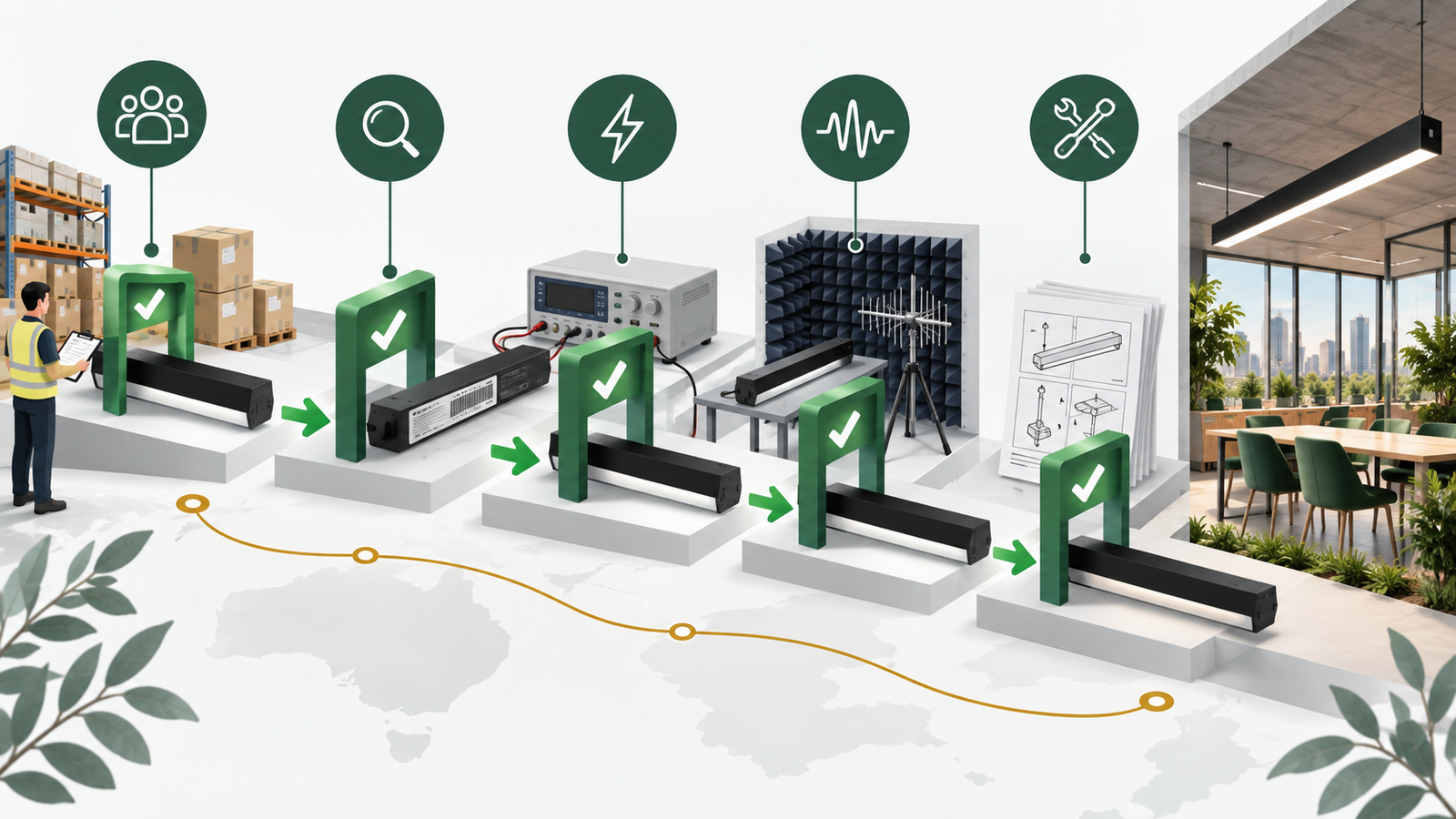
8. Approve the label against the exact model
Review model identifier, electrical ratings, responsible-supplier identification or coding, RCM placement and other required warnings or symbols. The label must remain legible and durable in the installed environment. Model names on the label should match certificates, reports, invoices and registration records.
For multi-wattage luminaires, state how the selected rating is identified. If a field switch changes power, confirm what ratings must appear and which settings were assessed. Do not let a generic label cover incompatible configurations.
9. Review installation instructions for Australian conditions
Instructions should identify the intended track system, supply requirements, isolation procedure, qualified installation, adapter insertion and locking, circuit selection, earthing, mechanical loading, clearances, adjustment, controls and maintenance. Ask the local installer whether the instructions are sufficient for the actual rail and ceiling.
A long linear track fitting creates different leverage from a compact spotlight. Verify weight, centre of gravity, support, adapter retention and rail compatibility with a physical sample. Compliance documentation cannot compensate for an unsuitable or damaged site track.
10. Test a production-intent sample
The sample should use the same driver, adapter, PCB, LED, optic, housing and label proposed for production. Conduct a controlled rail fit, electrical test and real-space lighting mock-up. Record incoming power, basic function, controls, colour, panel movement, temperature observations and any relevant safety verification by qualified personnel.
For an adjustable dual-panel model, move both panels through the intended range and confirm that adjustment does not disturb the adapter. Measure light on the target shelves or walls and inspect glare. This proves application suitability separately from regulatory compliance.
11. Control changes before and after the first order
Require written notice before substitutions to drivers, LEDs, PCBs, cables, lenses, adapters, enclosures or controls. The responsible supplier should assess whether existing evidence and registration still apply. A cheaper “equivalent” driver can change safety, EMC, flicker, dimming and thermal behaviour.
Keep an approved bill of materials and golden sample. Link batch codes to component lots and production records. If a field complaint occurs, traceability can contain the investigation to the affected quantity.
12. Verify production before shipment
Agree factory tests and sampling before the purchase order. Common checks include configuration identity, appearance, protective earthing where applicable, electrical strength or other routine safety tests, input power, function, controls, colour, mechanical adjustment, adapter locking, label and packing. The test plan should be prepared by competent parties and aligned with the product’s applicable requirements.
For a first order, arrange an inspection that compares selected production units with the approved sample and documents. Do not wait until containers arrive in Australia to discover a changed driver or incorrect RCM label.
13. Confirm records and market responsibilities
Ask who will retain evidence, respond to regulators, manage registrations, control labels, handle complaints and coordinate corrective actions. Record renewal and review dates for certificates or registrations. Monitor official guidance because requirements, fees and interpretations can change.
The EESS Responsible Supplier guidance explains the local entity and registration role. Use official sources rather than supplier blogs as the final authority.
Questions Australian buyers should ask a factory
- Which exact models and components are covered by each report?
- What equipment classification has been assumed, and who confirmed it?
- Is the evidence for the complete luminaire or only the driver?
- Which production-intent adapter was tested?
- What EMC operating modes and control options were assessed?
- Can we approve the rating label and instructions before production?
- How are component changes reported and evaluated?
- Which routine factory tests are recorded per batch?
- Can the supplier provide samples for rail-fit and lighting mock-up?
- How are model and batch traceability maintained?
What to include in your RFQ
State the destination state or territory, responsible importer, product application, quantity, voltage and frequency, track brand and profile, control method, required power, optic, CCT, CRI, label, instructions, compliance evidence, sample tests and delivery schedule. Ask suppliers to list exclusions and gaps rather than promising that everything is “Australian approved.”
Our RFQ and sample-approval guide can help freeze the technical configuration. For existing rails, also use our track compatibility checklist and provide a physical sample where possible.
Final recommendation
An Australian compliance plan needs three connected elements: a responsible local supplier, evidence for the exact product and correct registration or marking actions. Removing any one of them turns the RCM into an unsupported symbol.
If you want us to quote an LED track or linear light for Australia, tell us the responsible supplier, proposed classification, track system and document requirements before ordering samples. We can organise factory evidence and product configuration for review, while your Australian compliance owner makes the final regulatory decision.

