 跳到内容
跳到内容 
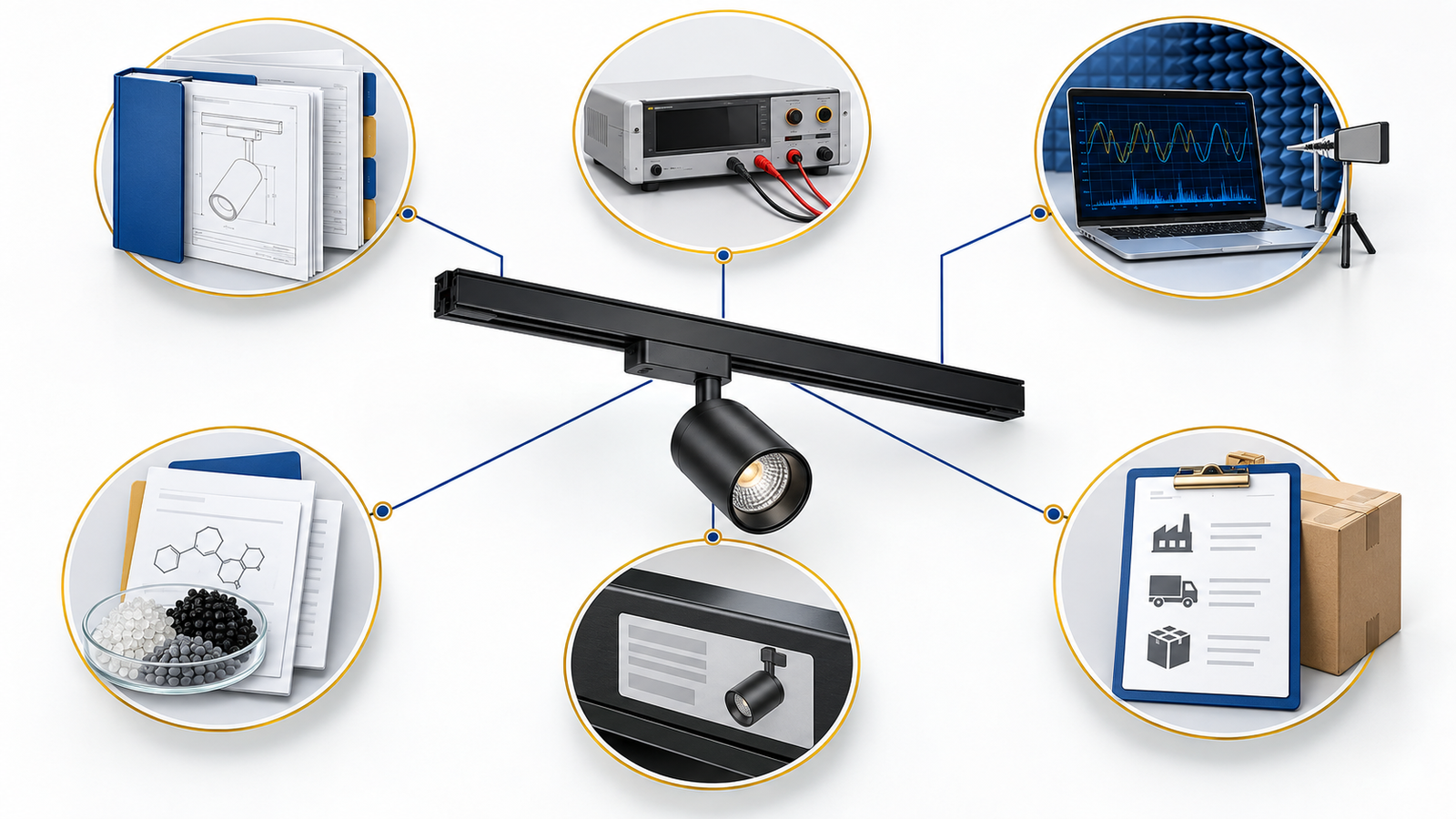
When an EU buyer asks whether an LED track light is “CE certified,” a simple yes or a logo on a catalogue is not enough. CE marking is a manufacturer’s declaration that the product complies with the EU rules that apply to it; the useful evidence is the chain behind that declaration: the exact model identity, risk assessment, test evidence, technical documentation, EU Declaration of Conformity, product marking and traceability.
We wrote this checklist for importers, distributors, private-label brands and project buyers sourcing commercial LED track lighting. It is not legal advice, and the responsible economic operator should confirm current obligations for the exact product and destination. Its purpose is to help you ask better questions before an order, so a missing document does not become a customs, market-surveillance or customer problem later.

First, understand what CE marking does—and does not—mean
The European Commission explains that the manufacturer is responsible for carrying out the conformity assessment, creating the technical file, issuing the EU Declaration of Conformity and affixing the CE marking. CE is not a general quality award, and there is no single universal “CE certificate” that automatically covers every variation of a luminaire. A third-party report can support the assessment, but the responsible party still needs a complete, coherent compliance case.
For an imported private-label luminaire, clarify who is the legal manufacturer, who imports it into the EU, whose name and address appear on the product or documentation, and who retains the technical file. If your brand changes the model, driver, adapter, control option or label, do not assume the factory’s paperwork automatically covers the new combination.
1. Freeze the exact product configuration
Begin with a configuration sheet. It should identify the luminaire model, power, input voltage and frequency, LED module, driver, track adapter, optic, CCT, CRI, dimming or control option, housing, cable and any accessories. Include the product drawing and photographs. If several wattages share one enclosure, list each configuration separately and show which evidence applies to which model.
This step matters because test reports often describe one sample, while the purchase order describes a family. A report for a non-dimmable driver does not automatically validate a DALI version. An adapter change can affect mechanical, electrical and EMC considerations. Ask the supplier for a matrix that maps every ordered model to its critical components and reports.
2. Identify the EU legislation that applies
The applicable rules depend on the product and configuration. For mains-powered commercial luminaires, buyers commonly evaluate electrical safety, electromagnetic compatibility and restricted substances, while ecodesign and energy-labelling obligations may apply to light sources and separate control gear, including light sources placed inside a containing product. Radio-enabled controls can introduce additional requirements. Packaging, waste and national obligations may also be relevant.
Do not copy a directive list from a competitor’s declaration. Ask a competent compliance professional to determine scope for the exact product. Use current European Commission and EUR-Lex sources. The Commission’s CE marking guidance explains the manufacturer’s core responsibilities, while the Commission’s light-source ecodesign page links to current lighting regulations and updates.
3. Review the standards list critically
The Declaration of Conformity should identify the legislation and standards used to demonstrate compliance. Check the titles, editions and amendments against the report and the product’s date of placement on the market. A familiar standard number is not enough if the report covers a different product category or an obsolete edition without a documented transition analysis.
For track-mounted luminaires, the standard set may address general luminaire safety plus product-specific construction, EMC emissions and immunity, harmonics, flicker, photobiological considerations and other relevant characteristics. We recommend that importers have the standards list reviewed by someone qualified to understand the exact scope rather than asking sales staff to guess.
4. Check the electrical-safety test report
The report should identify the applicant, manufacturer, model, sample and critical components. Compare its photographs with the product you are buying. Review rated voltage, insulation class, earthing, creepage and clearance considerations, temperature testing, mechanical strength, strain relief, wiring, terminal and adapter construction, abnormal operation and marking. Confirm that the track adapter used in the report is the one in production.
Pay particular attention to differences marked as “similar” or “representative.” If 27 W, 40 W, 50 W and 60 W versions are grouped, ask how the worst-case sample was selected for temperature and electrical stress. A lower-power sample is not automatically worst-case. The engineering justification should be written, not implied.
5. Verify EMC evidence for the complete luminaire
An LED driver report is helpful but may not represent the complete luminaire with its wiring, LED load, controls and enclosure. Ask for evidence appropriate to the complete product configuration. Review conducted and radiated emissions, immunity and any other relevant tests, along with sample description, cable arrangement, operating mode and limits.
For a selectable-wattage or dimmable product, ask which settings were tested. The worst EMC condition may not be obvious. If the supplier changes the driver, cable routing or control module, require an impact review and, where necessary, additional testing.
6. Confirm RoHS and material evidence
A one-page supplier promise should not be the whole restricted-substances file. Ask for a component and material declaration process that covers LEDs, driver, printed circuit boards, solder, cables, lenses, coatings, adhesives and other relevant homogeneous materials. Third-party analytical reports can support high-risk materials, while supplier declarations and bill-of-material controls support broader coverage.
Check that the declaration references the current applicable restrictions and exemptions. If an exemption is relied upon, record why it applies and its status. Require change control so a substituted cable, solder or electronic component is reviewed before production.
7. Address ecodesign and energy information correctly
EU lighting rules distinguish light sources, separate control gears and containing products. The correct responsibilities depend on how the light-emitting parts can be removed for verification and how the product is placed on the market. Do not assume that every complete luminaire needs the same energy label as a replaceable lamp, or that a luminaire escapes all obligations because it is sold to professionals.
Review Regulation (EU) 2019/2020 and Regulation (EU) 2019/2015 as currently amended, along with Commission guidance. Check reference control settings for adjustable or dimmable configurations, declared performance, removability information and any required product database responsibilities. Keep evidence for the exact LED and driver combination.
8. Inspect the EU Declaration of Conformity
The declaration should clearly identify the product and manufacturer, state the applicable Union legislation, list the standards or other specifications used, contain the required responsibility statement, identify the authorised signatory, and include place and date of issue. It should be signed by a person authorised to commit the manufacturer.
Compare model spelling and suffixes with the rating label, carton and invoice. If one declaration covers a series, make sure the relationship is unambiguous. Avoid declarations that name only “LED light” or use photographs unrelated to the ordered fixture.
9. Review product marking and traceability
Approve the rating label artwork before production. Check model, electrical ratings, manufacturer or responsible-party information, CE marking and any other required symbols or warnings. The markings must be durable, legible and placed appropriately. The exact requirements depend on the applicable legislation and product design.
Add batch, date or serial traceability appropriate to your quality system. Traceability lets you connect a field unit to its components, production tests and corrective actions. Without it, one complaint can force the buyer to treat an entire mixed shipment as suspect.
10. Approve instructions and safety information
Installation instructions should cover the intended track system, qualified installation, isolation, orientation, locking, circuit selection, mechanical loading, clearances, adjustment, controls, cleaning and maintenance. Warnings should address foreseeable misuse. Provide the languages required for the countries where the product will be supplied.
For an adjustable track fixture, explain how the adapter is inserted and locked and how the body or panels are aimed without stressing the rail. A photograph is useful, but it should support—not replace—clear instructions.
11. Build a technical file index
Create an index instead of saving files in an unstructured folder. A practical index may include:
- Product description, intended use and model matrix
- Drawings, photographs and bill of materials
- Risk assessment and applicable-legislation review
- Safety, EMC and performance test reports
- RoHS and material declarations
- Ecodesign and energy-related information where applicable
- Critical-component certificates and specifications
- Labels, packaging and instructions
- EU Declaration of Conformity
- Production quality controls and change-control records
- Complaint, corrective-action and traceability procedures
Record report numbers, revisions, issue dates and model coverage in the index. This makes gaps visible and speeds up review when a customer or authority asks for information.
12. Audit consistency across every commercial document
Compare the technical file with the website, catalogue, quotation, purchase order, product label and carton. Claims such as power, lumens, CRI, lifetime, IP rating, dimming and compatible track types must be consistent and supported. A product can fail a credibility review even when individual reports look professional if commercial claims exceed the evidence.
For private-label projects, decide whether the factory model and brand model are cross-referenced. Keep the link confidential if needed, but make it available to the responsible compliance team.
13. Control changes after approval
LED lighting supply chains change. Drivers, LEDs, lenses, cables, PCBs and adapters may be substituted. Require the supplier to notify you before changing safety-critical, EMC-critical, optical or regulatory-relevant parts. Define which changes need a document update, engineering review, verification test or new sample.
Retain an approved golden sample and critical measurements, but do not depend on appearance alone. Two drivers can look similar while behaving differently electrically. The bill of materials and test evidence remain controlling.
14. Conduct receiving and production verification
Before shipment, inspect a defined sample of production units. Verify model configuration, labels, adapter, workmanship, function, electrical safety tests performed by the factory, power, colour, controls and packing. Check traceability and compare selected units with the approved sample.
Our LED lighting RFQ and sample-approval guide provides a structure for locking specifications before production. For track compatibility, use the sample with the actual rail rather than relying on a generic adapter description.
Questions to ask before paying the deposit
- Who is the legal manufacturer and who will be the EU importer?
- Which exact models and configurations does the declaration cover?
- Which reports evaluate the complete luminaire rather than only components?
- How are selectable power, dimming and adapter variations addressed?
- Which legislation and standard editions were reviewed?
- How are RoHS materials and supplier substitutions controlled?
- What ecodesign or product-information duties apply?
- Can labels and instructions be reviewed before mass production?
- How long and where will technical documentation be retained?
- What change-notification and batch-traceability process is included?
Final recommendation
The safest procurement question is not “Do you have CE?” It is “Can you show a consistent technical file for the exact product we will place on the EU market?” A responsible supplier should be able to explain the connection between the ordered model, critical components, test reports, declaration, label and production controls.
If you are evaluating one of our LED track or linear lighting products, send us the destination, model configuration and your compliance-document checklist at the quotation stage. We can organise the available evidence around the exact sample, identify gaps that require confirmation and avoid presenting a general logo as a substitute for due diligence.

