 跳到内容
跳到内容 
Supermarket shelf lighting succeeds when customers can see merchandise clearly, not only when a meter reads a high value on the aisle floor. This worked example explains how we separate horizontal and vertical illumination when comparing linear optics. The scenario is illustrative and does not represent a named customer project; final values require the store plan and measured photometric files.
At LCB Light, we ask where the visual task is located. For grocery aisles, labels and packaging are mainly vertical. For produce tables, checkouts and circulation, horizontal light becomes more important. One repeated optic may not serve every zone equally well.
Illustrative store zone
Assume a 24 m-long grocery aisle, 2.4 m clear width, shelving on both sides to 2.2 m high and luminaires mounted at 3.6 m. The proposed line runs along the aisle center. The buyer wants strong shelf visibility, comfortable navigation, CRI suitable for packaged goods and the ability to reconfigure displays.
We compare a broad diffuse linear insert with a double-asymmetric shelf-oriented optic. Both must be evaluated at the same delivered lumen level and mounting position.
Horizontal lux describes only part of the experience
A calculation grid on the floor or a nominal work plane shows circulation and general brightness. A broad optic can produce smooth overlap and attractive averages. But high horizontal values can coexist with dim upper or lower shelves if much of the light travels downward rather than toward the vertical merchandise planes.
Record average and minimum horizontal levels, but do not use them as the only acceptance criteria for retail aisles.
Vertical lux shows how merchandise is revealed
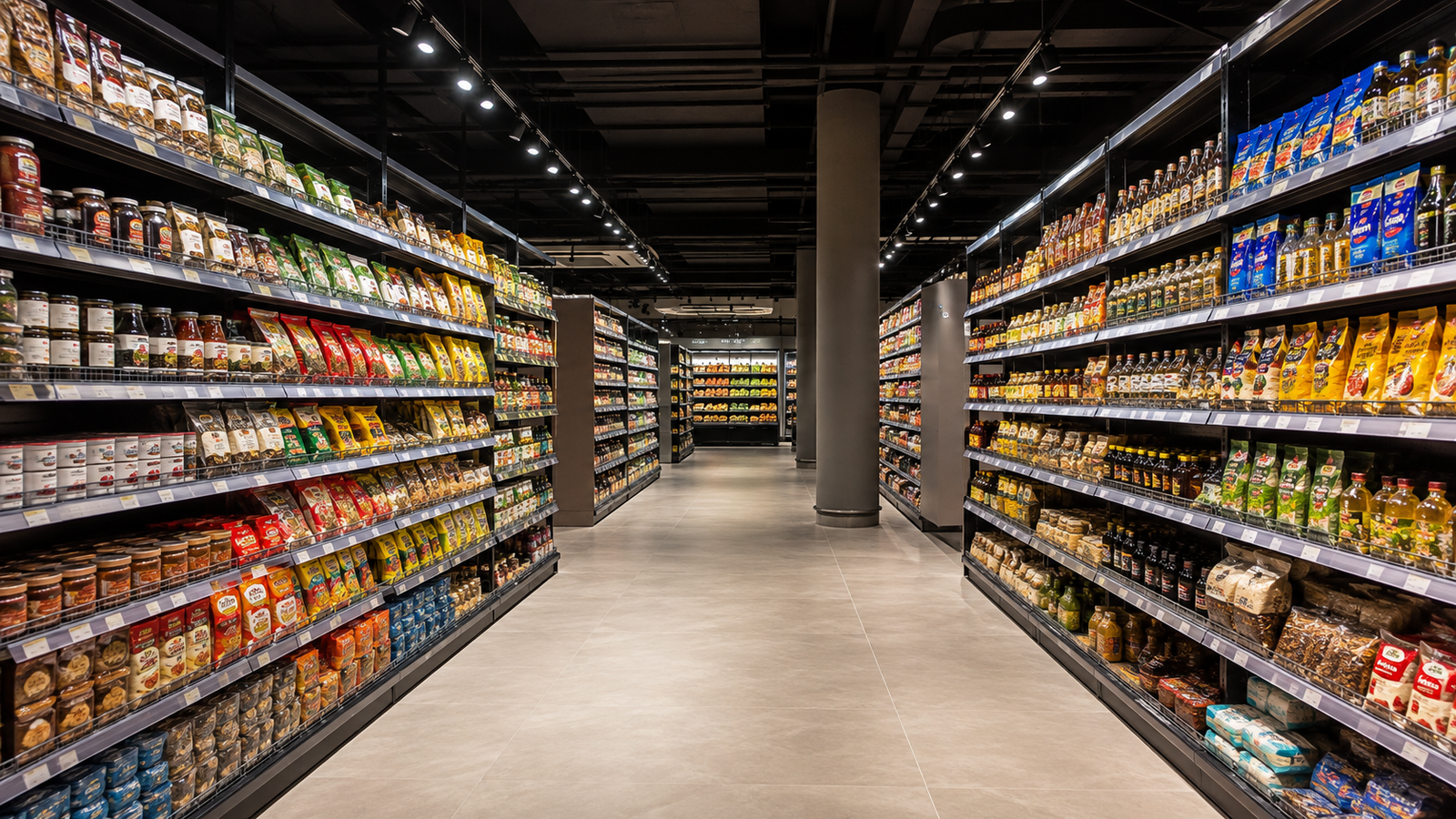
Add calculation surfaces on both shelf faces at representative heights. Compare average, minimum and gradients from top to bottom. An asymmetric or double-asymmetric optic can redirect intensity toward products, potentially improving visibility without increasing total lumens.
Orientation, shelf setback and luminaire position matter. A shelf-oriented optic installed off-center or rotated incorrectly can favor one side. The first installed aisle should therefore be checked before the same layout is repeated across the store.
Avoid glare and harsh reflections
Glossy packaging and freezer doors can reflect bright apertures. View the line from shopper height and from checkout or end-cap sightlines. A very narrow shelf optic can create sparkle or high luminance if the luminous area is small. Diffusers and optical films should be assessed with the actual output.
Glare control is a balance: reduce uncomfortable brightness without removing the vertical light that makes products readable. Use calculations and a mock-up rather than choosing the darkest-looking louver.
Color and contrast are part of shelf performance
CCT and color rendering should support the merchandise and brand environment. Produce, bakery and meat areas may use distinct spectra or warmer presentations, while general packaged goods need consistent white light. Avoid abrupt color differences where zones meet.
For long rows, specify color tolerance and batch control. Our linear-light color-temperature guide can help structure the choice, but physical samples under real finishes remain valuable.
A comparison table for the buyer
| Decision | Broad diffuse optic | Shelf-oriented optic |
|---|---|---|
| Likely strength | General aisle uniformity | Vertical merchandise illumination |
| Risk to check | Underused light on floor or rack tops | Orientation, glare and uneven shelf gradient |
| Best evidence | Horizontal and vertical calculation | Vertical planes plus full-size mock-up |
| Typical complementary zone | Open sales floor and circulation | Long double-sided aisles |
The project may combine both rather than force one optic into every department.
From model to store opening
- Confirm final shelf heights, aisle widths and signage.
- Model both vertical faces and the horizontal aisle plane.
- Check end caps, freezer reflections and crossing views.
- Approve one full aisle or representative bay.
- Label optic orientation on product and drawings.
- Commission dimming and after-hours zones.
- Measure after merchandise is stocked because products change reflectance.
Document the approved optic and aiming so future reconfiguration does not accidentally reverse the shelf distribution.
Illustrative calculation surfaces
For the example aisle, create a horizontal plane near floor or relevant task height and vertical rectangles on both shelf faces. Divide the vertical surfaces into top, middle and lower bands so a good average cannot hide a dark lower shelf. Add end-cap and crossing-aisle views where promotions are displayed. Use the same maintenance factor and product output for each optic comparison.
If freezer doors are present, model their location and then validate reflections physically. Software can estimate light levels, but material gloss, packaging and shopper views still need observation.
Merchandising changes the lighting task
White paper packaging, dark bottles, metallic pouches and fresh produce reflect light differently. The store should choose representative merchandise for the mock-up. Empty white shelves can make a lighting design look more uniform and brighter than the stocked condition. Signage may also shade upper products or create bright reflections.
At LCB Light, we ask which departments drive brand perception and which are primarily functional. This helps allocate higher color quality, special spectra or tighter optical control where they support sales and customer experience.
Coordinate general and accent lighting
A continuous line can provide dependable aisle coverage while track spotlights emphasize end caps, seasonal displays or premium zones. Keep the roles separate in the calculation. Using accents to repair weak general shelf light can create uneven brightness, while using only diffuse general light can flatten the visual hierarchy.
Energy controls without distracting customers
Daylight zones near façades can reduce output, and back-of-house or closed sections may use occupancy response. On a trading floor, aggressive sensor changes can be visually distracting. Scene scheduling, smooth fades and minimum background levels may suit the customer experience better than abrupt switching.
Record after-hours, cleaning, stocking and emergency modes. The controls are part of the operating brief, not an accessory selected after luminaires arrive.
Packaging, installation and optic orientation
Similar-looking inserts with different optics should be labeled clearly on the product and carton. Number long runs and match them to the plan. During the first aisle, check suspension alignment, feed position, optic direction and dimming group before repeating installation. A small orientation error multiplied across dozens of aisles can erase the expected vertical-light advantage.
Commercial comparison
Compare cost per complete aisle, not price per luminaire. Include rail or trunking, feeds, connectors, accents, sensors, emergency parts, installation and commissioning. Then relate that cost to verified shelf coverage and connected load. A proposal that uses fewer fittings but leaves lower shelves dim is not a like-for-like saving.
Use the first aisle as a controlled learning step
Before full rollout, complete one representative aisle with real shelves, signs and merchandise. Review upper and lower product visibility, floor uniformity, glare, reflections, color appearance and control behavior. Measure agreed horizontal and vertical points using a recorded method. Invite merchandising, design and facilities teams because each sees a different part of the result.
Document adjustments to optic direction, output, suspension or spacing, then update the drawing and bill of materials before repeating the installation. This small pilot can prevent dozens of identical errors and creates photographs and data that support future store standards without pretending every location has the same ceiling or shelf geometry.
Turn the technical finding into a purchasing decision
A useful specification states the application, exact luminaire configuration, operating conditions, required evidence and acceptance method. At LCB Light, we encourage buyers to separate mandatory performance from preferences and to approve one production-intent sample. That makes quotations comparable and gives production inspectors a clear reference.
Keep the approved product code, drawing, driver, optic, test file and finish in one project package. If any of those items changes, review the effect before shipment. This simple change-control step protects the result more effectively than adding more marketing adjectives to the purchase order.
Our recommendation for a supermarket quotation
Send the shelf plan, mounting height, ceiling coordination and merchandising priorities. Ask each supplier to show both horizontal and vertical results using the quoted optic. At LCB Light, we would also identify where wide, asymmetric or accent modules create the best value and how the system can adapt when aisles change.
This approach connects lighting cost to merchandise visibility. It helps the buyer avoid paying for high floor lux that does not reach products, while keeping glare, energy and installation practical.
Frequently asked questions
Is vertical lux more important than horizontal lux in every supermarket?
No. It is especially important on merchandise faces, while circulation, tables and checkouts also need appropriate horizontal illumination.
Can track spotlights replace linear shelf lighting?
They can add accent and flexibility, but a long aisle may need continuous, uniform vertical coverage. Many stores combine general linear light with selected accents.
Should a supermarket use one CCT everywhere?
Not necessarily. Departments may need different presentation, but transitions and brand consistency should be planned rather than accidental.
Discuss Your LED Linear Lighting Project
Share your layout, mounting height, target light level, optic, control and destination-market requirements. The LCB Light team can help you prepare a project-specific configuration and sample plan.

