 跳到内容
跳到内容 
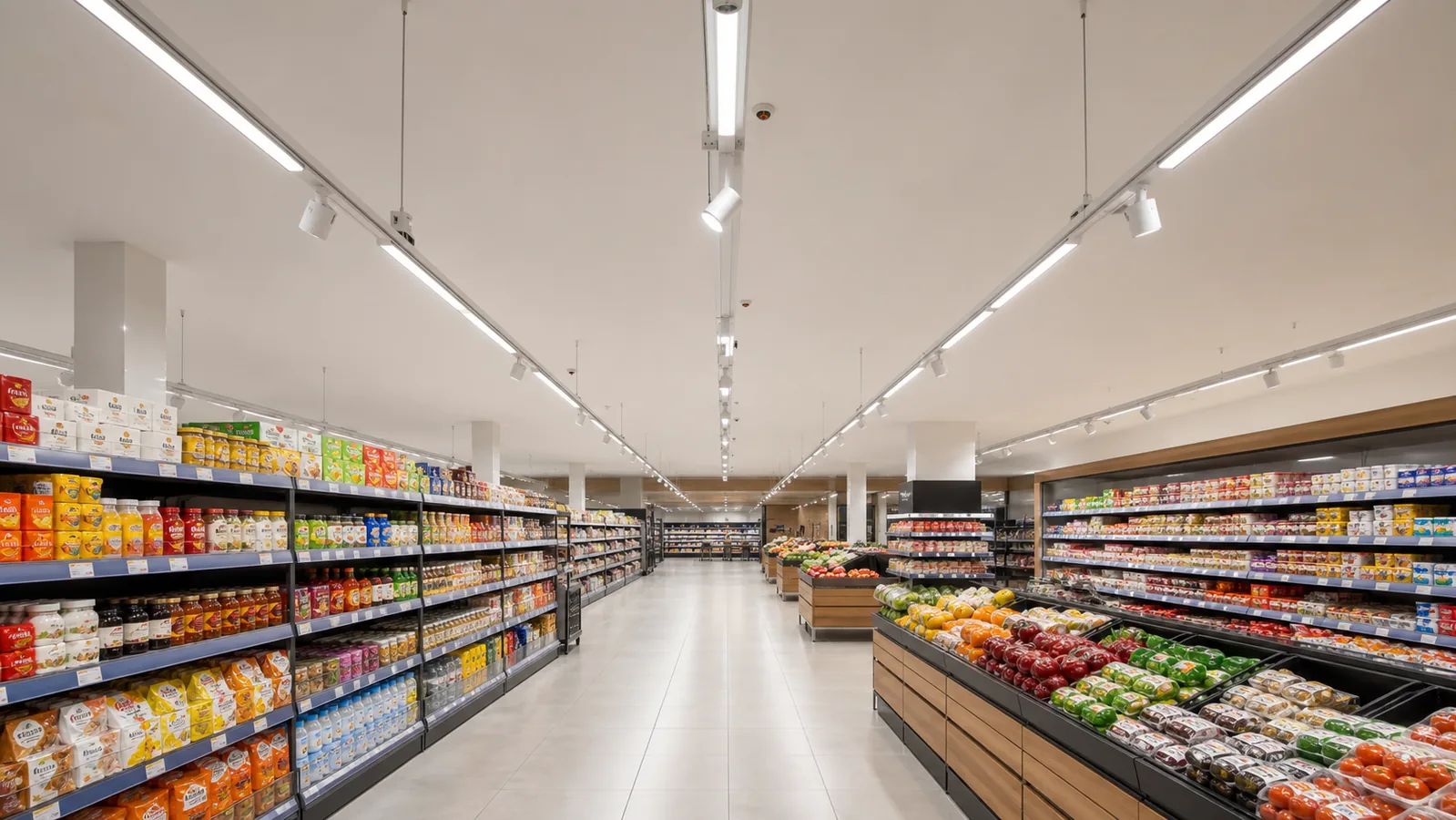
At LCB Light, we consider a trunking line to be long-term electrical and mechanical infrastructure. The light inserts may be moved or replaced, but the rail, conductors and connector family can remain in the building for years. That is why we encourage buyers to evaluate system capacity, compatibility and future flexibility before focusing on fixture price.
LED trunking linear lighting combines a mechanical rail, continuous wiring and plug-in light modules. It is widely considered for supermarkets, warehouses and industrial spaces because one infrastructure can support lighting, controls and future layout changes. System compatibility and planning are essential.
What is included in a trunking system?
A typical system includes trunking rails, internal conductors, connectors, feeds, suspension or surface brackets, light inserts, optics and end pieces. Some systems also carry control or emergency circuits. Components from different families are not automatically interchangeable, even when their dimensions look similar.
Why supermarkets use trunking lines
Continuous rows can follow aisles and create an orderly visual rhythm. Wide distributions support general sales floors, while asymmetric or double-asymmetric optics can direct light toward shelves. Track spotlights or accent modules may be integrated on compatible systems to highlight promotions and displays. For retail-focused planning, see our linear track-light guide.
Why warehouses use trunking systems
In warehouses, long powered rails can reduce separate cable runs and make module placement repeatable. Aisle optics can improve vertical illumination on racks, while wide optics suit packing and open storage zones. Plug-in sensor modules may support occupancy-based energy savings.
Plan wiring and controls early
Confirm conductor count, phase selection, maximum current, feed positions and control topology. Long physical runs may require more than one electrical feed. Mark emergency modules, sensor zones and daylight groups on the shop drawings. Changing the control strategy after procurement may require different rails, drivers or connectors.
Coordinate layout and installation
- Map standard rail lengths and joint positions.
- Confirm suspension spacing and structural support.
- Align optics with aisles, shelves and work areas.
- Plan feeds to minimize visible cabling.
- Allow access for reconfiguration and maintenance.
Check whether the system permits modules to be moved while the rail remains installed and what safety procedure is required. The installation team should follow the manufacturer’s load, polarity and connection instructions.
Procurement checklist
Compare luminaire output, rail capacity, optic options, driver and sensor compatibility, ambient rating, emergency solution, spare components and documentation. Order a representative set of joints, feeds and accessories with the sample—not only the light insert. For general output selection, use our lumens and wattage guide.
Plan for future reconfiguration
One advantage of trunking is the potential to move or add compatible modules when aisles and displays change. Preserve that flexibility by documenting conductor allocation, control addresses, maximum loads and spare capacity. Keep several critical connectors, feeds and light inserts as project spares if the facility depends on a specific system family.
When evaluating suppliers, ask about product continuity and backward compatibility. A trunking rail is a long-term infrastructure decision; replacement modules and accessories should remain obtainable beyond the first installation phase.
Label installed rail sections and store the as-built plan. Future contractors can then adjust the LED trunking linear lighting safely without guessing which conductors or control groups serve each aisle.
How we evaluate the trunking rail before the light insert
We first review conductor capacity, phase arrangement, control wiring, feed options and mechanical load. The rail must support the present lighting plan and reasonable future changes. At LCB Light, we recommend identifying spare electrical capacity and keeping an as-built record. This allows facility teams to relocate modules without creating unknown loads or control conflicts.
Supermarket and warehouse priorities differ
In supermarkets, we look closely at shelf brightness, aisle rhythm, product appearance and the possibility of accent modules. A distribution that directs light toward vertical merchandise can be more useful than one that produces the highest floor reading. In warehouses, we prioritize rack-face illumination, sensor coverage, ambient conditions and simple maintenance. The same rail family may support both, but the optics and control zones should follow the tasks.
What we recommend sampling
Order a short rail section with a real feed, connector, suspension set, light insert and optic. Test how the module locks into place and how phase or control selection is made. Review joint alignment and the visibility of wiring accessories. If future reconfiguration is important, have the maintenance team observe the process and confirm the required safety procedure.
Commercial risks to discuss before nomination
- Availability of compatible modules and connectors for future phases
- MOQ and lead time for special optics or control gear
- Backward compatibility when the product family is updated
- Spare-part strategy for feeds, joints and drivers
- Packaging sequence for very long site runs
At LCB Light, we encourage buyers to treat these as part of the quotation rather than after-sales questions. A trunking system can be a long-term commitment, so supplier continuity has more value than a small saving on the first batch.
How we can review your project
Send the floor or aisle plan, mounting height, target light levels, control needs and expected module positions. We can discuss the system information required for layout, rail loading and accessory selection. Our aim is to help you receive a complete schedule instead of discovering missing feeds, connectors or suspension parts during installation.
Build the inquiry around the complete rail system
Include overall run lengths, feeds, phases, control zones, emergency requirements, optics, mounting and expected future changes. At LCB Light, we can then discuss the rail and light modules as one schedule. This is more useful than quoting only a price per insert because it exposes the connectors, suspension parts and electrical choices that influence installation. Complete scope is the basis of a meaningful commercial comparison.
An illustrative supermarket run
A supermarket may have long grocery aisles, promotional end caps, checkout areas and back-of-house storage. We would use the rail plan to coordinate general linear inserts, shelf-oriented optics and compatible accent modules where supported. Checkout and promotional zones may need separate control or emergency treatment. The trunking infrastructure creates continuity, while the modules respond to different visual tasks.
At LCB Light, we recommend labeling each insert type on the plan and packaging list. Similar housings with different optics can be difficult to identify after unpacking, and incorrect placement may not be obvious until the store is illuminated.
Installation planning for long runs
Confirm where rails begin and end, how joints align with structure and where feeds enter. Long runs can accumulate dimensional error, so reference points should be agreed. Installers also need to know conductor phase, control selection and the procedure for adding or moving modules. A short pre-installation briefing can prevent damage and inconsistent settings.
We encourage buyers to inspect the first completed run before the team repeats it throughout the building. Alignment, suspension and optic direction can then be corrected while the lessons are easy to apply.
Lifecycle value and system continuity
The rail may remain after store layouts or warehouse operations change. Keep spare capacity, compatible components and an as-built schedule. Ask the supplier how product updates will affect existing rails. If the system family has proprietary connections, continuity and after-sales support deserve weight in the commercial evaluation.
From our perspective, the value of trunking lies in the combination of faster organized installation and future flexibility. A low initial price is less attractive if replacement inserts or connectors cannot be sourced later. We therefore recommend comparing the supplier’s system roadmap, documentation and spare strategy alongside present-day efficiency.
Our final system-selection principle
Choose the trunking platform for the building’s expected life, not only for the first lighting layout. Rail capacity, module compatibility and supplier continuity determine whether future changes remain simple. At LCB Light, we recommend defining present loads and likely expansion together.
A complete proposal should make every rail, insert, feed, connector, suspension part, control and spare visible. That transparency allows the buyer to compare installed scope and reduces the risk of urgent accessory orders during construction. It also gives facility teams a system they can understand and manage after handover. Clear as-built labeling then turns that original planning into practical value whenever the space is reconfigured.
We also recommend approving one complete powered section before volume shipment. The sample should include a feed, joint, light insert, selected optic, suspension part and control connection. Testing the system as a system exposes compatibility and installation questions that a loose luminaire sample cannot reveal, while giving the site team a physical reference for the first production run.
Frequently asked questions
Is trunking lighting the same as track lighting?
No. Trunking systems primarily provide continuous powered infrastructure for linear modules, while track lighting often emphasizes movable spotlights. Some hybrid systems combine both functions.
Can a trunking system be expanded later?
Often yes, but expansion depends on electrical capacity, compatible components and continued product availability. Plan spare capacity and record exact system codes.
Discuss Your LED Linear Lighting Project
Share your application, dimensions, target output, optics, controls and installation requirements. The LCB Light team can help evaluate a suitable linear-lighting configuration for your project.

