 跳到内容
跳到内容 
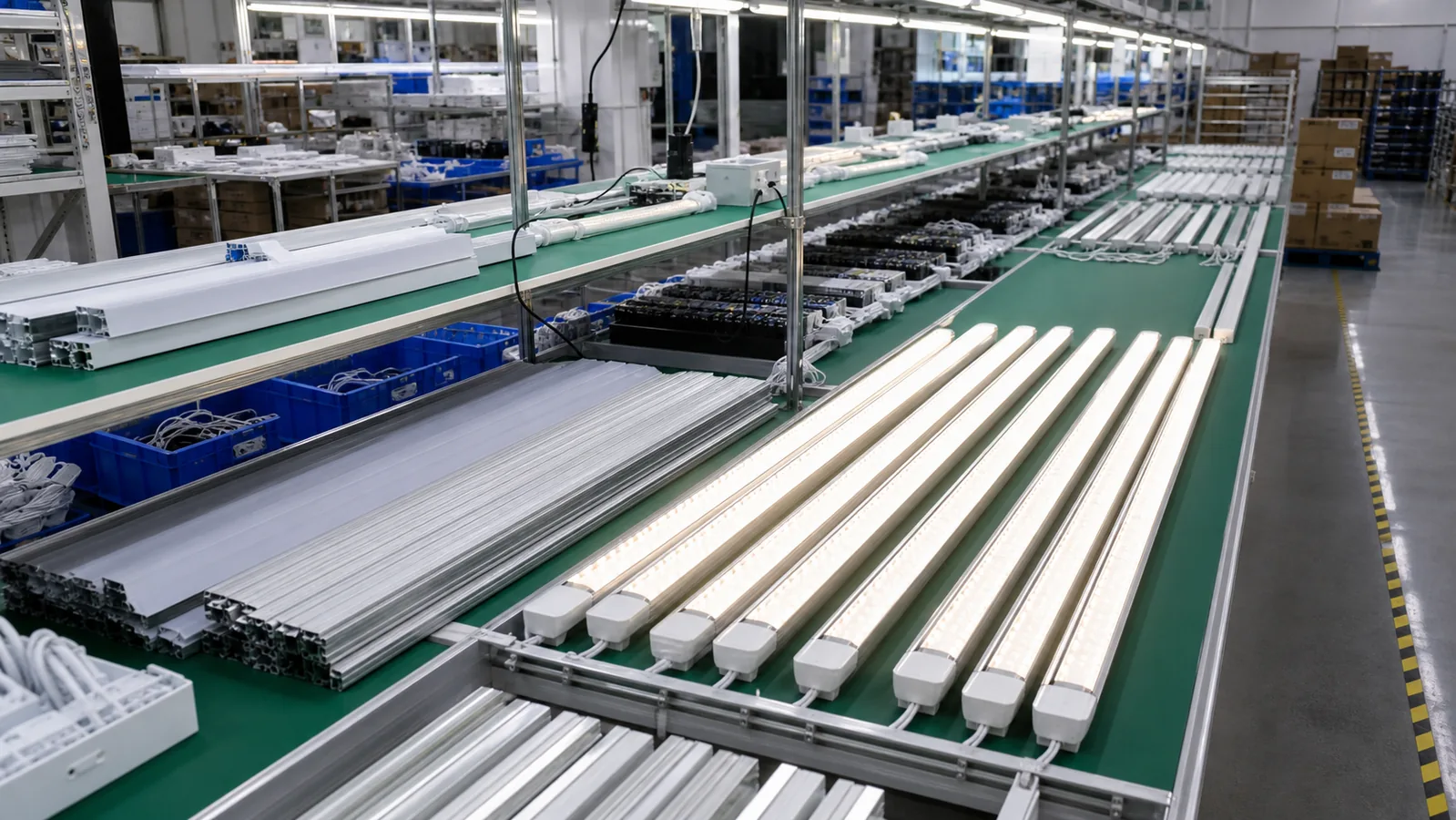
As an LED lighting manufacturer, we know that OEM buyers are not simply purchasing a luminaire; they are choosing an engineering and supply partner. We have written this guide from the manufacturer’s side so you can identify the information that improves sampling, reduces revisions and makes repeat production easier to control.
Choosing an LED linear light manufacturer for an OEM project involves more than comparing unit prices. The supplier must translate a design brief into repeatable products, traceable components and documents that support installation and market access. The best evaluation starts with a clear project definition.
Define the OEM brief first
State the intended application, target dimensions, mounting type, lumen package, efficacy goal, CCT, CRI, optic, dimming protocol, finish and required documentation. Separate must-have specifications from preferences. This makes quotations comparable and reduces engineering changes after sampling.
Evaluate engineering capability
Ask how the manufacturer handles thermal design, optical selection, driver matching and continuous-run connections. A capable team should explain trade-offs rather than simply promise every option. For a new profile or mechanical part, clarify tooling ownership, drawing control and how revisions are approved.
Request evidence, not only claims
Useful evidence can include photometric files, integrating-sphere reports, thermal records, driver specifications, component lists and relevant compliance documents. Check that reports correspond to the exact configuration being quoted. An existing certificate for a different wattage, driver or construction may not cover your final product.
Review components and quality control
- LED brand, binning policy and color consistency
- Driver model, dimming range and flicker performance
- Aluminum profile, diffuser and finish tolerances
- Incoming material inspection and in-process checks
- Burn-in, electrical safety and final photometric sampling
- Serial, batch or date-code traceability
Ask for the inspection standard and an example quality report. A documented process is more valuable than a vague statement that every lamp is tested.
Test a production-intent sample
The sample should use the intended LEDs, driver, optics, wiring and finish. Review light quality, mechanical joints, suspension parts, dimming behavior and installation time. If the project uses connected rows, test a representative run—not only one short fixture. Our LED linear fixture selection guide can help structure the evaluation.
Confirm commercial and service terms
Discuss sample timing, production lead time, minimum order quantity, spare parts, packaging tests, warranty handling and change notifications. Confirm whether replacement components will remain compatible throughout the project. A slightly higher initial price may reduce field failures and rework.
How to compare shortlisted manufacturers
Score each candidate against the same weighted criteria: engineering response, document quality, sample accuracy, component transparency, production capacity, commercial terms and communication speed. Record unresolved questions instead of relying on general impressions. During the sample stage, note every deviation and confirm the corrective action in writing.
A factory audit can be useful for higher-volume or strategically important projects. The audit should follow the real production flow—from incoming materials to assembly, electrical testing, aging, packing and traceability—while checking that procedures are used consistently on the floor.
Before nomination, ask the LED linear light manufacturer to identify any specification that is still provisional. Final approval should reference one controlled drawing, bill of materials and sample so purchasing, production and inspection all work from the same baseline.
What a serious OEM conversation should include
When we receive an OEM inquiry, we look for the application, destination market, expected annual volume, target cost, required performance and the reason for customization. These details help us decide whether an existing platform can be adapted or whether new mechanical work is justified. Buyers benefit when they share the commercial objective as well as the technical specification; it prevents engineering effort from being spent on features that the market does not value.
How we recommend controlling the sample process
We suggest using a sample approval sheet with dimensions, LEDs, driver, optic, finish, labels, packaging and test requirements. Comments such as “make it brighter” or “improve the color” are difficult to reproduce. A measurable target or approved physical reference is more useful. After revisions, every sample should carry a revision code so the approved version cannot be confused with an earlier prototype.
For several lengths or lumen packages, approve the highest-risk combinations. The longest housing may reveal alignment issues, while the highest output can create the greatest thermal challenge. Testing only the easiest model can leave problems for production.
Commercial details that protect both sides
- Who owns new tooling and drawings?
- Which component substitutions require written approval?
- How are MOQ, forecast and safety stock handled?
- What packaging test or drop requirement applies?
- Which records will accompany inspection and shipment?
At LCB Light, we prefer to resolve these points before a volume purchase order. Clear terms reduce last-minute negotiation and allow production planning to reflect the real project.
Why communication quality matters
A technically capable factory can still be a difficult partner if questions are answered inconsistently or decisions are not documented. We recommend evaluating how a manufacturer handles one challenging question during sampling. A clear explanation of limitations is often a better signal than an immediate promise. For OEM buyers, dependable change control and honest feasibility feedback can be more valuable than the lowest initial quotation.
If you are preparing a private-label line, we can review your target application, existing specification and customization priorities. A structured brief allows us to respond with realistic options for dimensions, optics, controls, finish, branding and packaging.
A stronger first inquiry saves development time
Send your current drawing or target dimensions, performance goals, preferred components, compliance market, annual estimate and launch schedule. Tell us which requirements are fixed and where alternatives are acceptable. At LCB Light, this allows us to respond with a practical development path rather than a broad promise. It also helps you compare our proposal with other manufacturers on the same technical and commercial basis.
From RFQ to a controlled pilot order
We recommend dividing an OEM program into clear gates. The RFQ confirms feasibility and commercial direction. The sample stage verifies appearance, function and documentation. A pilot order tests repeatability, assembly time, packing and communication under production conditions. Only after the pilot is reviewed should both sides treat the design as ready for normal volume.
At each gate, record what has been approved and what remains open. For example, a first sample may approve the profile and optic but not the final driver or label. Writing this down prevents a visually acceptable prototype from being mistaken for a complete production standard.
How we handle cost-down discussions responsibly
OEM buyers often need to reach a market price. At LCB Light, we believe cost reduction should be linked to specific changes rather than an unexplained discount. Options might include using an existing profile, standardizing lengths, selecting a common driver platform, simplifying packaging or adjusting a feature that customers do not value. Each proposed change should be reviewed for performance, lifetime, compliance and brand impact.
We recommend protecting the features that define the product’s market promise. If low glare, dimming quality or finish consistency is central to the brand, reducing cost in those areas can create a product that is cheaper but harder to sell. A transparent value-engineering table helps the buyer choose knowingly.
Planning for repeat production
The first successful order is only the beginning of an OEM relationship. Forecast information allows component planning and can reduce the risk of unexpected substitutions. We discuss which parts have long lead times, whether safety stock is practical and how end-of-life notifications will be handled. For a family of products, we also look for shared components that simplify inventory.
A regular review can cover quality results, delivery, warranty feedback and upcoming changes. We encourage buyers to share field observations, even when they are not formal complaints. Installation comments can reveal opportunities to improve connectors, labels or packaging. In our view, the strongest manufacturer relationship is one where product and process knowledge accumulate across orders instead of being rediscovered each time.
What a good manufacturer should be willing to say
A dependable partner should identify limitations, lead-time risks and specifications that still need validation. At LCB Light, we would rather clarify an uncertainty during development than allow it to appear in production. Buyers should expect documented answers and realistic alternatives, because honest feasibility work protects the product launch and the long-term value of the brand.
Frequently asked questions
What is the difference between OEM and ODM linear lighting?
OEM usually follows the buyer’s specification or brand requirements; ODM starts from the manufacturer’s existing design and allows selected customization. In practice, many projects combine both.
How many samples should be approved?
Approve at least one complete production-intent configuration, and consider a small pilot batch when multiple lengths, optics or controls are involved.
Discuss Your LED Linear Lighting Project
Share your application, dimensions, target output, optics, controls and installation requirements. The LCB Light team can help evaluate a suitable linear-lighting configuration for your project.

