
A suspended LED linear light, recessed light line, and surface-mounted fixture can use similar LED technology while creating very different architectural and installation results.
The best mounting method depends on the ceiling, visual goal, photometric requirement, service access, project schedule, and budget. This comparison helps project teams choose deliberately.
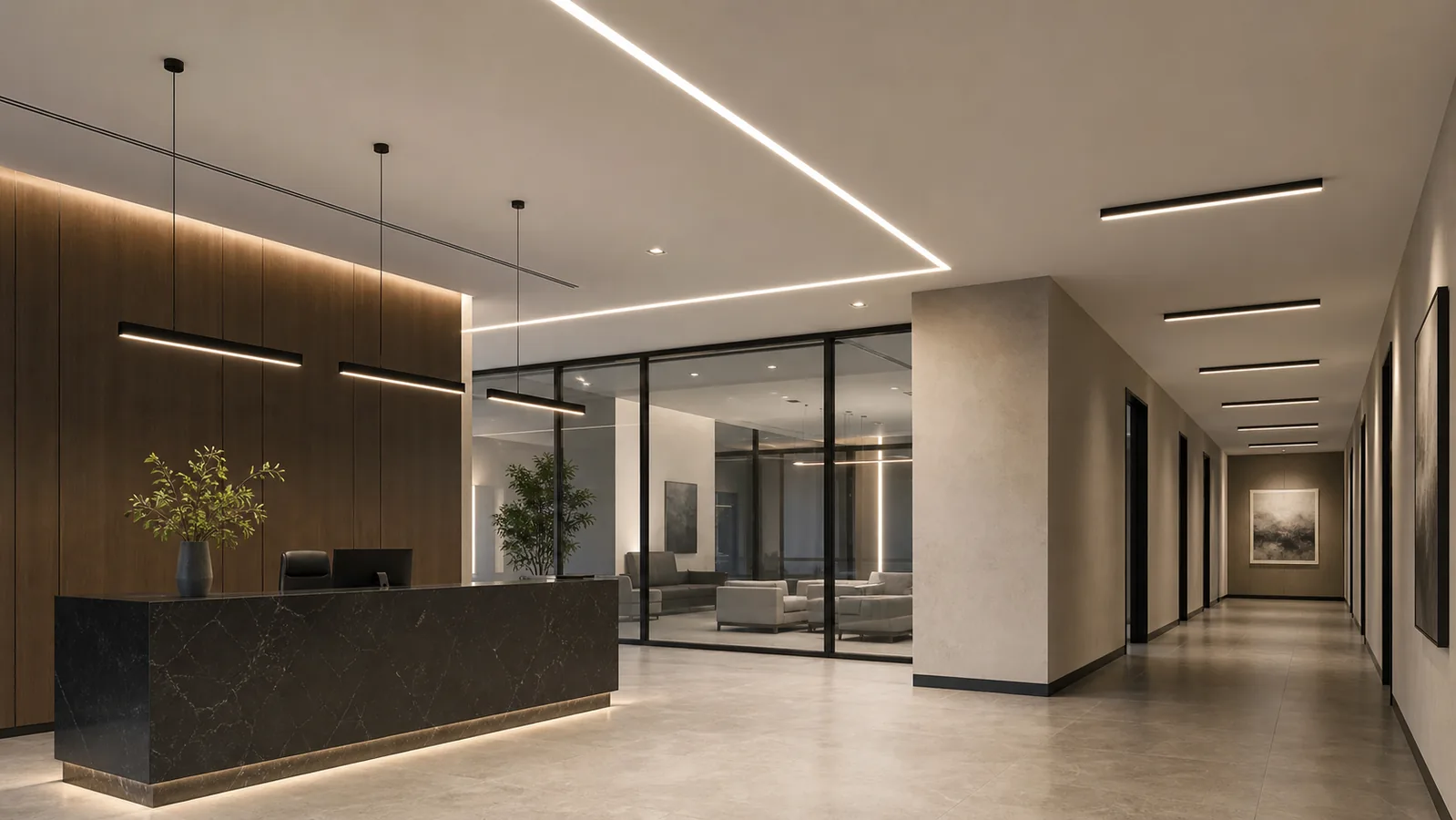
Suspended Linear Lights
Suspended fixtures hang below the ceiling on aircraft cables or rods. They can bring light closer to the workplane in high spaces and may provide direct light, indirect uplight, or a combination of both.
They are popular in offices, schools, libraries, showrooms, and public areas. Coordination is required for suspension points, feed canopies, seismic restraints where applicable, cable length, leveling, and alignment.
Recessed Linear Lights
Recessed fixtures sit within the ceiling or wall, leaving only the luminous aperture and trim—or a trimless edge—visible. They create clean architectural lines and can connect into continuous patterns.
The ceiling needs adequate depth and accurate openings. Installation must coordinate framing, drywall, mud-in channels, insulation, fire requirements, drivers, and future access. Recessed systems are usually less flexible after completion.
Surface-Mounted Linear Lights
Surface-mounted fixtures attach directly to the ceiling or wall. They are practical for concrete slabs, retrofit work, service corridors, utility spaces, and projects where cutting a recess is not possible.
They are generally easier to install and maintain, but the housing remains visible. Cable entry, conduit, ceiling flatness, and finish quality affect the final appearance.
Photometric Differences
A suspended fixture can combine downlight and uplight to brighten the workplane and ceiling. Recessed products primarily direct light downward unless integrated into a special architectural detail. Surface fixtures can offer wide or controlled distributions depending on the optic.
Compare IES or LDT files rather than assuming mounting type determines beam performance. Fixture spacing should be calculated using the exact distribution.
Installation and Maintenance Comparison
| Factor | Suspended | Recessed | Surface mounted |
|---|---|---|---|
| Ceiling depth | Usually minimal | Required | Usually minimal |
| Visible housing | Yes | Mostly concealed | Yes |
| Direct/indirect option | Common | Less common | Possible |
| Retrofit suitability | Good with structure | Project dependent | Very good |
| Alignment sensitivity | High | High | Moderate to high |
How to Choose
Use suspended fixtures when the design benefits from visible luminaires, lowered light, or uplight. Choose recessed systems when architectural integration is the priority and ceiling coordination is available. Choose surface mounting for simple construction, limited ceiling depth, or accessible retrofits.
Then verify output, glare, color, controls, dimensions, and service strategy using our fixture selection guide.
Continuous Runs and Custom Shapes
All three mounting methods can support continuous lines in the right product family. Ask for shop drawings that identify feeds, blank sections, illuminated lengths, connectors, corners, supports, and expansion allowances.
Contact Lowcarbon to discuss custom lengths, joins, finishes, suspension kits, and project-specific packaging.
Frequently Asked Questions
Are suspended linear lights suitable for low ceilings?
They can be, but the suspension length, glare, head clearance, and visual scale must be evaluated. Surface or recessed fixtures may be more practical in very low rooms.
Which mounting method is easiest to retrofit?
Surface mounting is often simplest, followed by suspension where structural points and power are available. Recessing usually needs more ceiling work.
Can recessed linear lights be trimless?
Yes, some systems use mud-in or plaster-in channels. They require careful coordination and finishing.
Can suspended lights provide uplight?
Many suspended fixtures offer direct/indirect distributions. The ceiling reflectance and suspension distance influence the uplight effect.
