 跳到内容
跳到内容 
Understanding how LED lighting works makes it easier to compare linear fixtures that look similar from the outside. A commercial LED linear light is a system in which the LED board, driver, housing, thermal path, optic, wiring, and controls must operate together.
This article follows electrical power through the fixture and explains how each component affects output, comfort, efficiency, and service life.
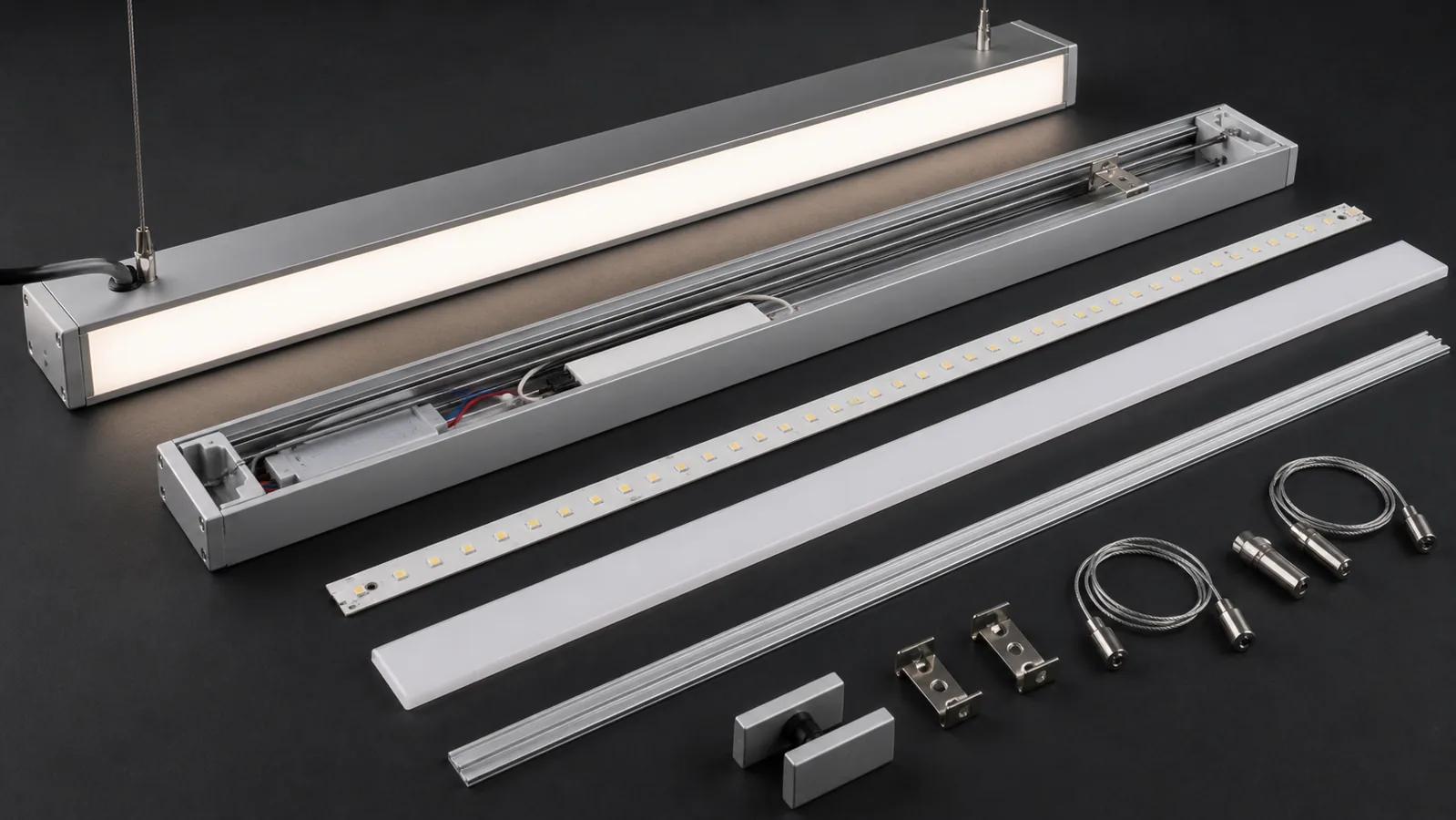
1. The Driver Converts Incoming Power
The LED driver converts mains electricity into the controlled current required by the LED modules. Its output range must match the LED load, and its thermal rating must suit the fixture enclosure.
Driver quality affects flicker, dimming performance, power factor, surge resistance, lifetime, and electromagnetic compatibility. A replaceable driver can simplify maintenance, provided it remains safely accessible.
2. The LED Board Produces Light
LED packages mounted on a printed circuit board emit light when current passes through their semiconductor junctions. The number, spacing, efficacy, spectrum, and operating current of the LEDs influence lumen output and color quality.
Driving an LED harder may increase output, but it also increases heat and can reduce long-term lumen maintenance. Responsible designs balance efficacy, temperature, cost, and lifetime.
3. The Housing Manages Heat
Most linear luminaires use aluminum because it provides structure and conducts heat away from the LED board. The thermal path must move heat from the LED junction through the board and housing into the surrounding air.
Operating temperature should be validated in the intended mounting condition. A fixture installed in a hot ceiling void or high-temperature industrial space may need a different driver or reduced output.
4. Optics Shape the Distribution
A diffuser blends individual LED points into a visually continuous line. Prismatic diffusers, lenses, reflectors, and louvers can change beam width, shielding, efficiency, and glare.
The best optic depends on the application. Wide diffuse light is useful for low ceilings and ambient coverage; controlled distributions are useful at greater heights or where spill light must be limited. Photometric files show the result of the complete optical system.
5. Controls Adjust Output
Fixed-output drivers operate at one level. Dimmable drivers can respond to 0–10V, DALI, phase-cut, wireless, or other control signals. Sensors and building-management systems can add occupancy response, daylight harvesting, scheduling, and scene control.
Dimming method, wiring topology, minimum level, fade behavior, and emergency operation must be confirmed during design. Learn more in Can LED Linear Lights Be Dimmed?
6. Mechanical Parts Create a System
End caps, joiners, suspension points, feed canopies, mounting clips, gaskets, and connectors determine how the fixture is installed and serviced. Continuous runs need accurate alignment and secure electrical connections between sections.
For wet, dusty, or industrial locations, seals and cable entries are part of the performance. An IP rating applies only when every component is installed according to the manufacturer’s instructions.
What Determines Lifetime?
LED lifetime is influenced by junction temperature, driver stress, operating hours, ambient temperature, switching cycles, contamination, and power quality. A long rated life should be supported by a stated test method and operating conditions.
For a complete specification overview, continue with our LED linear light fixture selection guide.
Frequently Asked Questions
Do LED linear lights need a driver?
Yes. LEDs require controlled current. The driver may be integrated into the housing, mounted in a canopy, or located remotely depending on the fixture design.
Why do linear lights use aluminum housings?
Aluminum provides structural rigidity and conducts heat away from the LED board, helping the LEDs operate within their intended temperature range.
What does the diffuser do?
It mixes light from individual LEDs, reduces visible hot spots, shapes the distribution, and can improve visual comfort. It also introduces some optical loss.
Can the LED module be replaced?
It depends on the product. Some fixtures are serviceable, while others use integrated modules. Buyers should confirm the replacement strategy before ordering.

