 跳到内容
跳到内容 
Selecting an LED linear light fixture requires more than choosing a length and wattage. Two fixtures with similar dimensions can produce very different distributions, glare levels, color quality, maintenance requirements, and installation costs.
This guide gives designers, contractors, distributors, and procurement teams a structured way to compare commercial linear luminaires.
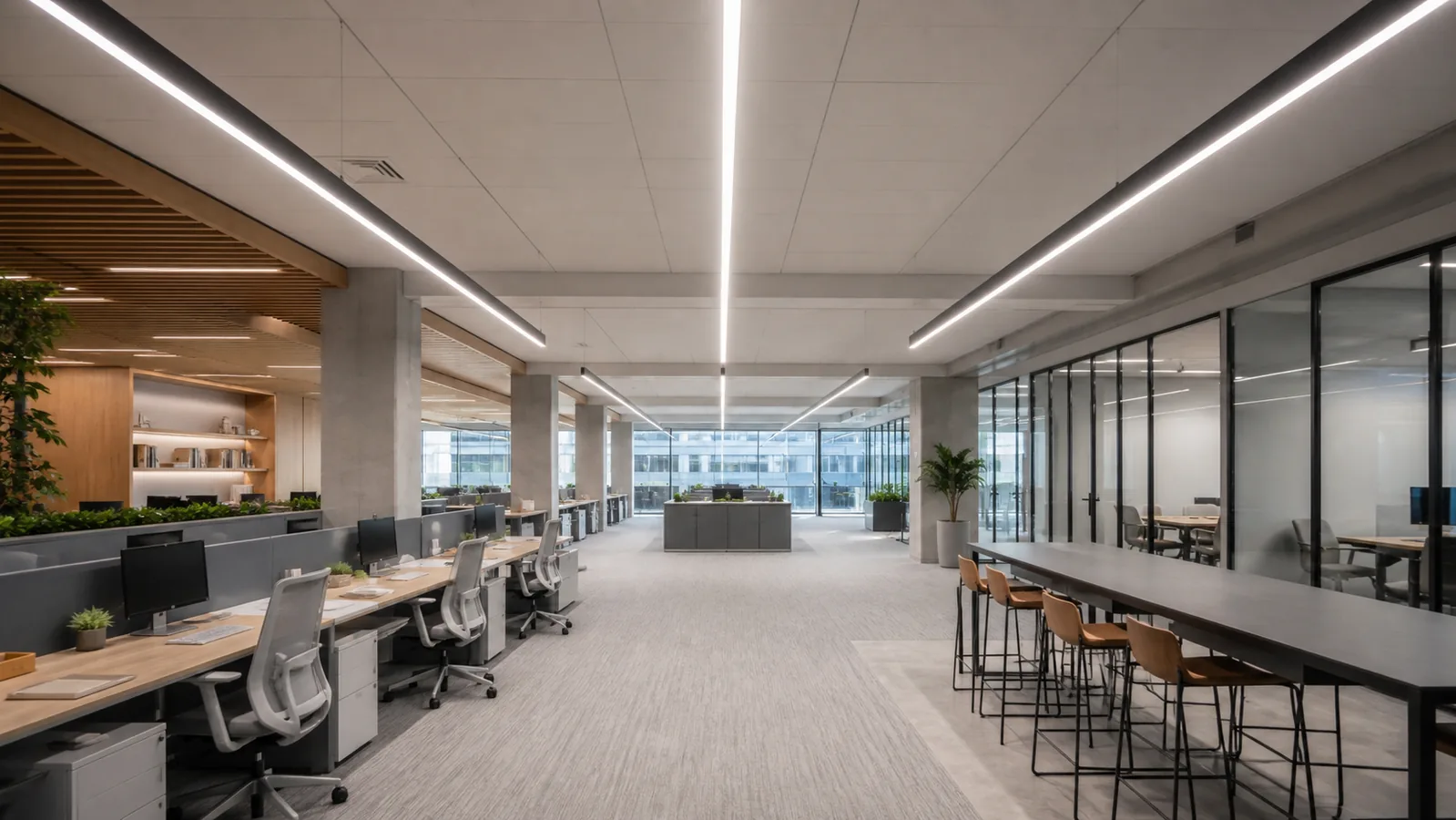
Define the Lighting Task First
Identify what must be illuminated: desks, shelves, production equipment, circulation routes, walls, or architectural surfaces. Horizontal illuminance is important for workplanes, but retail and showroom projects also depend heavily on vertical illumination.
Record the mounting height, room dimensions, surface reflectances, target illuminance, uniformity, and any glare requirement. This information is more useful than starting with a preferred wattage.
Choose the Installation Type
Suspended fixtures work well when the ceiling is high or when direct/indirect light is required. Recessed fixtures create a minimal appearance but need coordination with the ceiling construction. Surface-mounted fixtures simplify installation on concrete or finished ceilings.
Track-mounted and modular trunking products offer flexibility where layouts change. Compare the options in our mounting-type guide.
Compare Delivered Lumens and Distribution
Delivered lumens describe light leaving the complete fixture, not the bare LED module. Review the IES or LDT file to understand beam width, spacing, vertical light, and utilization in the real room.
A wide diffuser can improve visual continuity, while lenses or louvers can give better control at greater mounting heights. For offices, review luminance at high viewing angles and any available UGR calculation data.
Select CCT and Color Quality
3000K creates a warmer appearance, 4000K is a common neutral choice, and 5000K provides a cooler visual impression. The right choice depends on the brand, materials, tasks, daylight, and regional preference.
Specify CRI and consider more detailed color metrics for applications where materials, merchandise, artwork, or skin tones matter. Our 3000K vs 4000K vs 5000K guide explains the tradeoffs.
Check Driver, Controls, and Flicker
Confirm whether the driver is fixed-output, 0–10V, DALI, phase-cut, or connected to a wireless control platform. Dimming compatibility involves the driver, control signal, wiring, minimum level, and system commissioning.
Ask for flicker measurements, power factor, THD, surge protection, emergency options, and driver replacement access. See our dimming guide before specifying a control protocol.
Review Mechanical and Installation Details
Confirm the actual dimensions, ceiling cutout, suspension kit, feed canopy, joiners, end caps, cable entry, weight, finish, and tolerance. Continuous runs require coordinated shop drawings and clear rules for powered and non-powered connectors.
For suspended products, verify maximum cable length and recommended support spacing. For recessed products, check plenum depth, insulation restrictions, and service access.
Procurement Checklist
- Exact product code and configuration
- Delivered lumens, wattage, efficacy, and photometric file
- CCT, CRI, color consistency, and lifetime data
- Glare-control option and diffuser material
- Driver brand, dimming protocol, flicker, and surge rating
- Dimensions, mounting accessories, finish, and packaging
- Safety, EMC, and market-specific certifications
- Warranty, lead time, spare parts, and sample approval
Contact Lowcarbon for project-specific linear fixture configurations and OEM/ODM support.
Frequently Asked Questions
How do I choose the wattage of a linear fixture?
Use a lighting calculation based on delivered lumens, photometry, mounting height, spacing, room reflectance, and target illuminance. Wattage alone does not predict the result.
What is the best mounting type?
Suspended, recessed, and surface mounting each suit different ceilings and design goals. The best option is the one that meets installation, maintenance, photometric, and architectural requirements.
Should an office linear light be dimmable?
Dimming is valuable when daylight harvesting, occupancy control, scene setting, or energy management is required. The driver and control system must be specified together.
Do I need an IES file?
Yes for professional layout verification. It allows the designer to model illuminance, uniformity, spacing, and light distribution using the exact fixture configuration.

