 跳到内容
跳到内容 
You overbuy track heads and clutter the ceiling. Or you underbuy and leave your premium products in the dark. Both mistakes kill your retail ROI. Stop guessing. You need a technical calculation to ensure your store looks professional and your budget stays safe.
Calculate the number of LED track lights by dividing the target lux level by the center beam candlepower (CBCP) based on your mounting height. Typically, retail accent zones require 1000-1500 lux, while general areas need 500 lux. Space track heads every 0.8 to 1.2 meters for uniform coverage.

I want to help you avoid the common pitfalls of retail lighting. Let us look at the technical data and the formulas you need to win your next project.
How Do You Determine the Target Lux for Different Retail Zones?
Flat lighting makes products look cheap. You lose the “wow” factor that drives sales. If you do not zone your lux levels, you waste energy. You pay for light where you do not need it. You need a strategy to highlight the right items and guide your customers.
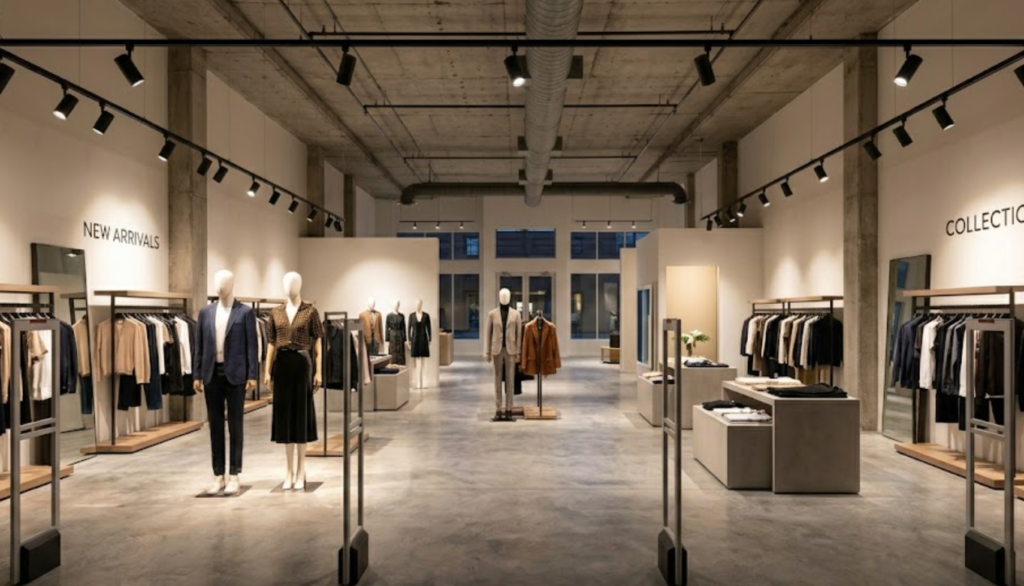
Retail stores require a layered lighting approach. Target 300-500 lux for general circulation areas. For focal points like mannequins or feature walls, aim for 1500-2000 lux. Use a 3:1 or 5:1 contrast ratio between accent lighting and ambient lighting to create visual hierarchy and guide customer movement.
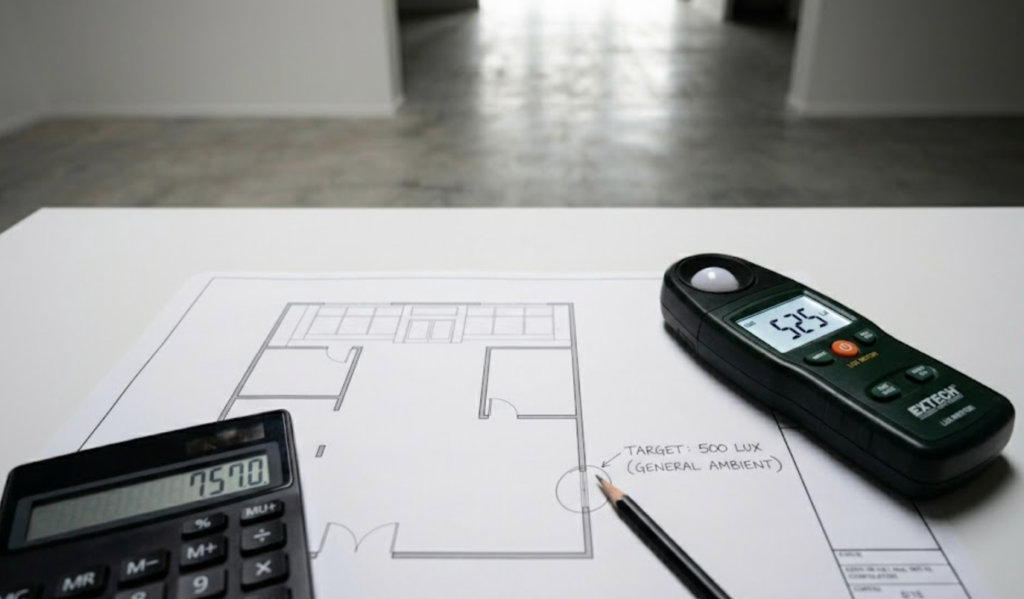
Contrast is the most powerful tool in retail. I have followed many projects where the buyer wanted everything “bright.” But if everything is bright, nothing stands out. In a recent project for a high-end fashion boutique, we found that the ambient light was 800 lux. The accent lights were also 800 lux. The store felt like a pharmacy, not a luxury shop. We reduced the ambient light to 300 lux using our LED linear lighting. We then focused the LED track lighting to hit 1500 lux on the displays. The products immediately looked more expensive.
The Physics of Retail Lux Levels
Lux is the measurement of light intensity on a surface. One lux equals one lumen per square meter. In a B2B project, we do not care how many lumens the fixture produces at the source. We care how many lux hit the product.
For general retail, use these standards:
- High-End Fashion: 1500 – 2000 lux on accents.
- Mass Market Retail: 750 – 1000 lux on accents.
- Supermarkets: 750 lux general lighting.
Color Rendering and Visual Value
You must also consider the Color Rendering Index (CRI). For retail, CRI>90 is the minimum standard. I have seen first-hand how a CRI<80 light makes red clothes look brown. This is a technical truth: high lux with low CRI is a waste of money. We also use SDCM<3 to ensure that every track light in the row has the exact same color temperature. If one light is slightly yellow and the next is slightly blue, the store looks messy.
Retail Lighting Requirement Table
| Retail Category | Ambient Lux (Floor) | Accent Lux (Product) | Contrast Ratio |
| Luxury Boutique | 200 – 300 | 1500 – 2000 | 5:1 or 10:1 |
| Fast Fashion | 500 – 700 | 1500 | 3:1 |
| Grocery / Supermarket | 750 | 1000 (End caps) | 1.5:1 |
| Furniture Store | 300 | 1000 | 3:1 |
To calculate the number of fixtures, start with your target lux. If you want 1500 lux on a mannequin, you must check the Center Beam Candlepower (CBCP) of the fixture at your specific mounting height. This prevents “site surprises” where the light is too weak to reach the floor. [LINK: Request a photometric report for your project]. We provide these data sheets for every fixture to ensure your calculation is accurate.
What Role Does Beam Angle Play in Fixture Count?
You pick a random 36° lens for every fixture. But the ceiling is 5 meters high. The light scatters before it hits the floor. You pay for electricity that lights up empty air. The product remains dim. You need to match your optics to your mounting height to avoid wasting light.
Beam angle determines the “spot” size and intensity on your display. A narrow 15° or 24° lens concentrates light for high-impact accents at greater heights. A wide 36° or 60° lens provides broader wash coverage for low ceilings. Choosing the correct angle allows you to use fewer fixtures to achieve target lux.
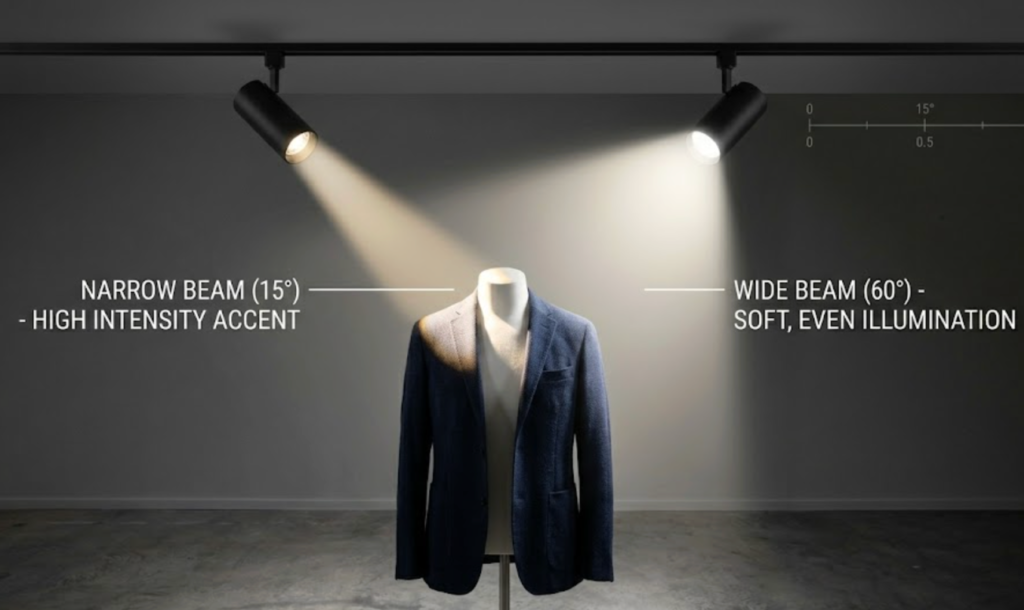
The beam angle is the “steering wheel” of your light. I have observed that many contractors default to 36°. This is a safe middle ground, but it is rarely the most efficient choice.
The Math of Beam Spreading
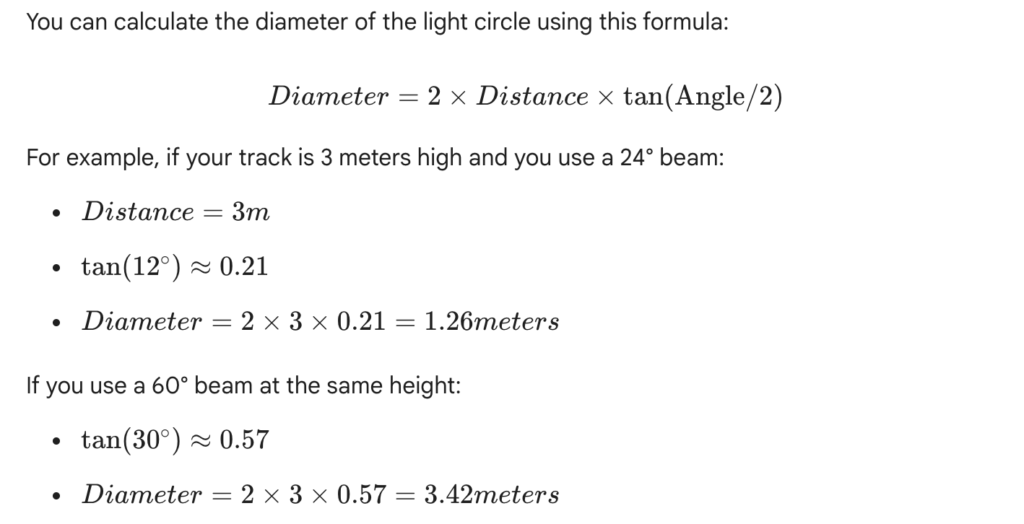
The wider beam covers more area, but the lux level drops significantly. This follows the Inverse Square Law. If you double the diameter of the circle, the light intensity drops by four times. So, if you want a high-impact spot, you must go narrow.
Shutterstock
探索
Matching Optics to Mounting Height
I worked on a project with a 5-meter ceiling. The client wanted to highlight small jewelry cases. We used 15° narrow beam track heads. Even at that height, the “punch” was enough to hit 2000 lux on the glass. If we had used 36°, we would have needed three times the number of fixtures to reach that intensity.
- High Ceilings (>4m): Use 15° or 24°.
- Standard Ceilings (2.8m – 3.5m): Use 24° or 36°.
- Low Ceilings (<2.5m): Use 36° or 60°.
Beam Angle Efficiency Table
| Beam Angle | Light Intensity (Lux) | Coverage Area | Best Use Case |
| 15° (Narrow) | Very High | Small | Mannequins, small displays |
| 24° (Medium) | High | Medium | Table displays, end caps |
| 36° (Standard) | Medium | Large | Wall washing, general accent |
| 60° (Wide) | Low | Very Large | Broad area lighting, low ceilings |
By choosing the right beam angle, you protect the project’s ROI. You use fewer watts to get more light where it matters. We offer interchangeable lenses for our LED track lighting. This means if the store layout changes, you only change the lens, not the whole fixture. [LINK: Explore our modular track light lenses].
How Do You Calculate Track Rail Length and Power Loading?
You install track rails and then realize the circuit cannot handle the load. Or the rails are too short to reach the new displays. Site surprises like this delay handovers and cause electrical failures. You must plan the infrastructure before you buy the fixtures.
Track rail length depends on your display layout and fixture density. Allow one 35W track head per meter for general retail. For high-density accent zones, you may need two or three heads per meter. Ensure total wattage does not exceed 80% of the circuit breaker capacity to prevent tripping.
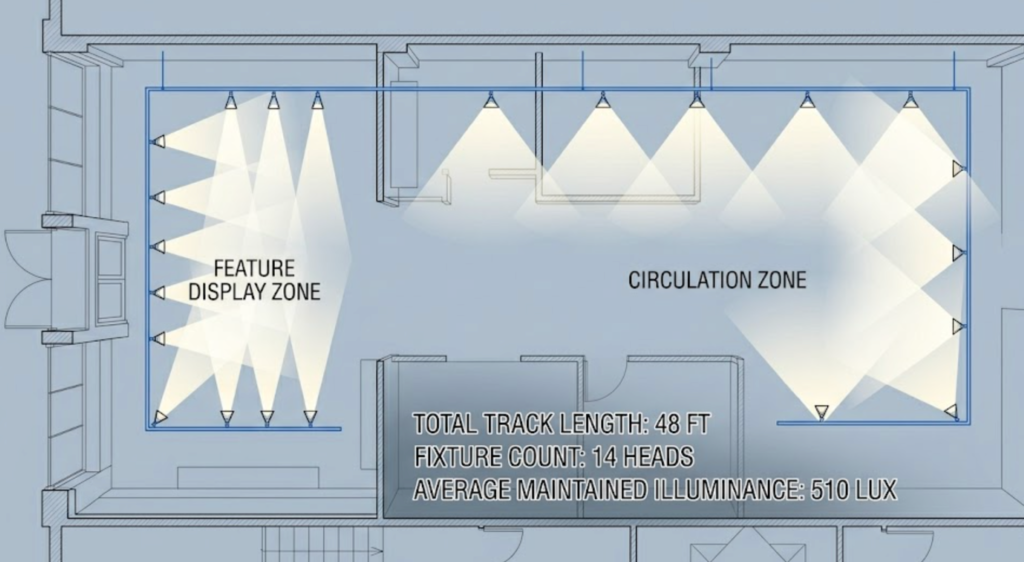
The track rail is the backbone of your system. I have seen first-hand how poor planning leads to messy ceilings with too many power feeds.
Understanding 3-Circuit (4-Wire) Tracks
I always recommend 3-circuit track systems for B2B projects. A 3-circuit track has three separate “Live” wires. This allows you to have three different groups of lights on one rail.
- Circuit 1: Ambient lights.
- Circuit 2: Accent lights.
- Circuit 3: Night/Security lights.
You can turn them on and off independently. This gives the store manager total control. It also helps with load balancing. You can spread the electrical load across three phases.
Calculating Electrical Load
In a professional environment, you must follow the 80% rule. If you have a 16A circuit at 230V, the total capacity is 3680W.

However, you rarely put 84 fixtures on one rail. You must consider the length. I usually suggest a power feed every 10 to 12 meters to avoid voltage drop. Voltage drop causes the lights at the end of the rail to look dimmer. This is a technical truth that kills the “look” of a premium store.
Track Density Guide
- General Retail: 1 track head per 1.2 meters.
- High-End Boutique: 1 track head per 0.8 meters.
- Window Displays: 2 track heads per 0.5 meters.
I remember a project where the client wanted to double the number of lights after the track was installed. Because we used 3-circuit tracks with high-quality copper busbars, we had enough “headroom” to add more fixtures without changing the wiring. This saved the client thousands in labor costs. [LINK: Technical data for 3-circuit track rails].
Why Is Color Consistency Vital for Track Light Density?
You buy fifty “3000K” track lights from a cheap source. You turn them on. One looks pink, another looks yellow. The store looks like a mess. Inconsistent color ruins the premium feel of the brand. You cannot fix bad binning after the lights are in the ceiling.
High fixture density makes color shifts more obvious. Specify SDCM<3 (3-step MacAdam Ellipse) to ensure every track light in the row matches perfectly. This consistency protects the brand’s visual identity and ensures that products look the same under every light source in the store.
Color consistency is a non-negotiable spec for me. I have followed many projects where the buyer tried to save $5 per fixture. They ended up with “SDCM<5” binning. When you put these lights in a continuous track, the difference is shocking.
The Science of MacAdam Ellipses
SDCM stands for Standard Deviation of Color Matching. It measures how much the color deviates from the target Kelvin point.
- SDCM<3: The human eye cannot detect the difference. This is the professional standard.
- SDCM<5: Most people can see a slight difference in tint. This is “consumer grade.”
In a project for a high-end watch brand, the luxury feel depended on perfect 3500K lighting. The white displays would show any hint of green or pink. We used chips with SDCM<2. The result was a seamless, pure white environment.
Impact on Skin Tones and Textures
We also focus on CRI (Color Rendering Index) and the R9 value.
- CRI>90: Essential for basic color accuracy.
- R9>50: Essential for rendering deep reds and skin tones.
In fashion retail, if the R9 is low, the customer looks “pale” or “sick” in the fitting room mirror. They will not buy the clothes. This is the “altruistic” part of lighting design: we help the store sell more by making the human experience better.
Maintenance and Binning Over Time
What happens if a light fails after two years? If you bought a cheap unbranded light, you will never find a match. The new light will be a different color.
We solve this by keeping strict binning records. Because we use Tier-1 chips, we can provide replacement heads that match the original installation. This is “Technical Honesty.” We don’t just sell you a light today; we protect your site for the next five years. [LINK: View our CRI and SDCM reports].
| Spec | Standard Requirement | Luxury Requirement |
| SDCM | < 3 | < 2 |
| CRI | > 90 | > 95 |
| R9 | > 50 | > 80 |
| L70 Lifespan | 50,000 Hours | 50,000 Hours |
When you calculate your fixture count, remember that quality is as important as quantity. Fewer high-quality lights always look better than many low-quality ones.
Conclusion
Stop guessing your retail lighting needs by using a target lux calculation, matching your beam angles to the ceiling height, and specifying SDCM<3 consistency to ensure a high-performing site with maximum ROI. Summarize your project goals and use photometric data to protect your professional reputation.

