 跳到内容
跳到内容 
Your client loves their new, modern office… but the employees are complaining. They have headaches. They say the light is “harsh.” You installed brand new, bright LED linear pendants, but the space just doesn’t feel right.
For employee wellbeing, a direct-indirect linear pendant is the best solution. It combines “up-light” (indirect) to make the space feel open and reduce shadows. It also has “down-light” (direct) to provide focused, low-glare task light for desks. This balance is key.

I’ve been manufacturing LED linear lights for over 20 years. This is a problem I see all the time. My partner in Germany, Mike, calls me with this issue. He’ll say, “Joe, my client’s light meter reads 500 lux on the desk, just like the architect wanted. But the employees hate it! What’s wrong?”
I always tell him the same thing. The amount of light (lux) is not the problem. The quality and direction of the light is the problem. It’s about how that 500 lux gets to the desk. This is the most important part of “office wellbeing lighting.” Let’s break down the two types of light and why the combination is the clear winner.
What is Direct Lighting, and Why Does it Cause Fatigue?
You need to light the desks in an office. The most obvious solution is a “down-light” pendant. All the light goes straight down. It seems efficient. But this is what’s causing the headaches.
Direct lighting is when 90-100% of the light from a fixture shines straight down. While it’s very efficient for task lighting, it creates two big problems for employee wellbeing: harsh shadows and the “cave effect.” This high-contrast light causes severe eye strain.
Let’s dive deeper into this. When you use only direct lighting, you light up the floor and the desk, but the top half of the room is dark.
The “Cave Effect”
I call this the “cave effect.” The ceiling is black. The walls above eye-level are dark. It can make the space feel heavy, like the ceiling is pushing down on you. It’s not a comfortable feeling for an 8-hour workday. Your employees are sitting in a bright “hotspot” surrounded by darkness. This high contrast is the root cause of eye fatigue. Your eye has to constantly re-adjust between the bright computer screen and the dark background. This is what causes the headaches.
The UGR Problem
The second problem is glare. A direct light is a bright source of light shining straight into your eyes. In Europe, especially in Germany, there is a very strict rule for office lighting called UGR (Unified Glare Rating). The rule says the glare must be UGR < 19.
A cheap, direct-only linear light with a simple “frosted” cover cannot do this. A frosted cover just scatters the light. It’s still a bright, glaring light source. To get UGR < 19, you must use a special, engineered optic. This is usually a microprismatic lens. This lens is not frosted. It’s a clear piece of acrylic with tiny, precise prisms. These prisms bend the light. They force the light to go straight down onto the desk. They cut off the high-angle light that would normally go into your eyes. As a factory, this is a key part of our “wellbeing” lighting. It is more expensive to make, but it’s the only way to do direct lighting correctly.
When is Direct-Only Good?
To be fair, direct-only light is a great tool for some jobs. It’s perfect for a workshop bench, a kitchen island, or a supermarket aisle. It’s for places where you need to see a task very clearly. But for a large office where people work all day, it’s a poor choice for wellbeing.
What is Indirect Lighting, and Is it Enough on Its Own?
So, you want to fix the glare problem. You take the light and flip it. You aim 100% of the light at the ceiling. This is “indirect lighting.” The light bounces off the ceiling and fills the room with soft, gentle light.
Indirect lighting (or “up-lighting”) is when 90-100% of the light shines up. It bounces off the ceiling to create a beautiful, soft, and shadow-free ambient light. It has zero glare. However, on its own, it is often too dim for tasks and can make a space feel “flat” or “unfocused.”
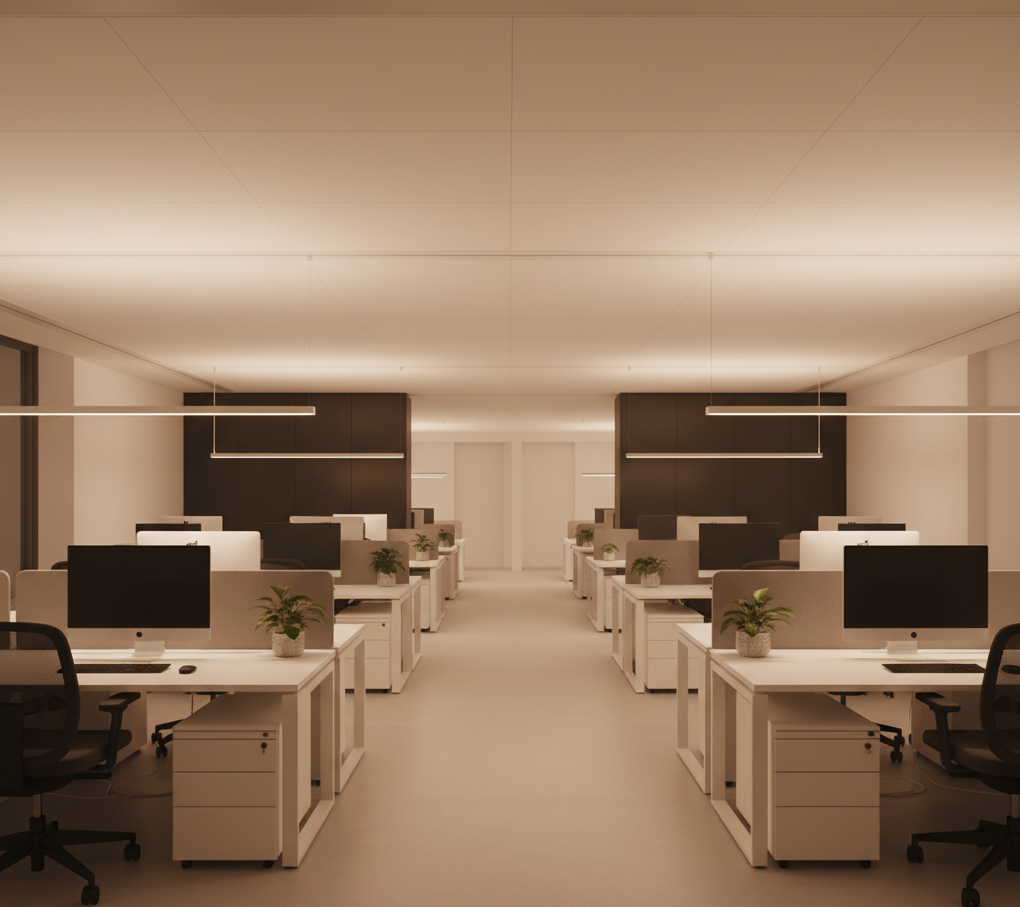
This method is fantastic for comfort. There is no glare. You cannot see the light source. The entire ceiling becomes one giant, soft light. It feels open and airy. It completely solves the “cave effect.”
So, why isn’t this the perfect solution?
The “Cloudy Day” Effect
I call this the “cloudy day” effect. It’s like working outside on a heavy, overcast day. There are no shadows. But there is also no “pop” or focus. The light is very flat. It can make employees feel sleepy. It is not good for “task” work. Your desk will not be bright enough to read documents clearly. Your eyes will have to strain to focus.
The Ceiling is Your Reflector
This is the most important technical point. Indirect lighting only works if you have a high, white, reflective ceiling. I have to explain this to contractors all the time.
If your client’s office has a dark wood ceiling, or a black painted “industrial” ceiling with exposed pipes, indirect lighting is useless. All the “up-light” will be absorbed. The light will just disappear. You will have wasted all that money and energy. This is a critical mistake I help my partners avoid. You must check the ceiling color and height before you specify an indirect light.
When is Indirect-Only Good?
This type of light is perfect for ambiance. Think of a high-end hotel lobby, a spa, or a relaxing lounge. It’s for spaces where you want people to feel calm, not productive. It is not a good solution for an active, working office.
Why is Direct-Indirect the Perfect “Wellbeing” Solution?
You are now stuck. You need bright, focused task light (direct). But you also need soft, comfortable ambient light (indirect). You cannot install two separate lighting systems. Your client’s budget and ceiling won’t allow it.
Direct-indirect (or “up-down”) pendant lighting is the perfect solution. It puts both in one fixture. The indirect “up-light” (e.g., 30-40%) bounces off the ceiling. This washes the room in soft light and kills the “cave effect.” The direct “down-light” (e.g., 60-70%) provides focused, UGR<19 light for the desks.

This is the best of both worlds. This is the true solution for employee wellbeing.
How it Beats Eye Strain
The “up-light” is the real hero. It lights up the ceiling and the top of the walls. This lowers the contrast between your bright desk and the rest of the room. Your eye does not have to work hard anymore. It can look up from the computer screen and the surroundings are comfortable. This is what stops the headaches.
The “Magic” Split: Customization is Key
As a factory, this is where we provide real value. We can customize the split of light. We don’t just sell an “off-the-shelf” light. We ask, “What is the job?”
- Standard Office: We usually recommend a 70% Down / 30% Up split. This gives you a strong 500 lux on the desk (direct) while providing enough ambient light (indirect) for comfort.
- Executive Boardroom: Here, you want a more balanced, high-end feel. We might do a 50% Down / 50% Up split.
- Creative Studio: We could do 40% Down / 60% Up for a very open, airy, and bright feeling.
A Real Project Example
This is where 1-on-1 factory support is so important. Mike had a client in Frankfurt. The architect specified a beautiful, black, open-truss ceiling. Mike called me. He said, “Joe, the designer wants an up-down light. But I told him your advice. The ‘up-light’ will be wasted on a black ceiling.”
He was 100% correct. I was proud of him. He saved his client from a big mistake.
So, what did we do? We built a custom fixture for him. We took the direct-indirect housing, but we put a 100% direct light engine inside. But, to avoid the “cave effect,” we used a very wide 90-degree beam lens. This wide beam was still UGR<19, but it was wide enough to throw some light on the upper parts of the walls. This small change made the room feel brighter, even with the black ceiling. Mike solved the client’s problem. We didn’t just sell him a product; we worked with him to deliver the right solution.
What Should You Ask Your Supplier Before Buying Up-Down Pendants?
You are ready to buy. You see a cheap “up-down” light on a big website. You are worried. Will the “up” light be a different color than the “down” light? Is the UGR<19 claim real?
**Before you buy, you must ask your supplier four questions:
- Can you customize the up/down split (e.g., 70/30, 50/50)?
- Is the “down-light” truly UGR<19 with a microprismatic lens, not just frosted?
- Do you guarantee color consistency (3-Step MacAdam)?
- Can you provide fixtures with two separate drivers for dual control?**

These questions will protect you from buying a bad product.
Dual Drivers: The Ultimate Control
This is a pro feature. Most standard up-down lights have one driver. This means the up and down light are always on or off together.
But a premium fixture has two drivers. This allows the user to control the up-light and the down-light on separate circuits. Why is this amazing?
- Presentation Mode: The client is showing a PowerPoint. They can turn off the down-lights (so the screen is clear) but leave the up-lights on at 20%. The room is not dark, and people can still see their notes.
- Task Mode: 100% down, 30% up.
- Evening Mode (Cleaning): 0% down, 50% up.
This is a high-value feature that we build for our partners in Europe and the Middle East. It gives the client the ultimate control.
The Color Consistency Nightmare
This is Mike’s biggest fear. What happens if you order 100 lights, and the up-light is a nice 4000K white, but the down-light is a cheap, ugly 4200K (greenish-white)? This happens all the time with cheap factories. They use different batches of LEDs for the top and bottom.
This is why we have 5 dedicated production lines. When you place an order for 100 lights, we lock the bin. We use LEDs from the exact same batch for your entire order. We guarantee a 3-Step MacAdam ellipse. This is a technical term that means your eye cannot see a color difference. The up-light and down-light will be a perfect match. This is the kind of reliability a professional project needs.
“Microprismatic” vs. “Frosted”
Do not let a supplier sell you a “frosted” or “opal” cover and call it UGR<19. A frosted cover wastes light. It might waste 40% of the lumens just to hide the dots.
A microprismatic lens is a piece of high-tech optics. It is not frosted. It is clear. It bends and directs the light. It is highly efficient (maybe 90% light transmission) and comfortable. This is the mark of a true, high-quality office-grade fixture.
Conclusion
Ultimately, direct-indirect pendants are the clear winner for employee wellbeing by providing both focused task light and comfortable, low-glare ambient light in one smart, customizable fixture.
Ready to Create a High-Wellbeing Office?
If you are a contractor or distributor in Europe, the UK, or the Middle East, you are probably facing this exact problem. You don’t have to guess. Let’s build the perfect lighting solution for your client together.
- Contact me on WhatsApp: Get a fast, 1-on-1 consultation for your project.
- Download our Catalog: See our full range of customizable direct-indirect linear lights.
- Book an OEM Consultation: Let’s talk about building a unique product for your next big project.

